Choreographic Objects

||HOST||The Royal Standard as part of the Liverpool Biennial27th October - 4th November 2012

||HOST||
The Royal Standard as part of the Liverpool Biennial
27th October – 4th November 2012
Sovay Berriman, Royal College of Art Alumni 2003

Choreographic Objects by William Forsythe

An object is not so possessed by its own name that one could not find another or better therefore.
– Rene Magritte

“Choreography is a curious and deceptive term. The word itself, like the processes it describes, is elusive, agile, and maddeningly unmanageable. To reduce choreography to a single definition is not to understand the most crucial of its mechanisms: to resist and reform previous conceptions of its definition.  There is no choreography, at least not as to be understood as a particular instance representing a universal or standard for the term. Each epoch, each instance of choreography, is ideally at odds with its previous defining incarnations as it strives to testify to the plasticity and wealth of our ability to re-conceive and detach ourselves from positions of certainty. Continue reading

Spatial Architectonics

Loie Fuller

Loïe Fuller, physical poet, 1862-1928

“Space – my space – is not the context of which I constitute the ‘textuality’: instead it is first of all my body, and then it is in my body’s counterpart or ‘other’, it’s mirror image or shadow: it is the shifting intersection between that which touches, penetrates, threatens or benefits my body on the one hand, and all other bodies on the other. Thus we are concerned, once again, with gaps and tensions, contacts and separations, Yet, through and beyond these various effects of meaning, space is actually experienced, in its depths, as duplications, echoes and reverberations, redundancies and doublings up…”

Text reproduced from The Production of Space, Henri Lefebvre, Trans. Donald Nicholson-Smith, Blackwell Publishing UK, 1991: pp.184

Image reproduced from http://www.metmuseum.org/collections/search-the-collections/287807 where you will also find more information on Loïe Fuller

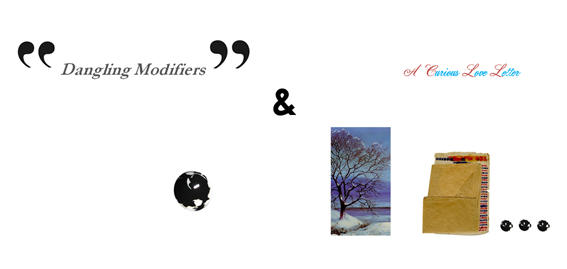
Dangling Modifiers & A Curious Love Letter, Micro Performance Lectures, Ragley Hall

Dangling Modifiers & A Curious Love Letter, Micro performance Lectures, Warwickshire Open Studios, Ragley Hall, Warks

Dangling Modifiers & A Curious Love Letter, Micro Performance Lectures, Warwickshire Open Studios, Ragley Hall, Warks

 [Briefly she enters another’s space becoming a site of inscription like the blank page…
he advances towards her with short, sharp stabbing motions. Can she subject her
sensuous gesture to his nervous tic? Following the curve of her S she drops down
heavily into its base disappearing from his line of site. She sways at the bottom before
rising and finds that he has become a woodpecker, his nervous tic feverishly
inscribing the trunk of a tree.]

“Dangling Modifiers” is the textual re-performance of a physical performance. High on a hilltop in the Lake District Denise engaged in an improvised choreography attempting to dance with the artist Paul Klee (1879-1940); to coax the performer’s body and Klee’s silent drawing into speech . Klee’s rhythmic line is expressive, lyrical, poetic and figurative evoking transcriptions of music. “The letter is not directed to the body; the line however, exists only through the echo it will encounter in other bodies where it will generate itself as a danceable volume, polyphony, scene, texture, at palpitating fingertips…” [1]. Positively performing a Kleeché  (taking a line for a walk), Paul Klee’s Drawing Knotted, 1920 was utilised as the performative score translating the drawing into movement by falling, jittering, twisting, snaking, weaving and shimmying on a hilltop like a deranged walker.

“Echo who cannot be silent when another speaks. Echo who cannot speak at all unless another has spoken. Echo who always answers back.” [2]

A Curious Love Letter is equally a failed attempt at speech, letters of love to an absent and unreachable addressee, based on an original reading of a performed letter at which Denise was absent. Separated by distance, time, space and location Denise has ventriloquised the original speakers voice into her own, reconstructing and miming the unheard text. Other voices and figures have been incorporated including artists Ad Reinhardt, Piet Mondrian & Michael Craig-Martin and literary figures such as Maurice Blanchot, Roland Barthes and Fernando Pessoa. The result is a polyphonic word and image divigation and a very curious love letter indeed.

Dates & Times: Saturday 5 th July 2pm & 3pm, Sunday 6th July 2pm & 3pm – Saturday 12th July 2pm & 3pm, Sunday 13th July 2pm & 3pm.

[1] Jean-Francois Lyotard, Driftworks, Semiotext(e), Inc, (Columbia University: New York, 1984), p.86/87.
[2] Ted Hughes, Tales from Ovid (London: Faber and Faber Limited, 1997), p.75/77.
Review: CHORALE, A Sam Shepard Roadshow, The War in Heaven

thewarinheaven

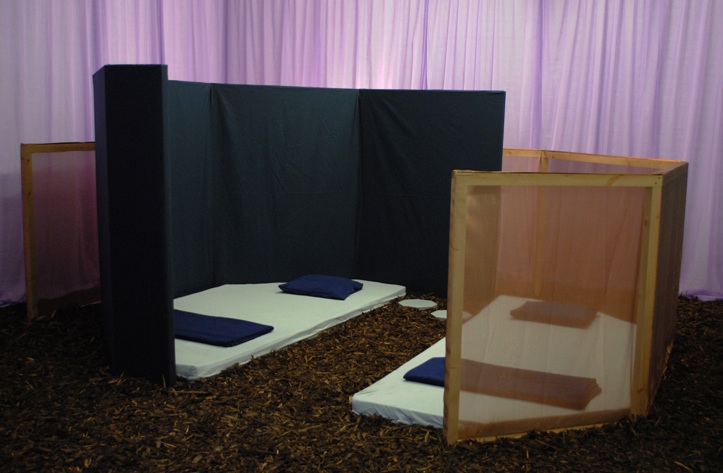
The War in Heaven (Photograph: Nina Sologubenko) CHORALE: A Sam Shepard Roadshow, The Presence Theatre Company

The War in Heaven, Sam Shepard

“I died the day I was born and became an Angel on that day”

Whilst the non resolution of The Holy Ghostly was resolved powerfully both in terms of the scenography, the visual imagery and the performance by John Chancer this did not translate successfully in The War in Heaven which Usher describes as “a moving plea from both a fallen angel and a man struggling to be heard once more.” I would argue important contextual information was missing for the audience in the interpretation of this play especially following the The Holy Ghostly since the full title is The War in Heaven: Angel’s Monologue. Whilst The Animal You and The Holy Ghostly were connected conceptually and through the characters there was absolutely no connection to the final instalment except the fact that it was Sam Shepard’s work.

As a general rule visually I  found the scene to be completely incoherent, which in itself is not a dismissal of the aesthetic, sculptural and conceptual qualities of this kind of work and its inherent complexities however it felt largely unresolved from a formal perspective. There was simply no connection between the performers in space and the set. Clearly narrative and visual incoherence are  conceptual strategies and the production appeared to commit to this concept as an overall architecture to the work. The play itself is on many levels trying to find form through language within a stream of consciousness speech but my feeling is it didn’t go far enough and was therefore caught somewhere between the concept and the execution. If this disconnection is a formal aspect of the work it is possible to resolve the visually incoherent formally but there seemed to be a failure to commit to the intention and make it concrete.

Continue reading

Review: CHORALE, A Sam Shepard Roadshow, The Holy Ghostly

The Holy Ghostly, (Photograph: Arnim Friess), CHORALE: The Sam Shepard Roadshow, The Presence Theatre Company

The Holy Ghostly, (Photograph: Arnim Friess), CHORALE: The Sam Shepard Roadshow, The Presence Theatre Company

“Sam Shepard begins and ends with the road where the route to promise and fulfilment, or damnation seem perilously interwoven…imagine luring Beckett onto the back of  a flatbed truck with Jack Kerouac, Corso and the Beats driving across America, hard, fast and furiously in search of a new sublime.”

Contrary to my usual approach I did not do any research prior to attending the performance in order to receive it as it was given. One of the main issues that has appeared for me as a visual artist in relation to this production and my own work is the intention or challenge To explain or not to explain the work”. That is the question critical to the reception of any visual art form and this work is packed with its own explanation, visual, textual, critical and contextual. This review is my attempt to unpack the work which is fittingly existentially burdened with its own history of making. I have not reviewed the first part of CHORALE The Animal You; contrary to Beckett I couldn’t go on.

CHORALE: The Sam Shepard Roadshow is highly challenging both in terms of its visual proposition, existential subject matter and its embeddedness within the mythology of the American landscape. There is a tremendous degree of  conceptual and contextual complexity embedded in the work, not least the intricate interrelationships of the part to the whole which includes the work of the playwright Sam Shepard (The Holy Ghostly and The War in Heaven), Shepard’s relation to actor, director and writer Joseph Chaikin and in turn the director of The Presence Theatre Company, Simon Usher who first directed Chaikin in 1987 in the The War in Heaven (co-written by Shepard and Chaikin). Although the relations between these parts are writ large in the supporting material they were not contextually clear leading to a lack of clarity, certainly where the audience is concerned, in terms of the overall visual proposition (i.e 3 plays, 2 films, 1 gig). The substantial amount of depth, labour, pathos and knowledge involved in this work is, to the uninitiated, largely inaccessible. There is an effort to address this within the production itself with the inclusion of rarely seen films by Shirley Clarke of Joseph Chaikin performing Shepard’s work in Savage/Love (1979) and Tongues (1969). These were aesthetically, conceptually engaging and successful pieces of work, yet in this presentation format they were reduced to explanation, contextual props and footnotes to the production. These films were critical to an overall understanding of the work however if you had not attended the workshop during the production you would not have seen Chaikin in Tongues which I certainly felt further contextualised The War in Heaven.

Whilst it had perhaps not been the intention it was natural enough as an audience member to read the production as a trilogy and although the relations were expanded and connected in terms of the characters, mood, narrative and the overall existential highway presented in the first two instalments The Animal You (developed from the work of Sam Shepard) and The Holy Ghostly, the last instalment The War in Heaven entered an entirely different psychological and theatrical realm and I really could not understand the decision to perform the latter two plays back to back. Since the performance of The Holy Ghostly was 90 minutes this was a substantial amount of time to inhabit a particular form and location which changed direction radically in the 2nd performance (an excruciating 35 minutes) severing the connection with the audience.

The Holy Ghostly, Sam Shepard (1969)

“What if I was to tell you there was a Chindi out there with more faces and more arms and legs than the two of us put together? You really think we’re alone, don’t ya boy?” *
Continue reading