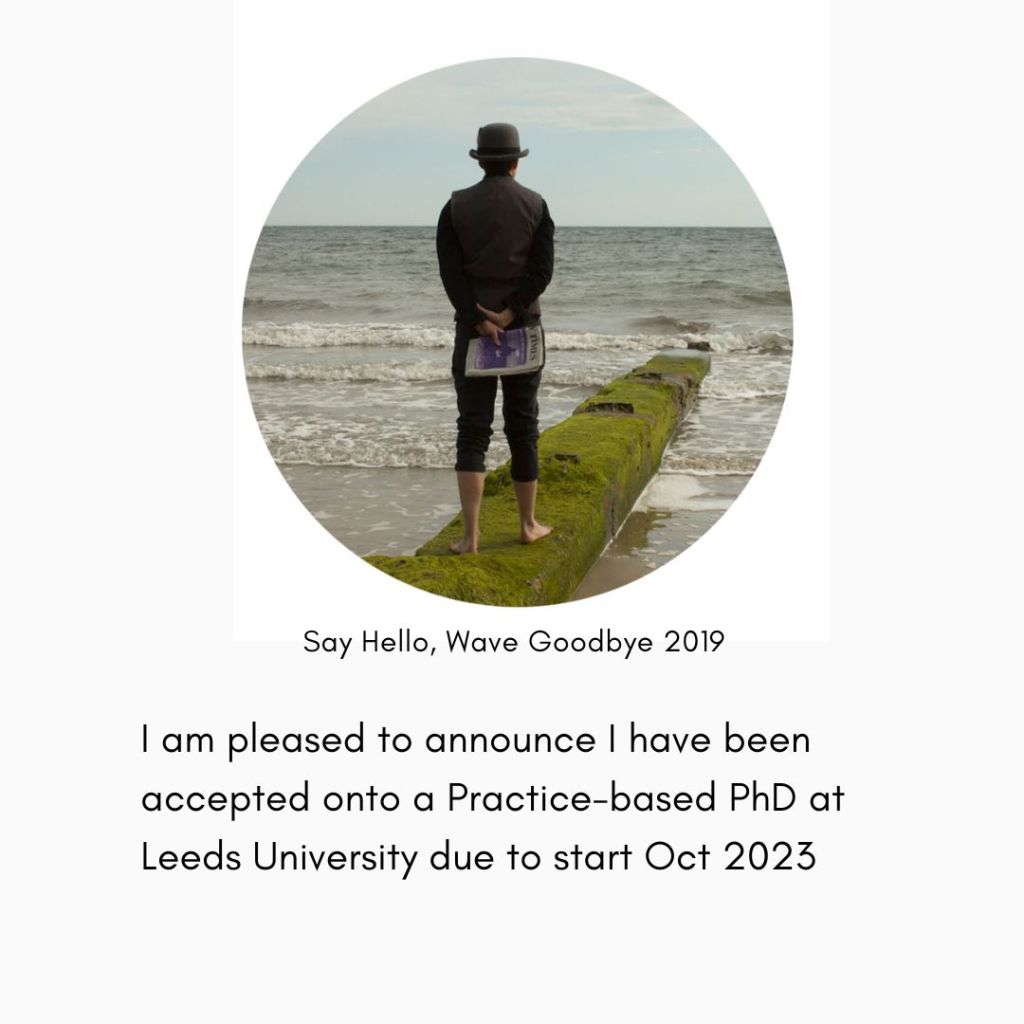
Exciting PhD News
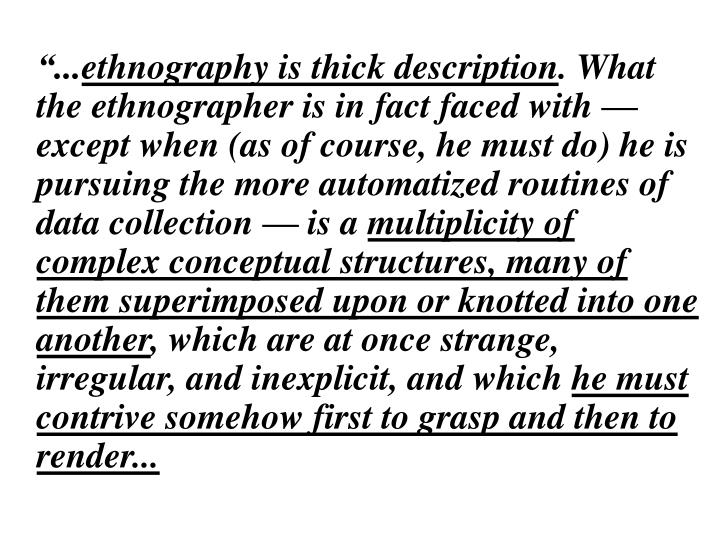
Quote reproduced from https://www.slideserve.com/woods/neo-evolutionism-and-cultural-ecology (accessed 04/10/22)

How shall I most freely cast a bridge between inside and outside?’ – Paul Klee[1]
She needs a framework, a basic conceptual structure, fixed yet fluid, a suture, a space of exchange. Invitingly provocative, she explores how it feels to be confused and insecure. Breathing deeply, exhaling freely, searching for the clarity of an image rendered in the act of moving. Finding in the rhythmic structure of move[me]nt a series of progressive events where an uncertain smile gropes in the dark for a sub-conscious memory. She is making a spectacle of herself but she cares not, she has surrendered herself to the moment, falling softly like a feather into a chasm where chance dares to hope, to dream, to tremble at the merest prospect of touch.
She tried this dialogue with Mondrian but became depressed when she ended up goose-stepping at right angles, her body locked in an alien rigor mortis. She abandoned this course of inaction and went back to the drawing board so to ‘act in such a way that I can speak to you.’[2] Slowly she traces his gestures with the pads of her fingers trying to get a sense of the performance, allowing the movement to find its own course.
The relationship with her body is inverted as this extremity becomes the locus of all sensation; her entire body now sits on the tip of her finger. This minute spot is suddenly electrified with an ‘intimate immensity’[3], ‘signing on the body body longing.’[4] Self-consciousness is elsewhere, she invests herself with a forensic energy looking for the cameo, the secret, the victim, here a perjured parrot under the skin looking for the ballad and the source. ‘Her hands, autonomous, pick out some refrain buried deep within her core.’[5]
Somehow he knows her even before she knows herself. Somehow she knows him even before she knows herself. She recalls the story of Butades, a miniature love story where a young woman distressed that her love was going away traces in outline on the wall, the shadow of his face thrown by a lamp, a substitute for the absent object of desire. This process of extraction is like drawing poison from a wound. ‘He takes hold of her and attracts her, drawing her out of her presence.’[6] Hidden in plain sigh[t] privately she makes an appearance speaking from a place where she is not, where she knows not. She remembers The Diary of a Nobody with all those Cummings and Gowings on the threshold. Is she coming or is she going? [Pull yourself together! She disobeys this command; she likes the way it feels to be confused and insecure.] Is she drawing, writing, dancing or speaking? She can no longer tell the difference, she is not herself but poetry in motion, black milk in human form. Now his drawing is etched into the whorls of her finger, it feels like a mutiny in the air with no objective. She hovers like a woman uncertain of his convictions, unsure of herself, a shadow soundtrack of whispering grass kicking the air.
‘Are you the figure or are you the ground?’ [o! Is that how his story goes?]
You might as well ask me if I am the wave or the sea.’[7]
‘To write’ he said ‘is not to set in black but be yourself the black where words sit.’[8] She is unsure whether this is what he had in mind. This is how poems come to be, they are written in the blood, tiny corpuscles passing through arteries where oxygen flows.
‘You tap a message into my skin, tap meaning into my body. Your morse code interferes with my heartbeat. I had a steady heart before I met you, I relied upon it. Now you alter its pace with your own rhythm, you play upon me, drumming me taught.’[9]
Language has us all dancing in the diamond room. It shoots, we jive. Rapid acts of teasing your desire gesture toward the sensual. As if submerged in water like a wet fish on velvet, it excites appetites. This subterranean muscle orders appearance, an anthropological analysis of bodily actions. Something stirs in the deep like a fish wriggling on a hook shooting like an arrow for the surface. A subcutaneous striation transforms into a red weal upon her face.
‘When suddenly she realized . . . words were coming …imagine…words were coming a voice she did not recognize…at first so long since it had sounded . . . then finally had to admit . . . could be none other . . . than her own.’[10]
Suddenly she feels herself falling

Image reproduced from https://artvee.com/dl/drawing-knotted-in-the-manner-of-a-net/ (accessed 08/06/2011)
[10] Ibid, http://www.english.emory.edu/DRAMA/beckettnoti.html (accessed 23rd July 2012).
[9] Winterson, Ibid, p.89.
[8] Ibid, p.78.
[7] Edmund Jabès, The book of Dialogue, Trans. Rosmarie Waldrop ( Connecticut: Wesleyan University Press), p.12.
[6] Blanchot, Ibid, p.85.
[5] These are selected extracts based on the screenplay by Steven Spielberg, Close Encounters of the Third Kind (Great Britain: Sphere Books Ltd, 1978). Due to the nature of the book (it is a ‘Fotonovel’) there are no page numbers given. I have changed the word him to her.
[4] Jeanette Winterson, Written on the Body, (London: Vintage Books, 1993), p.89.
[3] Bachelard, Op.cit, p.183. This is Bachelard’s term for our imaginative capacity to inhabit a landscape internally
[2] Maurice Blanchot, Awaiting Oblivion, Trans. John Gregg, (USA: University of Nebraska Press, 1997), p.5.
[1] Paul Carter, Dark Writing, Geography, Performance, Design (Honolulu: University of Hawaii Press, 2009), p.79.
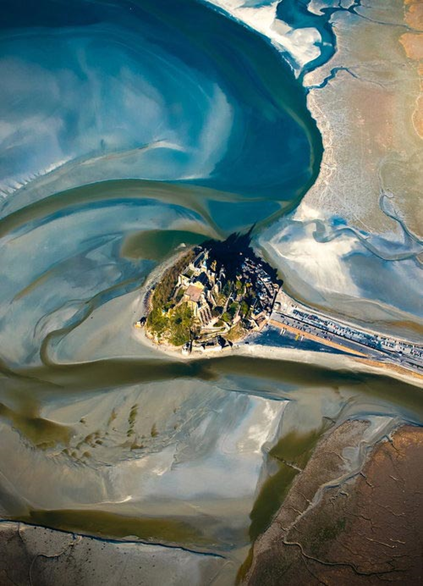
“The faery solitude of the place…his castle that lay on the very bosom of the sea…. at home neither on land or water, a mysterious amphibious place, contravening the materiality of both earth and waves…That lovely, sad, sea-siren of a place!.” The Bloody Chamber, p.8-9
This very brief analysis explores how we can approach gendered relations from the perspective of location to reveal the symbolic and metaphorical significance of Mont. Saint- Michel as it is employed in Angela Carter’s The Bloody Chamber. This analysis was given recently in a very short presentation. Examining Mont. Saint- Michel I explore its potential to represent feminine and masculine principles, nature and culture and how it is central to relations between the bride, her mother and the Marquis. Working through visual and sonic imagery highlights the relations between female anatomy, biology and the cyclical feminine flow ontology of the ‘sea-girt’. My interest lay specifically in the concept of the sea-girt, as a border or boundary surrounded or enclosed by the sea and how we might consider this in relation to the porous and the feminine. Continue reading
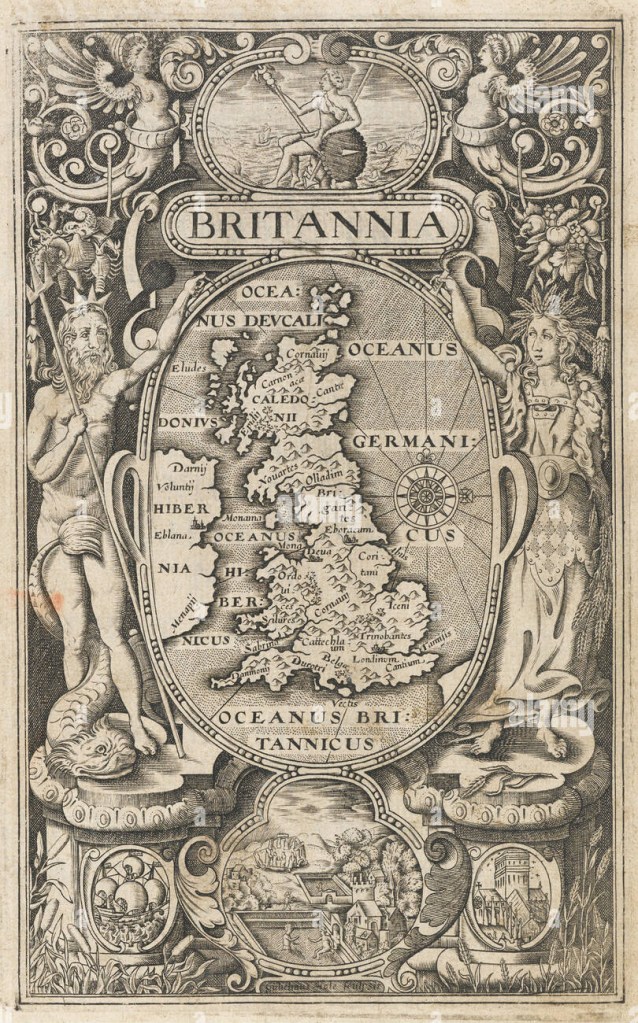
“A map of England, Wales, Scotland eastern Ireland, in an oval supported by Neptune and Ceres, with vignettes of Britannia sitting on a rock, a ship, St Paul’s Cathedral, and Stonehenge and the Roman Baths. On the map London and York are marked, but most of the other names are tribes. This frontispiece was one of three maps engraved by William Rogers (c.1545-c.1604) for the 1600 edition of William Camden’s ‘Britannia’, the fifth edition of the work, yet the first to contain maps. It was not until 1607 that a full suite of county maps was included, alongside a larger version of this map, engraved by William Hole.”
Text reproduced from https://www.abebooks.co.uk/servlet/BookDetailsPL?bi=31158455803&cm_mmc=ggl--UK_Shopp_RareStandard--product_id=bi%3A%2031158455803-_-keyword=&gclid=CjwKCAiApvebBhAvEiwAe7mHSKrgSaHbIJ-gLMONnS4zfobOGGL_kNcSs86HQENjxVf97aIYKEEEchoCF4YQAvD_BwE (accessed23/11/22)

