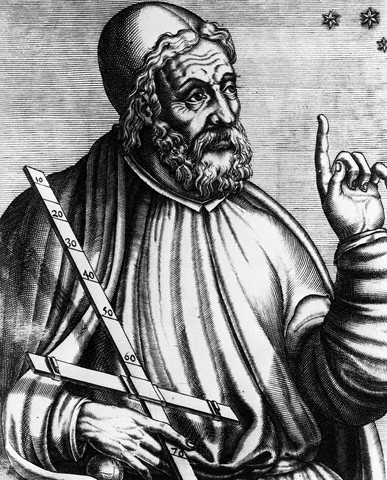
“Geography is a representation in picture of the whole known world together with the phenomena contained therein, it differs from Chorography in that Chorography, selecting certain places from the whole, treats more fully the particulars of each by themselves – even dealing with the smallest conceivable localities, such as harbors, farms, villages, river courses, and such like. It is the prerogative of Geography to show the known habitable earth as a unit in itself, how it is situated and what is its nature, and it deals with those features likely to be mentioned in a general description of the earth, such as the larger towns and great cities, mountain ranges and principle rivers […]
The end of Chorography is to deal separately with a part of the whole, as if one were to paint the eye or ear by itself. The task of Geography is to survey the whole in its just proportions, as one would the entire head, and afterwards those detailed features which portraits and pictures may require, giving them proportion in relation to one another so that their correct measurement apart can be seen by examining them, to note whether they form the whole or a part of the picture. Accordingly therefore it is not unworthy of Chorography, our out of its province, to describe the smallest details of places, while Geography only deals with regions and their general features. […] Chorography is most concerned with what kind of places those are which it describes, not how large they are in extent. Its concern is to paint a true likeness, and not merely to give exact position and size. Geography looks at the position rather than the quality […] Chorography needs an artist, and no one presents it rightly unless he is an artist…”
Claudius Ptolemy quoted in Volume II, Visual Culture: Histories, Archaeologies and Genealogies of Visual Culture. Eds. Morra, J, Smith. M, (Oxon, Routledge: 2006), p.17‐18.
What follows is an abridged and long unfulfilled PhD proposal that was successfully submitted to the Critical Writing department at the Royal College of Art as well as Coventry University and remains unrealised due to personal and financial circumstances. I am now in a position to conduct this research independently and plan to embark on it over the coming weeks.
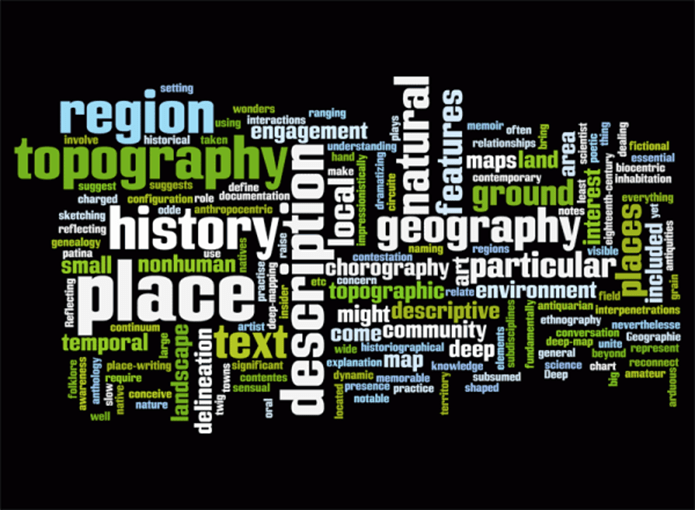
Darrell J.Rohl Chorography tag cloud
1.0 Abstract
To my knowledge this is the first PhD by practice in the UK to explore Chorography’s relevance as a methodological tool in contemporary artistic practice and critically address the historic yet neglected role of Chorography in the documentation of place. Pertinent to research across diverse academic disciplines this proposal is timely, relevant, and contemporaneous. Historically chorography, or place writing, is the artistic representation of a regional map which originated in Classical Geography (Ptolemy c.149AD). This field-based approach and detailed descriptor of place qualitatively maps characteristics of the locale by examining the constituent parts of that place.Currently there is a renewed methodological interest in chorography within Cultural Studies, Archaeology and Performance. These forms of chorography whilst practically and theoretically rooted in various strands of its developmental history, reflect its methodological richness and interdisciplinary nature although they do not have a locus as yet aligned. Therefore there is a need to analyse and synthesise these discrete bodies of knowledge that reflect current cultural pre-occupations with chorography to provide a clearer understanding of the relevance, meaning and impact of chorography today.
This research aims to provide a rigorous examination of chorography as a methodological tool which takes region as its lens and address it as a mode of mediating specific forms of cultural memory, narrative and belonging. This also includes asking how chorography can figuratively, metaphorically or symbolically excavate the hidden, the forgotten or the overlooked to reveal and re-present micro-histories, landscape narratives, texts, images, archives and collections either discarded or forgotten. Although a historic understanding is necessary this research recognises the chorographer’s body is also a site of historical crossing that both transcends and incorporates these boundaries made possible by the very nature of its mobility, which has implications for who, what and how people and places are remembered and re-presented.
As history, theory, artistic research and practice are increasingly complex and intertwined with bodies of knowledge from diverse spheres of scholarship and disciplinary boundaries become increasingly diffuse this ultimately raises the question of location. Combining tradition with innovation to position artistic research skills within the historically grounded yet expanded field of chorography I aim to actively engage this question in order to devise a new form and application of critical enquiry. Utilising chorography as a methodological framework in artistic practice will create new criteria with which to examine and re-interpret contemporary practices of place making by retrieving, restoring, developing and recreating a connection between chorography past and present. Combining historic method with contemporaneous form will enable a renewed understanding of the chorography of place not just artistically but contextually, historically and physically.
2.0 Research Context: Chorography
Chorography designates “a regional map in Renaissance geographic texts and the artistic description of regions” viewed and experienced from within linking “regional events at the time of occurrence in pictorial representations.” (Olwig 2001 and Curry 2005 cited in Päivi Kymäläinen and Ari A. Lehtinen 2010: 252). Chorography, defined by the polymath Ptolemy in the Geographike Hyphegesis (c.149AD) takes region as its lens. This field-based approach and detailed descriptor of place qualititively maps characteristics of the locale by examining the constituent parts of that place “to describe the smallest details of places.” Morra J, Smith M (2006: 17-18).
Chorography was re-discovered in Renaissance Geography and British Antiquarianism 16th -17th centuries. Historically William Camden’s Brittania (1586) or a Chorographicall Description of the most flourishing Kingdomes, England, Scotland, and Ireland is an encyclopaedic approach to a geographic, historical topographical survey of the British Isles which has been identified as a classic exemplar of the renaissance of a chorographic work “connecting past and present through the medium of space, land, region or country.” (Rohl 2012 2011). Cormack states “Chorography was the most wide ranging of the geographical sub disciplines since it included an interest in genealogy, chronology and antiquities, as well as local history and topography…uniting an anecdotal interest in local families and […] genealogical and chronological research.” (Cormack 1991 cited in Rohl 2012:22). British Antiquarianism therefore retrieved chorography and recreated it in an expanded field, re-interpreting its legacy, ensuring its survival, restoration and continuing communication. Susan Stewart discusses the antiquarian as being “moved by a nostalgia of origin and presence” whose “function is to validate the culture of ground.” (1984:153)
Currently there is a renewed methodological interest in chorography and broadly conceived place relations within Cultural Studies, Archaeology and Performance. There is therefore a need to assess, address and synthesise these discrete bodies of knowledge from diverse spheres of scholarship, theory and practice. Currently conducted independently of each other they nevertheless reflect current cultural pre-occupations with the concept, its application and theorisation. Selected practitioners and researchers of relevance to this study include Michael Shanks, Archaeologist, Stanford and Mike Pearson, Performance Studies, Aberystwyth. Their work Theatre/Archaeology (2001) creates a porous space whereby archaeological and performance theory combine to provide an architecture for the event “whose underlying questions was the representation of place and event” and the role of landscape within it (Shanks). Their concept of Deep Mapping is derived from chorography. They borrow the term from William Least Heat-Moon’s PrairyErth, an intensive look at a particular place that included discussion of geography, history, and ecology, that place being Chase County, Kansas. Pearson and Shanks were using the genre as a means to create techniques and re-think approaches to communities, locales and events. Their work incorporates chorography into performance and archaeology to activate, re-activate, question, examine and perform the histories of place utilising a range of methodological, archaeological, performance and narrative techniques including biography, memoir, folklore, topography to “juxtapose and interpenetrate the historical and the contemporary.” Pearson’s exercise in deep mapping (2007) is a complex intertextual topography and biographical derivé incorporating region, locale, chorography, landscape, memory, archaeology and performance “where historical, social, cultural and environmental temporalities are foregrounded.”
The scholarly work of Darrell J. Rohl, Archaeologist, Durham University, whose research is organised around past, present, people and place, identifies chorographic methods inarchaeological fieldwork andinterpretation (2012). Nicoletta Isar, Cultural Studies, Copenhagen University (2009) explores chorography and the performative relation between space and movement. This has largely been conceived under Dr A. Lidov’s neologism Hierotopy 2002, the organisation and mediation of sacred spaces, a transdisciplinary approach combining art history, archaeology and cultural anthropology.
3.0 Original Contribution to knowledge
Recent studies framed within visual arts do not adequately recuperate the concept, and its pertinence to the theorisation, contextualisation and politicisation of performative embodied tactics and spatial practices ‘space is a practised place.’(De Certeau 1984), O’Sullivan, Jill (2011) The chorographic vision: an investigation into the historical and contemporary visual literacy of chorography, PhD thesis, James Cook University (AU). This study traces the history and symbolism of chorography as a visual literacy of place through cartography and the graphic medium of print, privileging the map as the primary visual signifier of chorography. Although the study does acknowledge other forms of chorographic practice its principle aim is to map the development of historical chorography and the philosophical discourse on place whereby the practice based iterations reproduce historic practice without providing new applications or forms. It is these other forms of chorographic practice that depart from its historical nature that provide what I perceive to be chorography’s as yet unexplored methodological richness in artistic research and the layering of these historical crossings that connect the cultural and socio-political to the personal.
I argue as original contribution to knowledge if the relations posited within chorography are firstly empirical, experiential and emplaced it cannot be fully articulated by focussing on the cartographic. Put simply the medium is not the method. This authoritarian disembodied cartographic vision and static pictorial symbol or ‘image’ of place elides the textures of place and its complex network of relations i.e. the embodied, symbolic, socio-political, cultural, familial, contextual, discursive & historical which contribute to and profoundly affect how autobiographical identity is constructed, mediated, narrated, re-membered and situated. This research recognises that chorographic method is the trace of an embodied agent already implicated into the textures of place and that the physical act of mapped place is not synonymous with the map as object. Although a historic understanding is necessary this research recognises the body is itself a site of historical crossing that both transcends and incorporates these boundaries made possible by the very nature of its mobility. Historically chorography does not account for the body in the field yet a sensory physical mapping of place occurs prior to the act of representation.
There is a need to distinguish this act from its documentation and re-presentation to provide new theories, forms and applications by addressing the political implications of the embodied in the act of representation. To provide a contemporaneous account the performative relations between the body, mapping and place; the mobile, embodied and situated are therefore central to a contemporary interpretation of chorography. Historically there are no female chorographers and therefore no theoretical address on chorography that recognises the philosophical discourse on sexual difference and place from a feminine perspective in visual art. This research aims to address this lack.
The following research outcomes will provide a clearer understanding of the relevance, meaning and impact of chorography today.
Critically evaluate and determine chorography’s relevance and its application as a methodological tool that constructs and mediates specific forms of cultural memory, narrative and belonging and locate this in contemporary artistic research, theory and practice.
Create new criteria to examine practices of place making by retrieving, restoring, developing and communicating a connection between chorography past and present.
Assess and synthesise discrete bodies of knowledge from diverse spheres of scholarship, theory and practice. Conducted independently of each other they nevertheless reflect current cultural pre-occupations and a renewed interest in chorography.
Theorise chorography beyond its original conception, draw conclusions and propose future orientations, applications and developments.
4.0 Personal Statement & Objectives
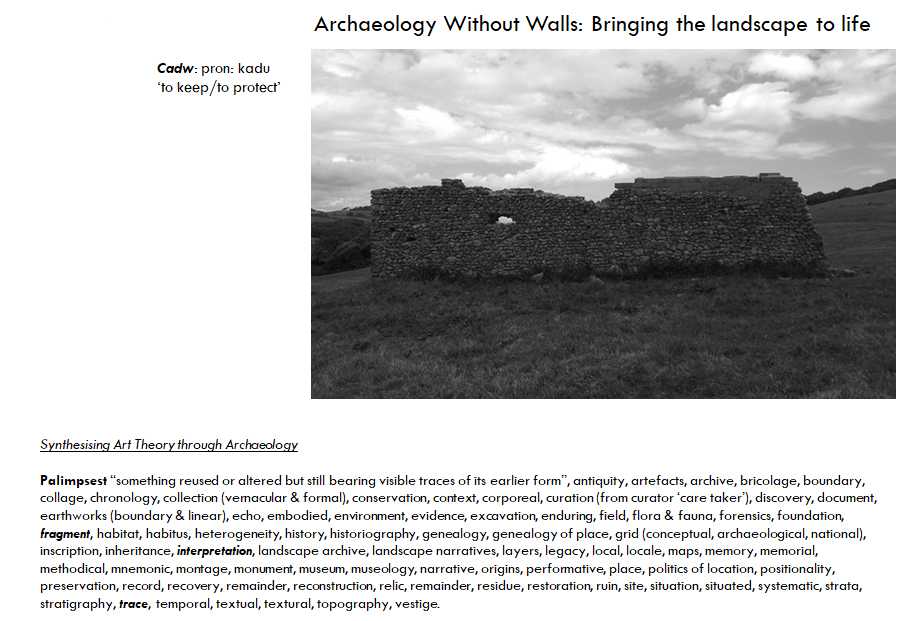
The desire to recuperate the historic yet neglected method of chorography in artistic research is philosophically rooted in my practice. Engaging with different conceptions of sites as markers of place via a curatorial approach is to actively ‘take care’ in the restoration, conservation and curation of micro-histories, narratives, texts, images, archives and collections either discarded or forgotten. During this process a historical figure, site, place, event or voice or voices are adopted to activate the work and produce a narrative arc. There is a desire to retrieve and recreate those figures in a present context and reopen a dialogue that is directed back toward its own context, boundaries and form. This displays a sensitivity to the re-presentation of material employed and a continually recurring hinge is the problematic interface between the public and the private. This problematic in some respects undermines the desire to protect as this act re-stages, re-articulates, re-presents and re-mediates what I term the performance of the private, the entry of the private domain into the public arena where it is both commodified and incorporated into the rhetoric of display. The concepts operative in the work and research and are critically examined through diverse yet interconnected bodies of knowledge. I understand this to represent a chorographic approach and pre-disposition to the concept of chorography.
Art, whilst innovative, can use archaeological method or historiographic accounts to excavate and recontextualise our relations to the past. Legacy, whilst not always visible is present. Therefore a critical reflection must recognise these relations do not occur in isolation but ‘in situ’ and within a context that affects how they are critically, ideologically, philosophically and historically situated. Applying existing artistic skills in a new field will enable the development of a more comprehensive understanding of place, not just artistically, but historically, physically and contextually.
The first stage on my tour of the body of work entitled Hints for British Tourists, CT20 Gallery in Folkestone. Hints for British Tourists is the restaging and fictional expansion of a found pamphlet containing instructions for travel. Presented as photographic documentation the work is a meditation on time, memory, travel and tourism. It showcases the first iteration of a new conception of the artist duo Vale & Howlette. These characters are adopted as dramatis personae in a wider body of work, becoming primary protagonists in a narrative that explores ideas of travel, leisure, time and memory performed by myself and my partner, whilst also introducing historic travel mythologies relating to legendary, often unreachable places.
Denise Startin: Hints for British Tourists, CT20 Gallery, 73 Tontine Street, Folkestone, Sept 20th – 24th
Text by Anneka French
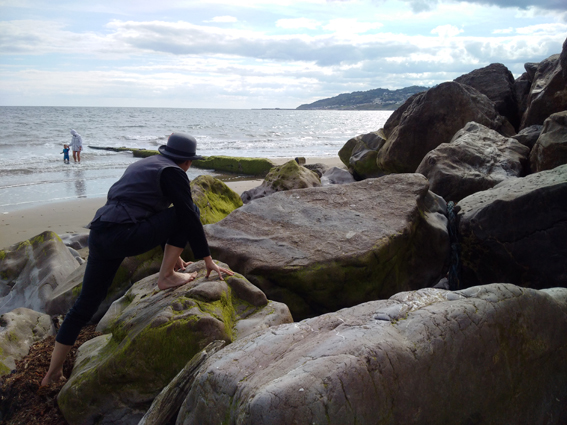
A figure in a bowler hat, waistcoat and rolled-up trousers brushes sand from their feet. They read a book in front of a painted beach hut, climb on rocks, clutch a newspaper, wait, fall asleep and look out to sea. In one moment after another, we see tourism performed and time laid out in photographic frames like film stills.
Coventry-based artist Denise Startin presents a series of site-based performative actions, seen here via photographic documentation. The genesis of the exhibition Hints for British Tourists comprises two chance encounters: the discovery of a tourism pamphlet on eBay (also titled Hints for BritishTourists) and a wall plaque on Hertford Street, Coventry, dedicated to the historic watchmaking trade that lists craftsmen Samuel Vale and George Howlette. The exhibition represents a re-staging and fictional expansion of these two very different starting points.
Vale & Howlette are adopted as dramatis personae in a wider body of work by the artist, becoming primary characters in a narrative that explores ideas of travel, leisure, time and memory performed by Startin herself and her partner. Startin’s work makes enquiries, both serious and humorous, that question what it means to be a tourist in post-Brexit England, in a world grappling with a pandemic and climate catastrophe, in a physical body that requires care and rest, and in a landlocked city more than one hundred miles from the nearest stretch of coastline.
The original pamphlet purchased by Startin was published in the former Yugoslavia in the 1970s, intended as a practical guide for travel. In it, the author observes, ‘One of the reasons I like Britainand the British, apart from liking the Sunday Times, cheese cake, Constables in the Tate, ‘apples andpears’ and not to mention the liveliness of their pubs is because their idea of a holiday is not just lyingaround on the beach and drinking.’ Startin’s work offers more than a nod to this ambiguous description, providing viewers with perspectives on place that appear both familiar and strange.
While also introducing historic travel mythologies relating to legendary, often unreachable places, the titles selected by Startin for the photographs shown – On the Rocks; Between a Rock and a HardPlace; Rush Hour – also point toward emotional states of being in motion, conflict, indecision or, indeed, indicate a sense of stillness. Vale & Howlette’s journey is as yet embryonic. They are on their way to who knows where.
—
Denise Startin studied at the Royal College of Art and has exhibited work at Compton Verney,Coventry Biennial and Whitechapel Gallery, London. She is the recipient of multiple awards andbursaries and has completed artist residencies in Wrexham and the Lake District.

 denisestartin.co.uk