“Ted Hughes (1930-1998) was born at 1 Aspinall Street, Mytholmroyd, in the West Riding of Yorkshire on the 17th August 1930. Ted was a pupil at the Burnley Road School until he was seven, when his family moved to Mexborough, in South Yorkshire. As a child he spent many hours exploring the countryside around Mytholmroyd, often in the company of his older brother, Gerald, and these experiences and the influences of the landscape were to inform much of his later poetry.
In ‘The Rock’, an autobiographical piece about his early childhood, Hughes writes about Scout Rock, whose cliff face provided ‘both the curtain and back-drop to existence‘. The area continued to be a powerful source of inspiration in his poetry long after he had left Yorkshire. Hughes described the experience of looking out of the skylight window of his bedroom on 1 Aspinall Street onto the Zion Chapel. The Chapel is long gone, but Zion Terrace remains, its name a reminder of more God-fearing times.
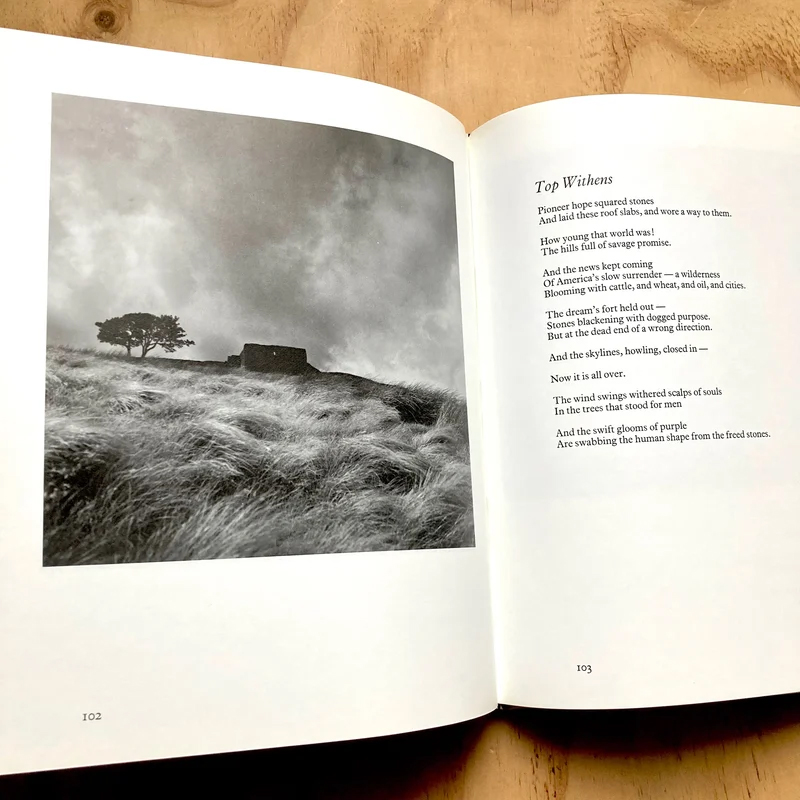
In his classic and richly personal collection Remains of Elmet: A Pennine Sequence (1979), with photographs by Fay Godwin, Hughes suggests that the Calder Valley was originally the kingdom of Elmet, the last Celtic land to fall to the Anglo-Saxons. A second, revised edition was published as Elmet in 1994.
Many of Hughes’s other poems also relate to the Calder Valley. ‘Six Young Men’, for example, was written at Hughes’s parents’ house at Heptonstall Slack in 1956. The poem describes a photograph belonging to Hughes’s father of six of his friends on an outing to Lumb Falls, taken just before the First World War.”
In the seventeenth century antiquarianism was a well-respected profession and antiquarian works were in demand, particularly amongst the gentry, who were especially interested in establishing lineage and the descent of land tenure. Although intended primarily as a source of information about who owned what and where, they often contained fascinating descriptions of the English landscape. Charles Lancaster has examined the town and county surveys of this period and selected the most interesting examples to illustrate the variety and richness of these depictions. Organised by region, he has provided detailed introductions to each excerpt. Including such writers as John Stow, William Dugdale, Elias Ashmole, Daniel Defoe, Gilbert White and Celia Fiennes, this is a book that will appeal to anyone with an interest in both national and local history and to lovers of English scenery.
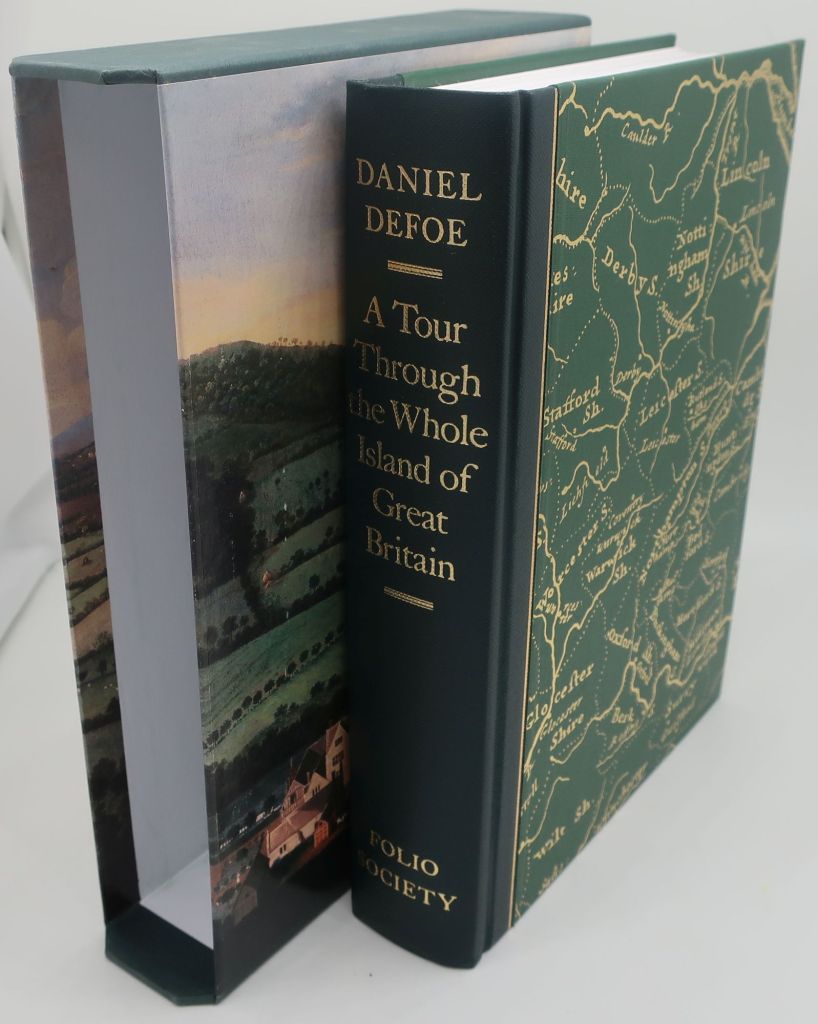
“Britain in the early eighteenth century: an introduction that is both informative and imaginative, reliable and entertaining. To the tradition of travel writing Daniel Defoe brings a lifetime’s experience as a businessman, soldier, economic journalist and spy, and his Tour (1724-6) is an invaluable source of social and economic history. But this book is far more than a beautifully written guide to Britain just before the industrial revolution, for Defoe possessed a wild, inventive streak that endows his work with astonishing energy and tension, and the Tour is his deeply imaginative response to a brave new economic world. By employing his skills as a chronicler, a polemicist and a creative writer keenly sensitive to the depredations of time, Defoe more than achieves his aim of rendering ‘the present state’ of Britain.”
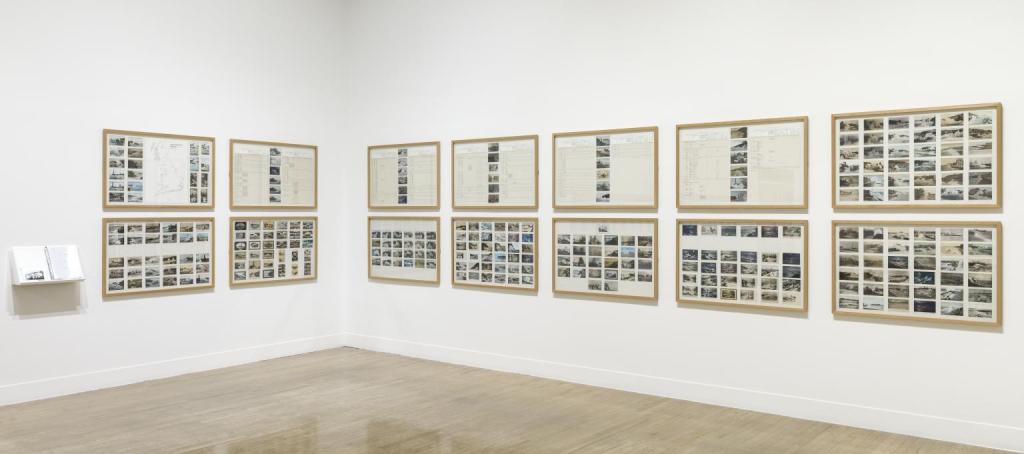
“Dedicated to the Unknown Artists 1972–6 consists of fourteen panels containing over three hundred original postcards depicting waves crashing onto shores around Britain. A large map annotated with each of the locations featured in the postcards is included in the first panel. The remaining panels have been subjected to what the artist has described as her ‘methodical-methodological approach’ (quoted in ‘Second Sight’ 2007, accessed 14 June 2018) and are organised into grids of postcards and tabulated details such as location, caption, legend, in vertical or horizontal format. Accompanying these panels are two additional components: a copy of a postcard-sized artist’s book and a dossier with supporting material, in which the artist describes herself as a curator presenting an exhibition of these overlooked cultural artefacts.
In 1977 Hiller discussed the work in the following way:
Dedicated to the Unknown Artists was designed as an exhibition piece with myself in the role of curator, collaborating with/extending the work of the unknown artists who created the Rough Sea ‘set’ of postcards. The ‘coincidental’ pairings of alternative descriptive languages – verbal and visual – are sustained as levels of presentation throughout the piece. While the charts may look like models of objectivity and the visual images like expressions of subjective internalizations, they lead to a series of paradoxes involving the unexpressed but intended vs. the expressed but unintended. (Quoted in Tate Britain 2011, p.76.)
The work illustrates Hiller’s interest in the subject of memory and memorials. The title identifies the work as a tribute to the overlooked and forgotten artists who painted, photographed or hand-tinted the numerous seaside images in the postcards she collected. By making such commonplace objects the subject of a dedicated and extensive presentation, Hiller gives new status to the mundane and provides the viewer with a familiar access point from which to engage with the work. Dedicated to the Unknown Artists has also been described as a work about invisibility (see ‘Second Sight’ 2007, accessed 14 June 2018). The group of postcards only came to exist as a ‘set’ by the artist’s act of collecting them, and the visual correspondences that the collection highlights would have been previously unseen.
Hiller’s choice of sublime or picturesque seaside motifs – with their subtext of romantic desire, the soul in turmoil, and a longing for nature – contrasts with a strict conceptual methodology. Coloured images in particular were generally excluded from contemporaneous conceptual artworks, and yet for this work Hiller opted to make the genre of popular colour postcards of the British seaside her prime focus. However, the grid formation, the serial presentation and the typed labelling all recall the language of conceptualism. Writer Brian Dillon has noted: ‘That Hiller effected a study of the invisible precisely by exhibiting objects of such ravishing (and also kitsch) visual texture is surely exactly what made the work, at the time, such a scandal for adherents of an austerely linguistic Conceptualism.’ (Brian Dillon in Tate Britain 2011, p.52.)”
Further reading Susan Hiller, exhibition catalogue, Tate Liverpool 1996, reproduced pp.12–13. Susan Hiller, exhibition catalogue, Tate Britain, London 2011, reproduced pp.52–5. ‘Second Sight’, Frieze, no.109, September 2007, https://frieze.com/article/second-sight-1, accessed 14 June 2018.


 denisestartin.co.uk