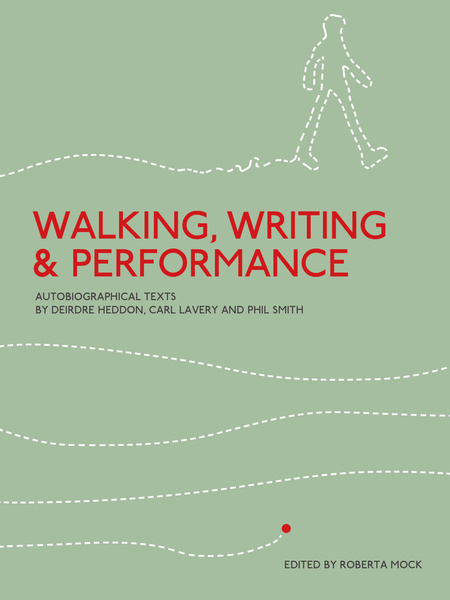
Walking, Writing and Performance

This collection charts three projects by performance-makers who generate autobiographical writing by taking walks. It includes performance texts and photographs, as well as essays by the artists that discuss processes of development, writing and performance.The Crab Walks and Crab Steps Aside are performances made by Phil Smith based on an initial exploratory walking of an area of South Devon where he was taken for childhood holidays and then on to Munich, Herm and San Gimignano. Both shows were accompanied by the distribution of maps seeking to provoke the audience to make their own exploratory walks. Mourning Walk is a performance that relates to a walk Carl Lavery made to mark the anniversary of his father’s death. Lavery shows how a secret can be both shared and hidden through the act of communication as he explores “an ethics of autobiographical performance”. In Tree, the result of a multi-disciplinary collaborative process, Dee Heddon occupies a single square foot of soil, and discovers that by standing stationary and looking closely she can travel across continents and centuries, making unexpected connections through an extroverted autobiographical practice.The work of all three artists, taken together and separately, raises important issues about memory, ritual, life writing, textuality, subjectivity, and site in performance.

Image and text reproduced from https://www.intellectbooks.com/walking-writing-and-performance (accessed 07/12/24)

Iain Sinclair and Psychogeography

“Iain Sinclair’s classic early text, Lud Heat, explores mysterious cartographic connections between the six Hawksmoor churches in London. In a unique fusion of prose and poetry, Sinclair invokes the mythic realm of King Lud, who according to legend was one of the founders of London, as well as the notion of psychic ‘heat’ as an enigmatic energy contained in many of its places. The book’s many different voices, including the incantatory whispers of Blake and Pound, combine in an amalgamated shamanic sense that somehow works to transcend time. The transmogrifying intonations and rhythms slowly incorporate new signs, symbols and sigils into the poem that further work on the senses. This was the work that set the ‘psychogeographical’ tone for much of Sinclair’s mature work, as well as inspiring novels like Hawksmoor and Gloriana from his peers Peter Ackroyd and Michael Moorcock, and Alan Moore’s From Hell.”

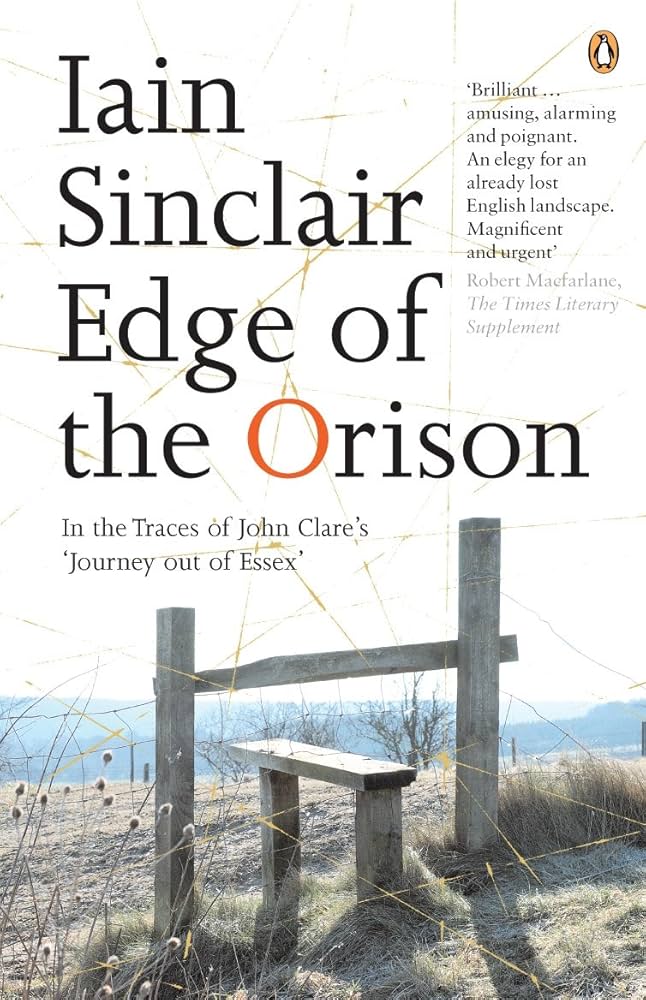
“In 1841 the poet John Clare fled an asylum in Epping Forest and walked eighty miles to his home in Northborough. He was searching for his lost love, Mary Joyce – a woman three years dead …In 2000 Iain Sinclair set out to recreate Clare’s walk away from madness. He wanted to understand his bond with the poet and escape the gravity of his London obsessions. Accompanied on this journey by his wife Anna (who shares a connection with Clare), the artist Brian Catling and magus Alan Moore – as well as a host of literary ghosts, both visionary and romantic – Sinclair’s quest for Clare becomes an investigation into madness, sanity and the nature of the poet’s muse.”

“Dining on Stones is Iain Sinclair’s sharp, edgy mystery of London and its environs Andrew Norton, poet, visionary and hack, is handed a mysterious package that sees him quit London and head out along the A13 on an as yet undefined quest. Holing up in a roadside hotel, unable to make sense of his search, he is haunted by ghosts: of the dead and the not-so dead; demanding wives and ex-wives; East End gangsters; even competing versions of himself. Shifting from Hackney to Hastings and all places in-between, while dissecting a man’s fractured psyche piece by piece, Dining on Stones is a puzzle and a quest – for both writer and reader.”

Text reproduced from Amazon and World of Books (accessed 14/11/24)

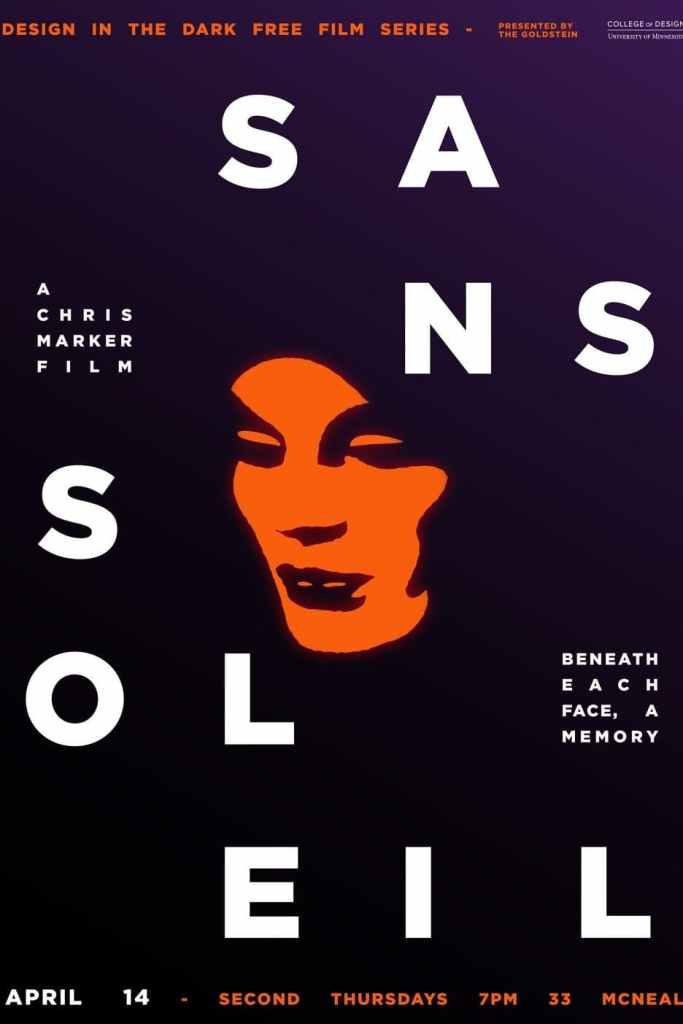
Chris Marker Sans Soleil (Sunless)

Chris Marker’s speculative travelogue-essay, reflecting on culture and history in narrated letters from Guinea to Japan to Iceland. A poetic documentary tour of Tokyo, Guinea-Bissau, Iceland and San Francisco, Sans Soleil mingles personal reflections with the history of the world. The female narrator reads letters sent by fictional Sandor Krasna, writing from ‘another world’. The spoken word, synthesized sound and haunting visuals investigate relationships between developed and developing societies. Virtuoso editing and special effects conjure the disorientation of a world traveller, journeying through cultures, secret rituals and confusions of time.

“The consummate cine-essay, framed as reportage from a roving cineaste, built mainly from Marker’s observations of the ‘empire of signs’ that is modern Japan and the poverty endemic in Guinea Bissau. Entertainingly provocative speculations on the ‘post-political’ world, haunted by the piano music of Mussorgsky.” Tony Rayns “A treatise on travel, on history, on art and on life, Marker’s film unfolds like an epistolary novel in dialogue with itself. His virtuosity with the camera is matched by the brilliance of the montage.” Bruce Jenkins

Text reproduced from https://www.bfi.org.uk/film/a9bab1d5-f6df-51d3-bdda-5e1beba14602/sans-soleil (accessed 08/03/24)

Psychogeography

Psychogeography: In recent years this term has been used to illustrate a bewildering array of ideas from ley lines and the occult, to urban walking and political radicalism. But where does it come from and what exactly does it mean? This book examines the origins of psychogeography in the Paris of the 1950s, exploring the theoretical background and its political application in the work of Guy Debord and the Situationists. Psychogeography continues to find retrospective validation in much earlier traditions, from the visionary writing of William Blake and Thomas De Quincey to the rise of the flâneur and the avant-garde experimentation of the Surrealists. These precursors to psychogeography are discussed here alongside their modern counterparts, for today these ideas hold greater currency than ever through the popularity of writers and filmmakers such as Iain Sinclair, Will Self and Patrick Keiller.

From the urban wanderer to the armchair traveller, psychogeography provides us with new ways of experiencing our environment, transforming the familiar streets of our everyday experience into something new and unexpected. Merlin Coverley conducts the reader through this process, providing an explanation of the terms involved and an analysis of the key figures and their works.

Text reproduced from Amazon

Research Methods: Ethnofiction

In “No Fixed Abode”, Marc Auge’s pathbreaking fictional ethnography, a man named Henri narrates his strange existence on the margins of Paris. By day he walks the streets, lingers in conversation with the local shopkeepers, and sits writing in cafes, but at night he takes shelter in an abandoned house. From here, we see a progressive erosion of Henri’s identity, a loss of bearings, and a slow degeneration of his ability to relate to others. But then he meets the artist Dominique, whose willingness to share her life with him raises questions about who he has become and what a person needs in order to be a part of society. This is a book about how we live in geographical space and how work and patterns of domicile affect our status and our inner being.