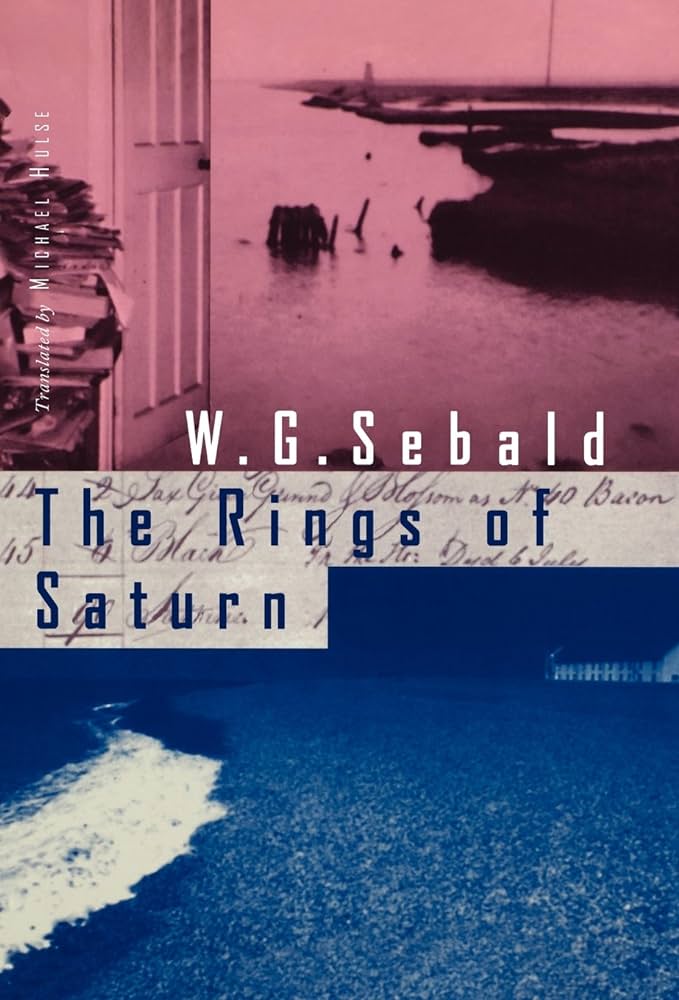
A fictional account of a walking tour through England’s East Anglia, Sebald’s home for more than twenty years, The Rings of Saturn explores Britain’s pastoral and imperial past. Its ten strange and beautiful chapters, with their curious archive of photographs, consider dreams and reality. As the narrator walks, a company of ghosts keeps him company – Thomas Browne, Swinburne, Chateaubriand, Joseph Conrad, Borges – conductors between the past and present. The narrator meets lonely eccentrics inhabiting tumble-down mansions, and hears of the furious coastal battles of two world wars. He tells of far-off China and the introduction of the silk industry to Norwich. He walks to the now forsaken harbor where Conrad first set foot on English soil and visits the site of the once-great city of Dunwich, now sunk in the sea, where schools of herring swim. As the narrator catalogs the transmigration of whole worlds, the reader is mesmerized by change and oblivion, survival and memories. Blending fiction and history, Sebald’s art is as strange and beautiful as the rings of Saturn, created from fragments of shattered moons.”–Publisher’s description
“This book celebrates some of the most dazzling treasures of English literature to show how Britain’s greatest authors have been inspired by, and even redefined, their country. From Chaucer’s pilgrims journeying from Southwark to Canterbury, to the 21st century suburban hinterlands of J.G. Ballard, this book will explore how the places and landscapes of Britain permeate the nation’s great literary works and how these works have, in turn, helped shape our perception and understanding of landscape and place, both real and imagined. As well as celebrating the traditional British landscape the book will also examine the literary construction of the city, following the mysterious fog-filled streets that stretch from the London of Dickens and Robert Louis Stevenson’s Strange Case of Dr Jekyll and Mr Hyde to the urban underworlds revealed by contemporary writers such as Neil Gaiman and Iain Sinclair. Accompanying a major exhibition at the British Library, the book also features such diverse landscapes as Emily Bronte’s wild and windy Yorkshire Moors, Elizabeth Gaskell’s industrial northern towns, the seaside-turned-nightmare of Bram Stoker’s Dracula, Graham Greene’s seedy and menacing Brighton, Virginia Woolf’s Bond Street and Hanif Kureishi’s suburbia, this book will describe and illustrate the work of over 100 of the greatest British writers who have been inspired by place, spanning the Middle Ages to the 21st century.”
The purpose of this article is a comparative analysis of Drayton’s poems Ideas Mirrour and Poly-Olbion tracing echoes of the former in his latter richly chorographical work. For the purpose of this analysis the main focus is on Poly-Olbion as a prime exemplar of a chorographic work and I also aim to draw out strands that specifically follow the concept of the body as it pertains to one of my research questions: If a sensory physical mapping of place occurs prior to representation where is the body in the process of chorography and how do we address the political implications of the embodied in the act of representation? It appears this question is complex as bodies often appear symbolically in rich and intricate intertextual and iconotextual relationships. The body it seems emerges as a chimera hiding in plain sight like Poe’s purloined letter.A chorographic text such as Poly-Olbion offers tangible clues as to how this problematic might be addressed through practice.
POLY-OLBION (1612-1622):
Poly-Olbion is an expansive poetic journey through the landscape, history, traditions and customs of early modern England and Wales. Originally published in two parts (1612, 1622), it is also a richly collaborative work: Michael Drayton’s 15,000-line poem navigates the nation county by county and is embellished by William Hole’s thirty engraved county maps. It is accompanied for its first eighteen ‘songs’ by John Selden’s prose illustrations. Drayton was a contemporary of Shakespeare and Ben Jonson, and Poly-Olbion crystallizes early modern ideas of nationalism, history and memory.
Drayton’s Early Sonnets, Poly-Olbion and Chorography:
Reyes outlines how Drayton’s epic Poly-Olbion was influenced and connected to his earlier sonnets particularly Ideas Mirrour (1594) later published as Idea (1599-1631) which both reflect and explore his interest in the history and topography of his country and celebrate ‘the discovery of England.’ p.1002The central trope in the allegorical Idea is fluvial and Drayton draws on ‘chorographic techniques to represent the beloved.’ p.1003 The central figure Idea, as an ideal representation of woman contained within the ideal geography of the English landscape, is embedded in the River Anker which runs through Drayton’s home county of Warwickshire and later appears in Poly-Olbion ‘where the poet finds the woman that he had originally praised under the poetic name of Idea.’p.1014
In Poly-Olbion Reyes identifies close connections to distant genres including sonnet, sequence, perspective, pastoral, epic, the heroic, lyrical and topographical as Poly-Olbion comes to represent the ‘eroticisation of the landscape’. whilst simultaneously trying to reify Drayton’s English identity. p.1003 Developments at the time facilitated this vision in the ‘revival of geographical writings and advancements in cartography’ and the renaissance of chorographic works in the 16th-17th Centuries, the most notable exemplar of the genre being William Camden’s Brittania (1586) pp.1003-4. Other proponents of the descriptive and primarily textual approach to history and travel narrative included the antiquarian works of John Leland’s Itinerary (1549) and William Lambarde’s A perambulation of Kent (1576). The rise of the ‘body politic’ and the ‘vision of the allegorical body’ supported ‘a spatial construction of national identity.’ p.1004 The rediscovery of Strabo and Ptolemy presupposed the encyclopedist approach to the genre but one whose methodologies ‘favoured a qualitative and localist point of view with a pictorial quality.’ P.1004
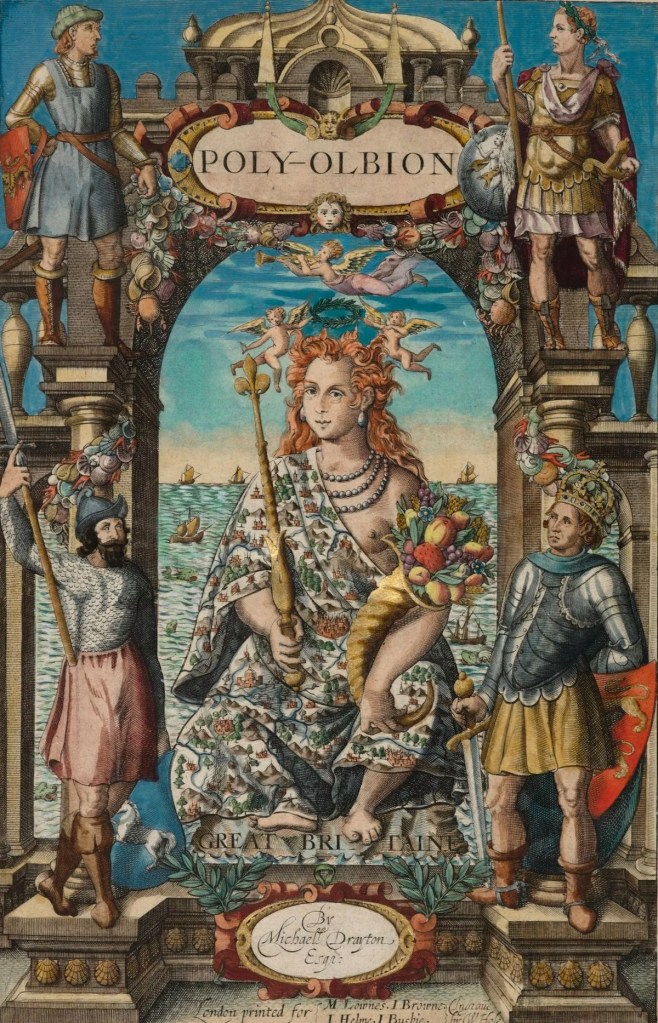
Reyes states that ‘Drayton’s interest in topography and the human body was driven by the Golden age of cosmography and cartography in England […] and reflected the idea of a human being as a microcosmos.’p..1006 According to D K Smith (XXXX no date given) in the 16th-17th Centuries this ‘resulted in a new cartographical epistemology and a cartographic imagination that provided English authors with a new set of metaphors and rhetorical tropes related to space and it’s embodiment.’ P.1006 Reyes states ‘the conception of the body as space determined the aesthetics of Poly-Olbion’. She cites Traub (XXXX no date given) ‘the description of human figures became a common aesthetic in Renaissance cartographies – ‘maps began to imply that bodies may be a terrain to be charted and is responsible for the chorographic function of human figures.’ P.1006 The ‘representation of the human body came to be seen as a ‘conglomerate of delimited spaces’. P1006 According to Reyes this explains the ‘anthropomorphizing representations of rivers, hills, mountains and forests’ in the maps of Poly-Olbion and that this representation of space is commensurate with a topographical representation of the body. P.1006 Between Ideas Mirrour and Poly-Olbion there is a ‘reciprocal movement from the topographical representation of the human body and the personification of the landscape’. P.1006. This personification of the landscape is represented in the above engraving, the frontispiece to Poly-Olbion which Helgerson (XXXX no date given) states is ‘a goddess like woman dressed in a map’ holding the horn of plenty, which symbolizes prosperity, and who stands as ‘a living embodiment of nature.’ P.1010
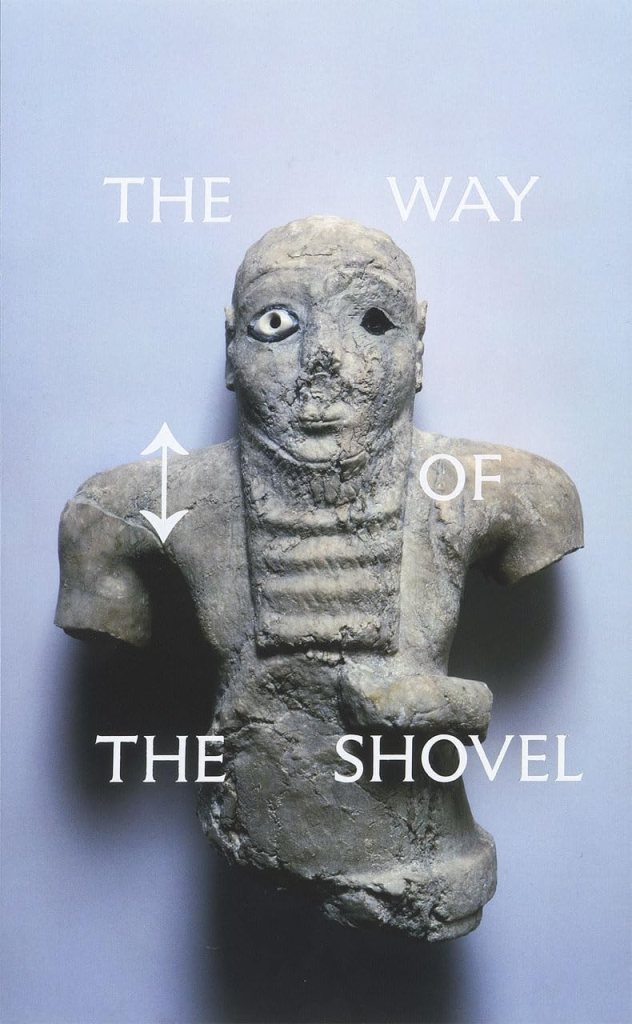
“Contemporary art is often obsessed with the new, but it has recently begun to turn to projects centering on research and delving into archives, all in the name of seeking and questioning historical truth. From filmmakers to sculptors to conceptualists, artists of all stripes are digging into the rubble of the past. In this catalog that accompanies an exhibition at the Museum of Contemporary Art Chicago in the fall of 2013, Dieter Roelstraete gathers a diverse range of international artists to explore the theme of melding archival and experiential modes of storytelling – what he calls “the archaeological imaginary” – particularly in the wake of 9/11. The Way of the Shovel offers a well-constructed balance among excursions into the situation of contemporary art, broad philosophical arguments around the subjects of history and the archive, and cultural analysis. Roelstraete’s opening essay maps the critical terrain, while Ian Alden Russell explores the roots of archaeology and its manifestations in twentieth-century art, Bill Brown examines artistic practices that involve historical artifacts and archival material, Sophie Berrebi offers a critique of the “document” as seen in art after the 1960s, and Diedrich Diederichsen writes on the monumentalization of history in European art. The book features work by both established and young artists, and thoughtful entries by Roelstraete accompany the exhibition catalog, along with statements from artists Moyra Davey, Rebecca Keller, Joachim Koester, Hito Steyerl, and Zin Taylor. The first exhibition to showcase this innovative approach to some of the most intriguing art of the past decade, The Way of the Shovel is indispensable for anyone seeking to understand the forces driving contemporary art.”
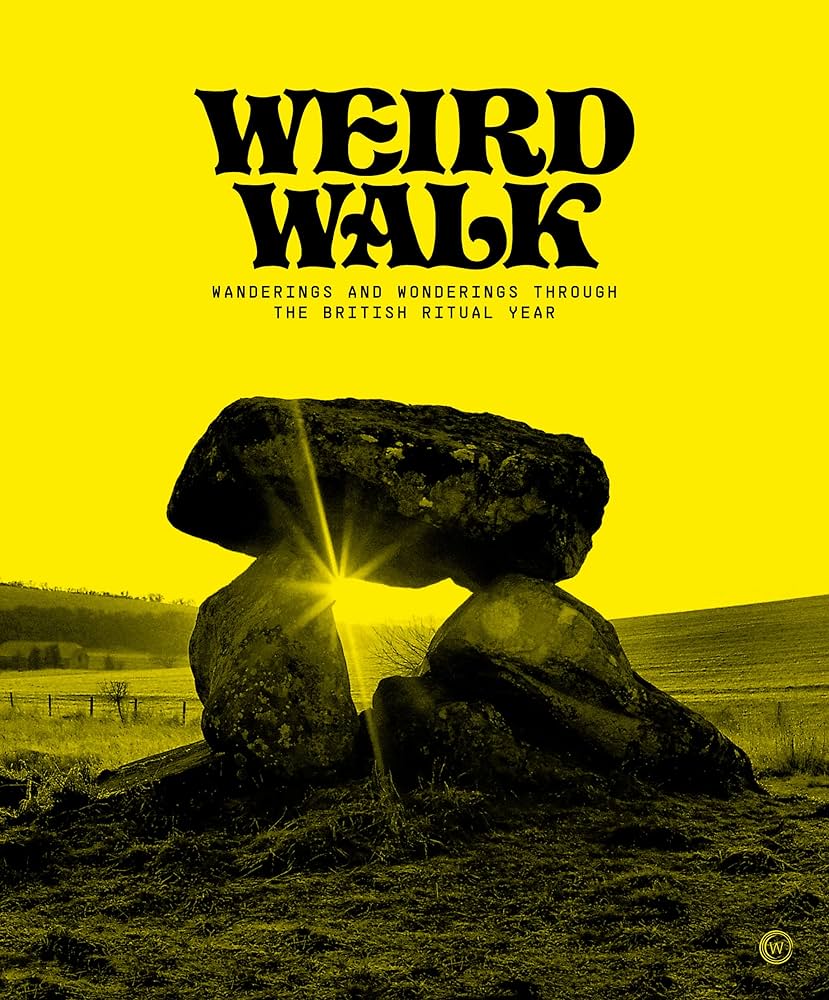
By walking the ancient landscape of Britain and following the wheel of the year, we can reconnect to our shared folklore, to the seasons and to nature. Let this hauntological gazetteer guide you through our enchanted places and strange seasonal rituals. SPRING- Watch the equinox sunrise light up the floating capstone of Pentre Ifan and connect with the Cailleach at the shrine of Tigh nam Bodach in the remote Highlands. SUMMER- Feel the resonance of ancient raves and rituals in the stone circles of southwest England’s Stanton Drew, Avebury and the Hurlers. AUTUMN- Bring in the harvest with the old gods at Coldrum Long Barrow, and brave the ghosts on misty Blakeney Point. WINTER- Make merry at the Chepstow wassail, and listen out for the sunken church bells of the lost medieval city of Dunwich. The first book by iconic zine creators and cultural phenomenon Weird Walk. This is a superbly designed guide to Britain’s strange and ancient places, to standing stones and pagan rituals, and to the process of re-enchantment via weird walking.


 denisestartin.co.uk