Godland

Harshness is transformed into beauty and then terror by this extraordinary film from Icelandic director Hlynur Pálmason about a 19th-century Danish pastor sent to establish a new church on Iceland’s remote south-eastern coast. I left the cinema dazed and elated by its artistry; it is breathtaking in its epic scale, magnificent in its comprehension of landscape, piercingly uncomfortable in its human intimacy and severity. There is such superb compositional sense in the still life tableau shots and the almost archaeological sense of time, creating something deeply mysterious and unbearably sad. There are echoes of Werner Herzog’s Aguirre, the Wrath of God, Roland Joffé’s The Mission, Lisandro Alonso’s Jauja – and even Howard Hawks’s Red River.

Pálmason announces in the opening credits that the story was inspired by the supposed discovery in Iceland of seven glass-plate photographs of people and places taken there at the end of the 19th century. While the claim is a deadpan fiction, his screen has an almost square 1.33:1 aspect ratio, perhaps in honour of the still photograph motif. This smaller-size, in such contradistinction to the movie’s CinemaScope ambition and spectacle, gives a density to the viewing experience.

Elliott Crosset Hove plays Lucas, a highly-strung young clergyman instructed by his bishop to travel to a pioneer community in Iceland (then a Danish dependency), superintend the church-building and install himself as parish priest. Lucas makes this arduous journey first by sea and then overland with horses, taking among his luggage a huge and burdensome cross, climbing mountains and fording rivers with it. But Lucas has a secular-ethnographic project to go with the imperial Christian mission: he dreams of taking the first pictures there, capturing the people with new technology. His cumbersome tripod goes on his back, its three spiked feet poking up behind his head, a version of the points of a crucifix. The camera is Lucas’s ordeal as he visits his stations of the cross.

Driven to the edge of madness by hardship and physical pain, Lucas has a thwarted friendship – or something more – with his translator (Hilmar Gudjónsson), and finally finds an erotic connection with Anna (Vic Carmen Sonne), the daughter of the local parishioner, who takes him in. But his life is dominated by his cantankerous, contemptuous Icelandic guide Ragnar, a tough, weatherbeaten veteran tremendously played by Ingvar Sigurdsson, the cop from Pálmason’s previous film A White, White Day. Palmasón shows that Lucas is humanised and possibly even redeemed by his encounters at journey’s end, particularly his relationship with his quasi-host, the level-headed widower Carl (a shrewdly judged performance from Jacob Lohmann), who is bemused by Lucas’s self-harming decision to come to Iceland in the most difficult way possible, and then suspicious of his potential designs on his eldest daughter. Anna’s younger sister Ida (Ída Mekkín Hlynsdóttir) has an attractively emollient role and her relationship with Lucas is gentle and sweet and brings out the nearest Lucas has to warmth.

The film’s mightiest figure is the implacable Ragnar. Far from helping Lucas across the terrain, Ragnar embodies it; he is the very personification of its hostility. As an Icelander, he hates the high-handed Dane with his book-learning. Lucas comes in turn to hate and fear him. And yet Pálmason shows that Ragnar softens imperceptibly even as he sabotages Lucas; he needs someone to confess his terror of God to while exorcising a lifetime of buried rage. In Godland, these emotions are projected out on to the stunning, daunting landscape to the accompaniment of spine-meltingly beautiful choral music. That austere, boxy screen looks like a window on to a vast, unfathomable world.

https://www.theguardian.com/film/2023/apr/05/godland-review-hlynur-palmason (accessed 08/12/23)

Currently Reading

Deep maps are finely detailed, multimedia depictions of a place and the people, buildings, objects, flora, and fauna that exist within it and which are inseparable from the activities of everyday life. These depictions may encompass the beliefs, desires, hopes, and fears of residents and help show what ties one place to another. A deep map is a way to engage evidence within its spatio-temporal context and to provide a platform for a spatially-embedded argument. The essays in this book investigate deep mapping and the spatial narratives that stem from it. The authors come from a variety of disciplines: history, religious studies, geography and geographic information science, and computer science. Each applies the concepts of space, time, and place to problems central to an understanding of society and culture, employing deep maps to reveal the confluence of actions and evidence and to trace paths of intellectual exploration by making use of a new creative space that is visual, structurally open, multi-media, and multi-layered.

Utopia – Sir Thomas More

Text by Cristina Acuna and Reagan Bleasdell

“Sir Thomas More was the first person to use the term “utopia,” describing an ideal, imaginary world in his most famous work of fiction. His book describes a complex community on an island, in which people share a common culture and way of life (“16th Century Dreams: Thomas More”). The term he coined derives from the Greek word ou-topos meaning “nowhere,” (“Utopia Summary”). Ironically, it is the opposite of the similar-sounding Greek word eu-topos meaning “a good place,” (“Utopia Summary”). At its heart, the book poses the question of whether there could ever be such a thing as a “perfect” world and served as a platform to highlight the chaos of European politics at the time.”Sir Thomas More was the first person to use the term “utopia,” describing an ideal, imaginary world in his most famous work of fiction.

The book, written in 1516, is More’s attempt to suggest ways to improve European society, using “Utopia” as an example. More was a major figure of the English Renaissance who cared deeply about the moral and political responsibilities of individuals. He eventually rose to one of the highest offices in the land, and, as chancellor of England in 1529, came up against his own king with disastrous consequences. More strongly opposed Henry VIII’s separation from the Catholic Church and refused to sign the Oath of Supremacy, which would give King Henry more power than the Pope. He was convicted of treason and was imprisoned in the Tower of London. They continued to urge him to sign the oath, but he refused. He was sentenced to be hanged, drawn, or quartered, the usual punishment for traitors, but the king commuted this to execution by decapitation. While on the scaffold, he declared that he died, “The king’s good servant, and God’s first” (qtd. in “Thomas Moore” Wikipedia).

The society depicted in Utopia differs from the European society that Thomas More was living in at the time, one rife with intrigue, corruption and mired by scandal. The author’s experience with politics in his time and the Utopia that he invented demonstrates this contrasting relationship: Utopia is communal, allowing its people to easily meet their needs, while European society is described as a place where, “Idle monarchs and nobles seek to increase their own wealth and power at the expense of the people, who are left in poverty and misery” (“Utopia: Theme Analysis”). Clearly dissatisfied with the world he was living in, More sought to create a different place altogether on the page—a world free of the hierarchies that ultimately cost the author his life.”

Text reproduced from https://pressbooks.pub/earlybritishlit/chapter/sir-thomas-more-utopia/ (accessed 25/10/23) Image reproduced from https://www.britannica.com/topic/Utopia-by-More (accessed 25/10/23)

Currently reading

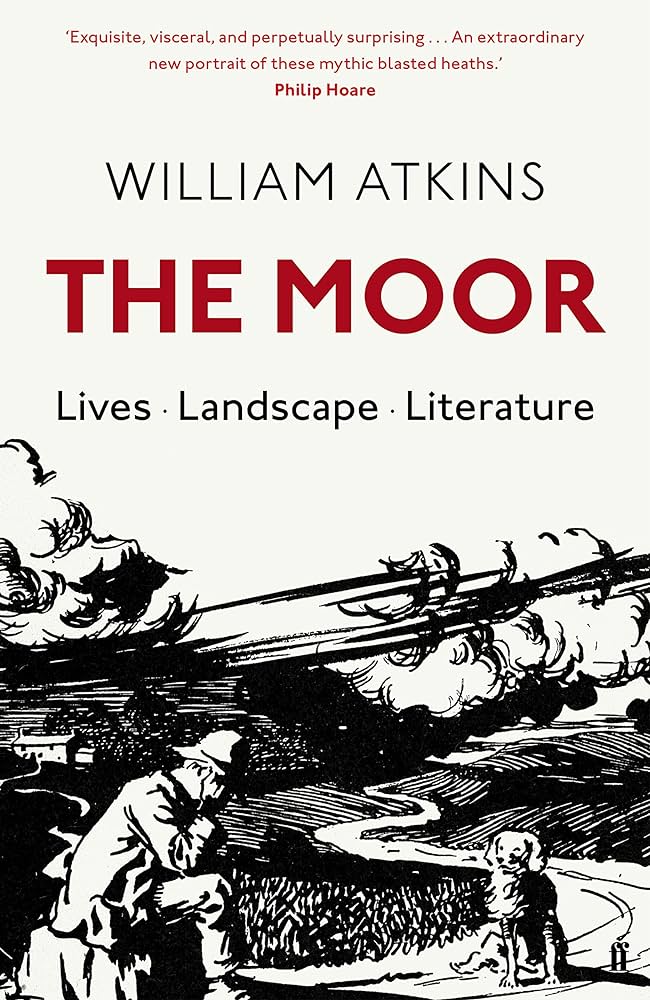
In this journey across England’s most forbidding and mysterious terrain, William Atkins takes the reader from south to north, exploring moorland’s uniquely captivating position in our history, literature and psyche. Atkins’ journey is full of encounters, busy with the voices of the moors, past and present. He shows us that, while the fierce terrains we associate with Wuthering Heights and The Hound of the Baskervilles are very human landscapes, the moors remain daunting and defiant, standing steadfast against the passage of time.

Poly-Olbion

William Hole’s frontispiece (from the Folger Shakespeare Library [http://luna.folger.edu/luna/servlet/s/7ihql3])

“Poly-Olbion is an expansive poetic journey through the landscape, history, traditions and customs of early modern England and Wales. Originally published in two parts (1612, 1622), it is also a richly collaborative work: Michael Drayton’s 15,000-line poem, which navigates the nation county by county, is embellished by William Hole’s thirty exquisite engraved county maps, and accompanied for its first eighteen ‘songs’ by the young John Selden’s remarkable prose ‘Illustrations’. Drayton was a close associate of Shakespeare and Ben Jonson, and his Poly-Olbion crystallizes early modern ideas of nationalism, history and memory.”

Image and text reproduced from https://poly-olbion.exeter.ac.uk/ (accessed 09/07/23)