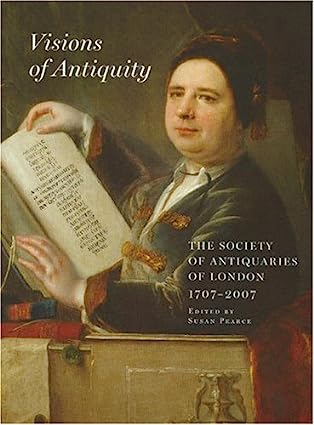
Visions of Antiquity

So I’m having to do some fairly niche reading for my PhD, which starts in October, since I am investigating a concept from the 16th-17th centuries although it’s provenance is much older than that and begins with Ptolemy’s Geographia (149AD). I am tracing it’s roots and development through British History and Antiquarianism (the historical precursor to Archaeology) which flourished in the 17th century and was part of an epic effort to map Britain, one famous example being William Camden’s Brittania (1586). With its overriding pre-occupation with place Camden’s Brittania, arranged chronologically, is a county-by-county survey of England & Wales which travels from the South to the North and represents a new ‘topographical-historical method’ (Mendyk 1986 cited in Rohl 2011: 22).

The book articulates the image of the antiquary in 17thC England, it’s relation to the graphic arts, art and antiquity in the long 19th Century, the interpetation of ancient objects, prehistory in the 19thC, nineteenth-century antiquarian culture and the project of archaeology, antiquaries and conservation of the landscape, grand excavation projects of the twentieth century and antiquaries and the professionalization of archaeology.

I am hard at work on my Bibliography and see some exciting trips to the Bodleian library, Oxford in the future.

Key words: antiquarian, antiquities, archaeology, barrow, conservation, culture, England, excavation, landscape, place, history

A Perambulation of Kent

“A Perambulation of Kent is the first English county history. It was written by William Lambarde, an Elizabethan antiquarian and lawyer. Lambarde wrote the text in 1570 but it was not printed until 1576. The book describes a journey through Kent and describes the antiquities of the county and its influence on English history. The text also includes a copy of Lambarde’s map of the ‘Heptarchy’ or the kingdoms of Anglo-Saxon England that he had first included in a collection of Anglo-Saxon laws he published in 1568.”

Text reproduced from https://www.rct.uk/collection/1072284/perambulation-of-kent, image reproduced from https://www.stellabooks.com/publisher/adams-amp-dart (accessed 13/06/23)

Currently Reading

Making Place, Making Self explores new understandings of place and place-making in late modernity, covering key themes of place and space, tourism and mobility, sexual difference and subjectivity. Using a series of individual life stories, it develops a fascinating polyvocal account of leisure and life journeys. These stories focus on journeys made to the North Cape in Norway, the most northern point of mainland Europe, which is both a tourist destination and an evocation of a reliable and secure point of reference, an idea that gives meaning to an individual’s life. The theoretical core of the book draws on an inter-weaving of post-Lacanian versions of feminist psycho-analytical thinking with phenomenological and existential thinking, where place-making is linked with self-making and homecoming. By combining such ground-breaking theory with her innovative use of case studies, Inger Birkeland here provides a major contribution to the fields of cultural geography, tourism and feminist studies.

Text and image reproduced from https://www.amazon.co.uk/Making-Place-Self-Subjectivity-Difference/dp/1138255238 (accessed 04/06/23)

Currently Reading

“Since 1857, hardly a year has gone by without some sort of Brontë ‘biography’ appearing. These range from pious accounts in Victorian conduct books to Freudian pyschobiographies, from plays, films and ballets to tourist brochures and images on tea-towels, from sensation-seeking penny-a-liners to meticulous works of sober scholarship. Each generation has rewritten the Brontës to reflect changing attitudes – towards the role of the woman writer, towards sexuality, towards the very concept of personality. The BrontëMyth gives vigorous new life to our understanding of the novelists and their culture and Lucasta Miller reveals as much about the impossible art of biography as she does about the Brontës themselves.”

Text reproduced from https://www.amazon.co.uk/Bronte-Myth-Lucasta-Miller/dp/0099287145/ref=sr_1_1?crid=JRQVJMGQ82N&keywords=the+bronte+myth&qid=1682966752&sprefix=the+bronte+myth%2Caps%2C684&sr=8-1 (accessed 01/05/23)

PhD Research

Poems – by Currer, Ellis & Acton Bell is a collection of poetry written by the literary sisters Emily, Charlotte, and Anne Brontë. Published in 1846 under the pseudonyms Currer (Charlotte), Ellis (Emily), and Acton (Anne) Bell, it only sold three copies when first published. After the success of their later works, the poems have since garnered more attention and acclaim. The Brontë sisters consisted of Charlotte (1816-1855), Emily (1818-1848), and Anne (1820-1849), who belonged to a nineteenth-century literary family associated with the village of Haworth in the West Riding of Yorkshire, England. The sisters are most famous for their novels, namely Charlotte’s “Jane Eyre”, Emily’s “Wuthering Heights”, and Anne’s “The Tenant of Wildfell Hall”, each an irrefutable classic of English literature. Contents include: “Mementos”, “The Wife’s Will”, “Gilbert”, “Life”, “The Letter”, “Regret”, ” Presentiment”, “The Teacher’s Monologue”, “Passion”, “Preference”, “Evening Solace”, “Stanzas”, “Parting”, “Faith And Despondency”, “Stars”, “The Philosopher”, “Remembrance”, “A Death-Scene”, “Song”, “Anticipation”, “The Prisoner”, etc. Complete with biographical notes of Emily and Anne Brontë by their sister Charlotte Brontë, along with an Essay by Virginia Woolf on the Brontë Family Home, Haworth.