The Gough Map

The Gough Map

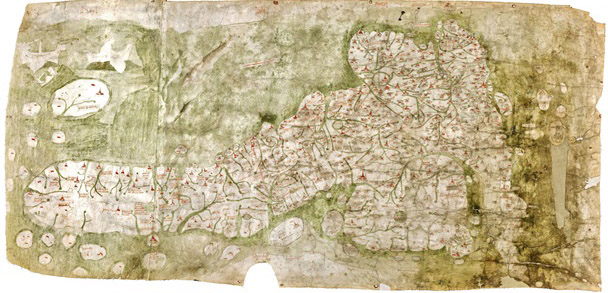
“The printer and publisher John Nichols described Richard Gough in a long tribute after his death as ‘the Father of British Topography’. More recently scholars have recognised him as the leading antiquary of his day. Gough was one of the first to recognise the importance of old maps in helping to understand the history of particular places and wrote a pioneering account of the development of British maps in the second edition of his British Topography (1780). This is the oldest map of Britain at the Bodleian Library, Oxfordshire (exact date unknown, approx. 14th Century). In addition, the topographical collection bequeathed by Gough to Oxford University in 1809 is one of the most important in the Bodleian Library, outstanding for the visual material received as well as the printed books and manuscripts. Among the maps is the earliest depiction of Britain in recognisable form (now known as the Gough Map) and large portions of the unique Sheldon tapestry map woven in the 1590s.

His Anecdotes of British Topography (1768) was the first comprehensive national bibliography of the subject and a remarkable achievement for one individual. It provided a gazetteer of sources relating to the local history and antiquities of each county, covering not just printed books and manuscripts but also maps and illustrations often with comments about dates, artists and when he acquired items. An enlarged second edition in two volumes was published in 1780 under the title of British Topography. Gough was one of the first to recognise the importance of old maps in helping to understand the history of particular places and wrote a pioneering account of the development of British maps in the second edition of his British Topography (1780).”

Text and image reproduced from https://www.bl.uk/picturing-places/articles/richard-gough-the-father-of-british-topography (accessed 21/07/23)

References for further research:

1] Richard Gough, British Topography. Or, an Historical Account of what has been done for Illustrating the Topographical Antiquities of Great Britain and Ireland, London, J. Nichols and T. Payne, 1780. The completed part of the 3rd edition was destroyed in 1808 by a fire in Nichol’s printing works. However the Bodleian has a copy of the 2nd edition with useful later additions by Gough (Gough Gen.Top. 363–5).

2] Peter Barber, ‘King George III’s topographical collection: a Georgian view of Britain and the world’, in Kim Sloan and Andrew Burnett (eds), Enlightenment: Discovering the World in the Eighteenth Century, London, British Museum, 2003, pp. 158–65.

 3] The most useful guide to Gough’s topographical drawings is Maurice Barley, A Guide to British Topographical Collections, [London], Council for British Archaeology, 1974, pp. 95–8.

Deep Mapping and the spatial turn

Archaeological plan of the sanctuary of Asklepios on Kos (Kiapokas 1999, 164) superimposed on a satellite image.

“There are ten things that I can say about these deep maps.

First. Deep maps will be big – the issue of resolution and detail is addressed by size.

Second. Deep maps will be slow – they will naturally move at a speed of landform or weather.

Third. Deep maps will be sumptuous – they will embrace a range of different media or registers in a sophisticated and multilayered orchestration.

Fourth. Deep maps will only be achieved by the articulation of a variety of media – they will be genuinely multimedia, not as an aesthetic gesture or affectation, but as a practical necessity.

Fifth. Deep maps will have at least three basic elements – a graphic work (large, horizontal or vertical), a time-based media component (film, video, performance), and a database or archival system that remains open and unfinished.

Sixth. Deep maps will require the engagement of both the insider and outsider.

Seventh. Deep maps will bring together the amateur and the professional, the artist and the scientist, the official and the unofficial, the national and the local.

Eighth. Deep maps might only be possible and perhaps imaginable now – the digital processes at the heart of most modern media practices are allowing, for the first time, the easy combination of different orders of material – a new creative space.

Ninth. Deep maps will not seek the authority and objectivity of conventional cartography. They will be politicized, passionate, and partisan. They will involve negotiation and contestation over who and what is represented and how. They will give rise to debate about the documentation and portrayal of people and places.

Tenth. Deep maps will be unstable, fragile and temporary. They will be a conversation and not a statement.”

Text reproduced from Clifford McLucas http://documents.stanford.edu/MichaelShanks/51 (accessed 04/05/23)

Image reproduced from http://deepmappingsanctuaries.org/deep-mapping/ (accessed 04/05/23)

Currently Reading – Nadja, André Breton

Léona Delcourt (Nadja), 1920s. Source: Jacques Rigaut

“One of the most iconic works of the French surrealist movement begins with the question “Who am I?

It is based on Breton’s actual interactions with a young woman, Nadja (actually Léona Camille Ghislaine Delacourt 1902–1941),[1] over the course of ten days, and is presumed to be a semi autobiographical description of his relationship with a patient of Pierre Janet. The book’s non-linear structure is grounded in reality by references to other Paris surrealists and includes 44 photographs.

The narrator, named André, ruminates on a number of Surrealist principles, before ultimately commencing on a narrative account, generally linear, of his brief ten-day affair with the titular character Nadja. She is so named “because in Russian it’s the beginning of the word hope, and because it’s only the beginning,” but her name might also evoke the Spanish “Nadie,” which means “No one.” The narrator becomes obsessed with this woman with whom he, upon a chance encounter while walking through the street, strikes up conversation immediately. He becomes reliant on daily rendezvous, occasionally culminating in romance (a kiss here and there). His true fascination with Nadja, however, is her vision of the world, which is often provoked through a discussion of the work of a number of Surrealist artists, including himself. While her understanding of existence subverts the rigidly authoritarian quotidian, it is later discovered that she is mad and belongs in a sanitarium. After Nadja reveals too many details of her past life, she in a sense becomes demystified, and the narrator realizes that he cannot continue their relationship.

In the remaining quarter of the text, André distances himself from her corporeal form and descends into a meandering rumination on her absence, so much so that one wonders if her absence offers him greater inspiration than does her presence. It is, after all, the reification and materialization of Nadja as an ordinary person that André ultimately despises and cannot tolerate to the point of inducing tears. There is something about the closeness once felt between the narrator and Nadja that indicated a depth beyond the limits of conscious rationality, waking logic, and sane operations of the everyday. There is something essentially “mysterious, improbable, unique, bewildering” about her; this reinforces the notion that their propinquity serves only to remind André of Nadja’s impenetrability. Her eventual recession into absence is the fundamental concern of this text, an absence that permits Nadja to live freely in André’s conscious and unconscious, seemingly unbridled, maintaining her paradoxical role as both present and absent. With Nadja’s past fixed within his own memory and consciousness, the narrator is awakened to the impenetrability of reality and perceives a particularly ghostly residue peeking from under its thin veil. Thus, he might better put into practice his theory of Surrealism, predicated on the dreaminess of the experience of reality within reality itself.”

Text quoted from https://en.wikipedia.org/wiki/Nadja_(novel) (accessed 28/11/22)

Image reproduced from https://artandthoughts.fr/2014/02/06/andre-bretons-nadja/ (accessed 28/11/22)

The Contingent Object

Richard Serra. Joe: Torqued Spiral, 2000. Weatherproof steel. 13 ½ x 45 x 36 ½ feet. Plate thickness: 2 inches. Collection of the Pulitzer Foundation for the Arts, Saint Louis. Photo by Dirk Reinartz. © 2008 Richard Serra/Artists Rights Society, New York.

Abstract forms and spatial experience

The function of copying or transcription

The play between abstraction and representation,

Equivalents – Fall

Artifacts and relics.

The cast and the copy; a function of authorship and reproduction.

Participation as a function of the original

Participation as an act of design or arrangement

Participation as a challenge to authority,

Participation as a vehicle for heterogeneity

Avalanche

Or performance

Of the fragmented mark

Of the symbolic equivalent

Of play between absence and presence

Performing the failure of the mark or trace of bodily action

The Shadow [Detective]

Fingerprint

The Shadow [Detective] collecting commodities and subjects as a basis for subsequent practices.

Slumber

Reproduction as a basis for quotation and reference

Reproduction as mediation and transformation of

Perpetual Photos and Plaster Surrogates

Originals decay or deteriorate.

Mortar and Pestle

Diagrams construct an ephemeral site in place of the object

Diagrams as a form of delay

Diagrams as a form of intent:  

Viewing Matters, Face to Face in the Public Toilets

‘May I Help You?’

‘Yes, I would like a bag of donuts and 3 urinals please.’

 ‘Not Here’

Avalanche

Lick, Lather and Gnaw at impermanence as the index

Lick, Lather and Gnaw at the contingent object

Lick, Lather and Gnaw at the experience

Lick Lather and Gnaw at the material evidence of authenticity

Gnaw at organic materials

Gnaw at chocolate, lard and soap

And yet still there looms a galvanized iron wall and a straight single tube where there dances the

Preserved Head of a Bearded Woman decorated with a String of Puppies

Puppies which need a lot of care and attention

What is this Strange Fruit [for David]?

Painted Bronze, Fountain Meltdown

The scrap metal process separates idea from material truth: an Island within an Island

No amount of Litanies can stop this Statement of Esthetic Withdrawal

The artist’s hand now becomes an object of desire along with Neon Templates of the Left Half of My Body Taken at Ten-Inch Intervals.

Drowned Monuments and Shared Fate; a function of external evidence like Every Building on the Sunset Strip

Short Circuit – Casting, Splashing, Torqued Ellipses

a simple ‘verb list’

Remade readymades,

Readymade readymades

Eureka!

Image reproduced from https://imagejournal.org/article/gravity-and-grace/ (accessed 25/11/22)

Currently Reading

“Placeways is a philosophical and historical interpretation of the experience and meaning of place. Searching for a way of knowing and living in the world that does not fragment experience or exploit the environment, E. V. Walter explores the way people in other cultures and other times have experienced place. The book develops Walter’s theory of topistics – a holistic way of grasping a place as the location of shapes, powers, feelings, and meanings. Exploring the common ground of such diverse fields as philosophy, history, urban planning, classics, cultural geography, architecture, sociology, and environmental psychology, Walter provides theoretical resources for readers who want to rescue the human environment from the loss of feeling and meaning. Walter discusses a wide variety of places, from prehistoric caves, the Australian desert, and classical Greece to medieval towns, Renaissance cities, and modern slums. He examines the changing realities of expressive space and reveals the nonrational, symbolic, and intuitive features in our experience of places – elements taken for granted by archaic peoples but discounted by modern civilization. The current crisis of environmental degredation, according to Walter, is also a crisis of places. For the first time in human history, people are systematically building meaningless places. If we are to comprehend and reverse the ruin and dislocation of our cities, we must develop another way of understanding the built environment and the natural landscape. True renewal, Walter says, will require a change in the way we structure experience and a return to an ancient paradigm for understanding both the natural land and the constructed world.”

Text and image reproduced from https://www.amazon.co.uk/Placeways-Theory-Environment-V-Walter/dp/0807842001 (accessed 01/10/22)