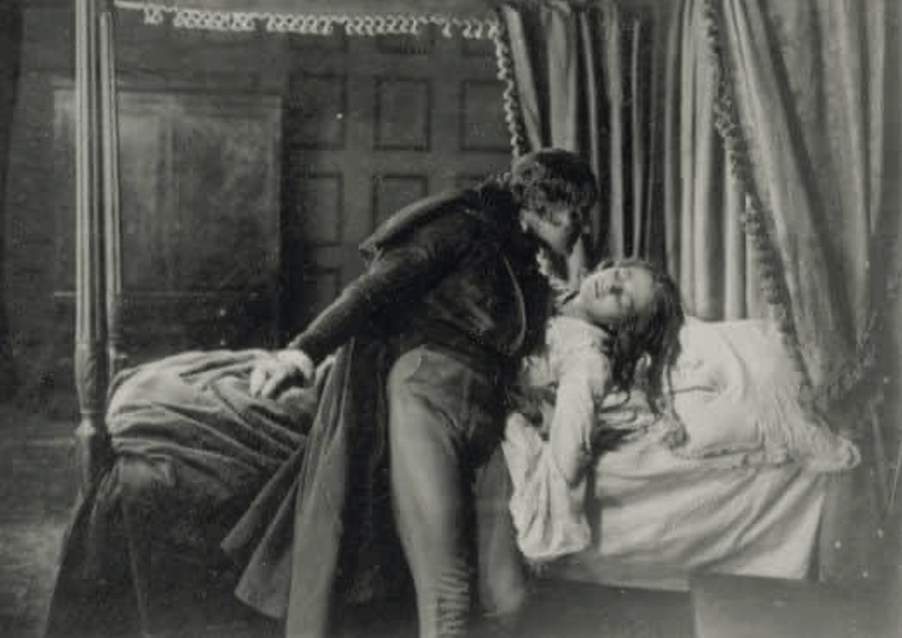
Thesis Preface: Mnemonic Residues-The Curated Ruin as Fictional Trace

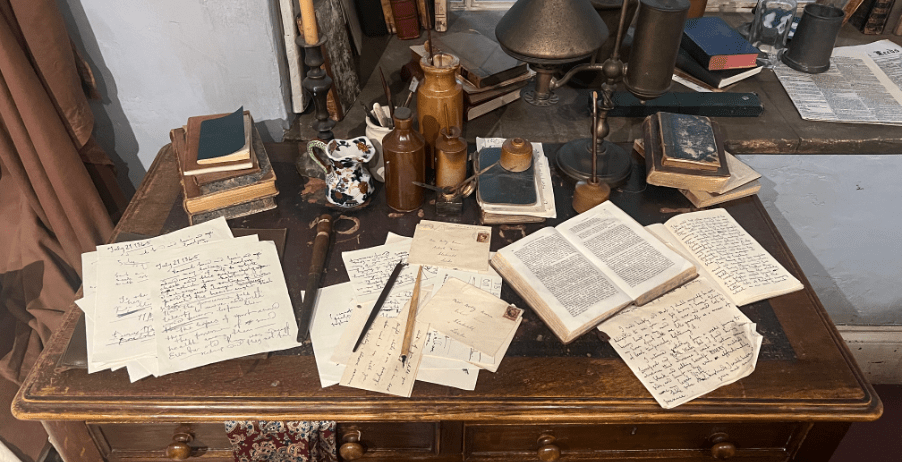
Fig. 1: Film Still, Letters to the Landscape, 2025, Episode 1 Epistles, Branwell Brontë’s Desk, Installation by Simon Armitage, Brontë Parsonage Museum

Fig.1 depicts Branwell Brontë’s desk at the Parsonage, part of Simon Armitage’s installation.

The desk is presented not merely as an archival object, but as a curated scene.

While Emily Brontë’s writing desk inspired this project, its modest size and protective casing rendered it visually elusive. In contrast, Branwell’s desk is prominent, cluttered, tactile, and performative. It transforms the archive into an encounter, where memory is actively constructed rather than simply preserved.

However, this is not strictly Branwell’s desk. It serves as a symbolic object, representing both a failed legacy and a speculative presence. The surrounding items are deliberately arranged, their authenticity uncertain. What matters is not whether they are real, but what they perform: a residue of ambition, a trace of authorship unmade.

The desk functions as a surrogate archive, a site where silence is staged, absence made visible. It embodies not Branwell himself, but the concept of Branwell, a mnemonic placeholder in literary history.

My entire PhD could be characterised as an attempt to crack open this image—to deconstruct its rhetoric of display, interrogate the politics of preservation, the aesthetics of collecting, and the archive’s desire to hold what cannot be kept, to capture what cannot be retained.

This is where the work begins…

Let us go you and I, let us begin by walking, together, into the landscape.

The wind on the moor carries more than weather, it carries memory, sediment, and the ghostly residue of letters never sent…

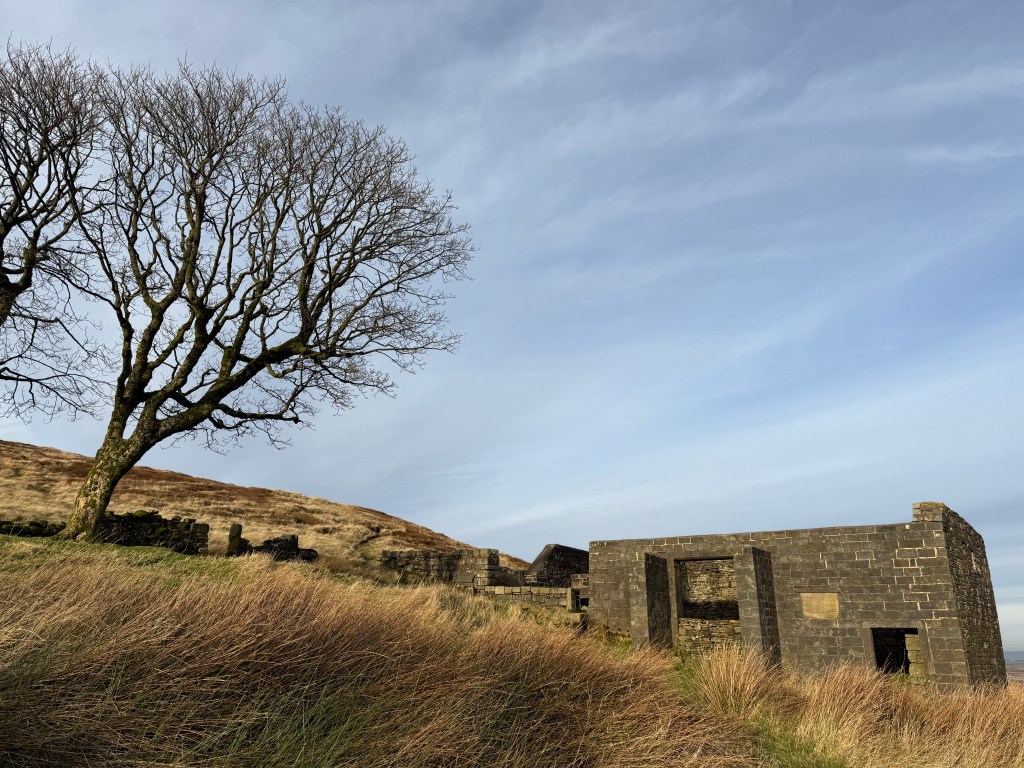
Fig.2 Top Withens, reputed site of Wuthering Heights (1847), photograph by Samuel Vale

Dispatches 03/02/2024: Today, there is a 65% chance of precipitation. The temperature is 5 degrees, but it feels like 2. The wind direction is South, at a speed of 9 miles per hour. Humidity is at 73% and visibility is very good. The sun rose at 7.39 am and set at 4 pm.

This is how the day began, A weather report. A mood. A trace.

It’s not just data, it’s atmosphere. It sets the tone for a fieldwork that is not simply visual but experiential, even visceral. Not evidentiary, but affective.

In Letters to the Landscape (2025), I return to Brontë Country not to recover a lost past, but to trace the gesture of its dispersal.

This thesis begins with a walk: a slow, deliberate movement through terrain marked by literary inheritance and vernacular forgetting. The film, composed of fragments, postcards, voiceovers, and archival stills, does not seek to reconstruct history, but to perform its dislocation. Through a speculative feminist lens, I engage with the archive not as a repository, but as a site of haunting and (re)collection. Drawing on Derrida’s notion of spectrality (1994) and Schneider’s theory of the explicit body (1997), I ask: What remains when the archive is touched, not read? What kinds of knowledge emerge when history is felt rather than narrated?

These provocations set the stage for a research journey that is as much about unearthing as about unsettling, as much about absence as about presence.

These fragments, objects, weather, walk, and archive embody the approach this thesis will take, moving between the material and the imagined, the evidentiary and the affective, the archive and the field, they set the mood and method for what follows. In what remains of this introduction, I move from the poetics of encounter to the conceptual and methodological frameworks that underpin this research.

From here, I turn to map the conceptual terrain, outlining the research questions, and situating my practice within the intersecting traditions of chorography, speculative feminist historiography, and creative fieldwork. The following section introduces the research context and background, main aims, themes, and structure of the thesis, and describes how the performative and speculative methods evoked here will be developed throughout its sections and into Brontë Country and beyond.

This is also where the work begins…

Episode 2: To Have and to Hold

I found a lock of hair in a glass case. The label said ‘Believed to be Emily’s’. Not Emily Brontë’s hair. Not a lock of hair. But hair, possibly Emily’s. The uncertainty is the most honest part. I think about the word believed, as if belief could bind the strands of hair to her scalp, as if glass could hold the heat of her breath. I hold it in my mind like a relic, a relic of a relic. Does the history of myself become parallel with the history of the object kept? What is this hinge or bridge that one builds to become the self that is now? I read Charlotte’s letters. I read Gaskell’s biography. I read the footnotes. I wonder how many women have been footnoted out of their own stories?

[Emily writes] She writes: “I have dreamed in my life, dreams that have stayed with me ever after, and changed my ideas; they have gone through and through me, like wine through water, and altered the colour of my mind.” I wonder if the same is true of objects. If they pass through us, staining the mind, altering the hue of memory. I wonder what Emily would have thought of her life behind glass. I wonder if Wuthering Heights was her own collection — of storms, of silences, of things too wild to hold. She never wanted to be seen, she wanted to vanish into the moor. And yet here she is, pinned like a butterfly. This is the trap: an anterior document, a document created to sustain an image, an image contained in a scene, a scene without a referent. What is occurring in this falling in together, apart, away?

There is a desire to recuperate the forgotten, the abandoned, the fragmentary, the lost but it is a fool’s errand. I am both wild goose and chase. I wonder if collecting is a form of violence or is it a form of love? The human heart has hidden treasures, in silence sealed, in secret kept. Surely to collect is to love without reciprocity, to name without being known, to hold without being held. But the collection is not a sanctuary, it is a séance, a summoning of what refuses to stay buried. The photograph is torn, the letter is foxed, the lock of hair curls like a question mark. Even the archive has a body and it is failing. I hold a stone from the path to Top Withens, it feels like a breath caught in the throat. It fits in my palm like a secret. Or a wound. Or a promise I can’t keep. I don’t know if it’s hers. I don’t know if it’s mine. But I keep it. To have. To hold. To lose. And still, it slips through.

Letters to the Landscape 2025 – About

Letters to the Landscape 2025: Title Image

Letters to the Landscape is an epistolary dialogue and travelogue exploring the relations between Brontë Country and Emily Brontë’s Wuthering Heights (1847). The artist uses various strategies of production including polyphony, narrative, autobiography, fact and fiction and the intimate to interrogate authorship, authenticity, and the role of narrative and collections in shaping cultural memory. This cinematic essay incorporates postcards, letters, pinhole photography, digital photography, found images, found texts and Super 8. The script is non-linear and hangs together as a series of episodes or meditations and incorporates other writers and voices including J.G Ballard, René Daumal, actress Merle Oberon, Elizabeth Gaskell, Charlotte Bronte’s biographer and Emily Brontë to name a few. The work has been constructed and fabricated through the interaction of several pseudonyms who constitute the research team and the film crew, operating under the fictional artist duo Vale & Howlette. Adopting these dramatis personae in a broader narrative framework, Vale & Howlette become primary characters in a narrative that explores the performance of identity through ideas of place, history, travel, time and memory. This body of work is entitled The Chronicles of Vale & Howlette (2021 to date). The fictional artist duo Vale & Howlette interrogate authorship and authenticity, the work explores how identity, place, and memory are performed and constructed through a multi-media approach incorporating narrative, image, collections and the archive.

The work is initiated through a fictional conceit as the response to a ‘found’ collection of old photographic equipment (utilised in the film), personal letters and photographs and over 300 postcards of Brontë Country which are used both for the fieldwork and to punctuate the films episodic narrative. This series of episodes or meditations include episode 1: Epistles, a meditation on the epistolary and the act of letter writing, Episode 2: To Have and to Hold is a meditation on the collection and the act of collecting, Episode 3: A Reluctant Pilgrim is a meditation on the journey to Top Withins (reputed inspiration for Wuthering Heights, Emily Brontë, 1847). Episode 4: A Lovers Spat re-imagines and re-writes the relationship between the two main protagonists in Wuthering Heights, Cathy & Heathciff and Episode 5 is a personal meditation on the act of dying which also symbolically represents the death of the female protagonist, Cathy in Wuthering Heights and the death of Emily Brontë. By foregrounding the fictional personas of Vale & Howlette, the work invites audiences to question the boundaries between fact and fiction, artist and character, author and place. It invites reflection on how artistic practice can be used to question historical narratives and reimagine place-based storytelling through the act of collecting.

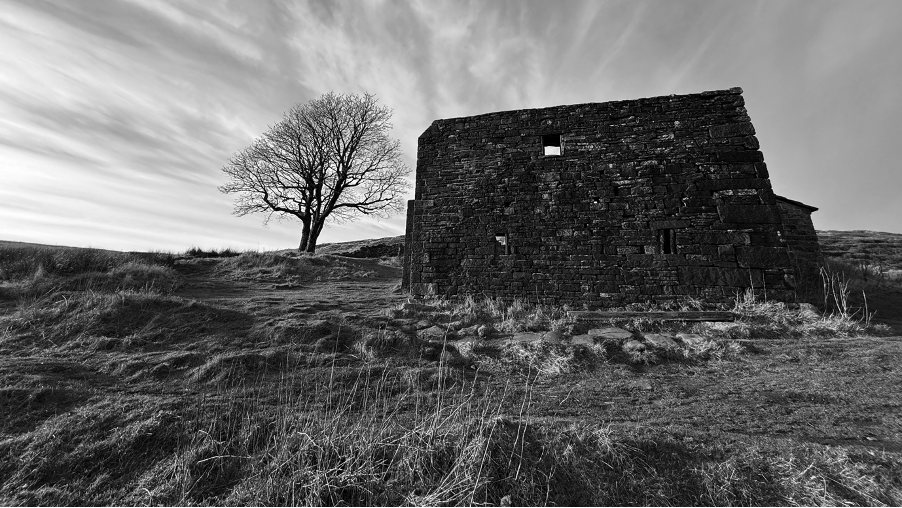
Still Image from film Introduction
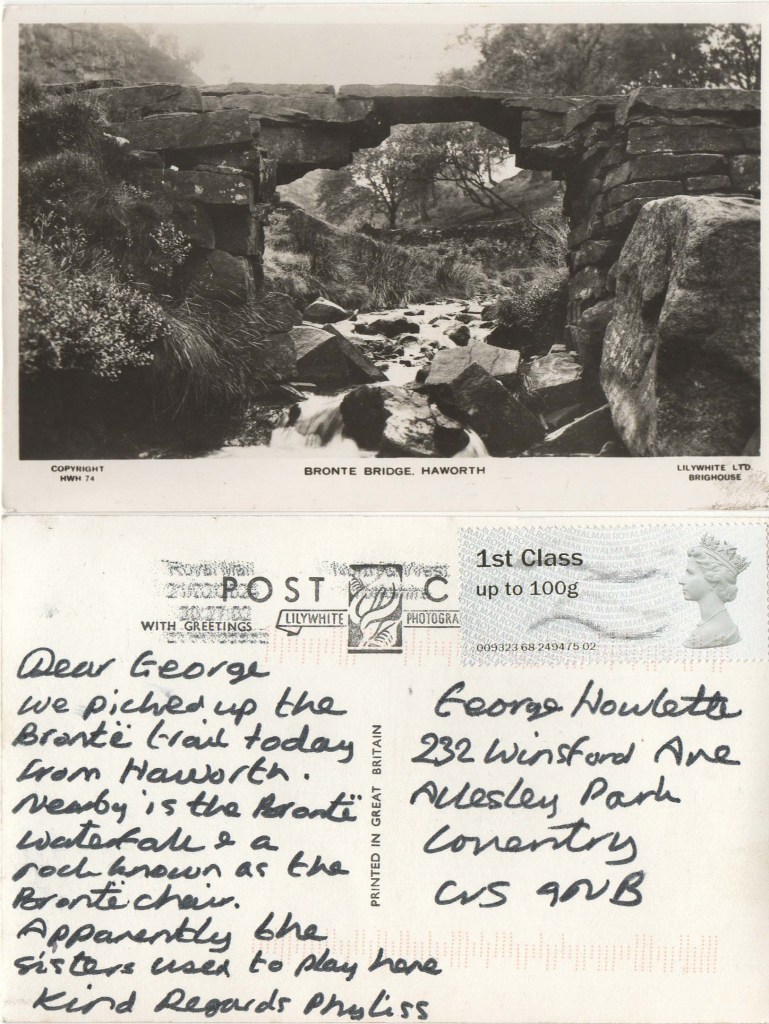
Film still Postcard Fieldnote from Phyliss Dare, the pseudonymous fieldworker and scriptwriter to George Howlette, the pseudonymous Director