
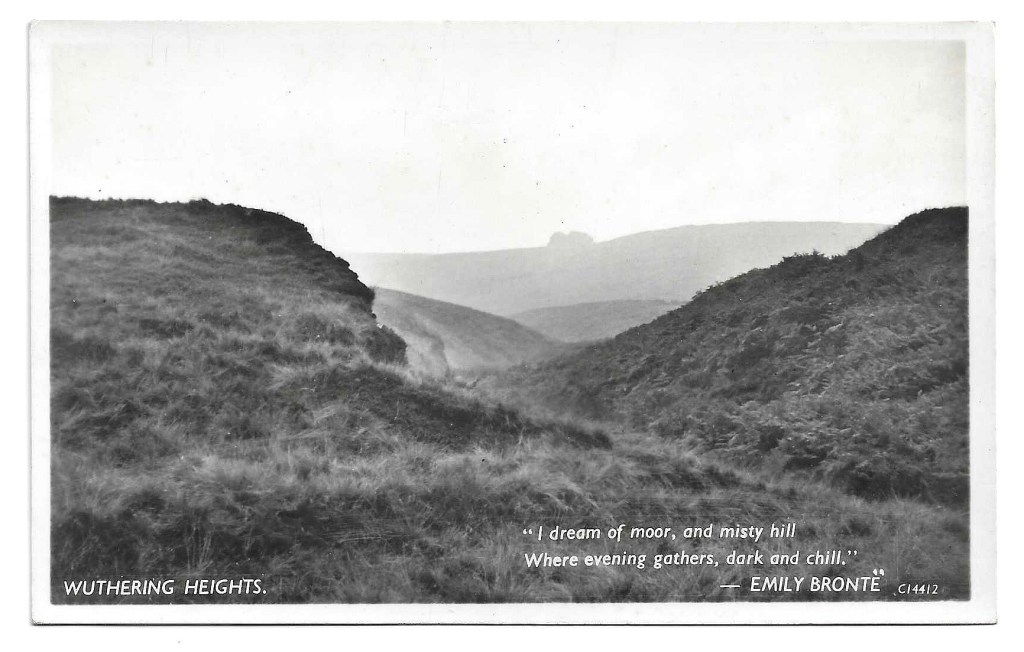
Rocky Valley, Yorkshire Moors

“Footsteps (2022) is a 97-minute video installation made by Fiona Tan at the invitation of Amsterdam’s Eye Filmmuseum. The work combines archival film footage from the museum’s collection with a voiceover of letters written to the artist by her father while she was a student in the late 1980s. Tan added a soundtrack to the film material that reflects the action and events taking place, bringing the century-old footage to life. As we listen to the artist’s father (voiced by actor Ian Henderson) write about the fall of the Soviet Union, civil unrest in China, and the everyday lives of the artist’s relatives in Australia, we watch men and women toil the land and harvest the sea, we see cows in the field and old men smoking pipes, sailboats moving across the horizon, and the emergence of industry and urbanisation.
Assembled from hundreds of hours of footage spanning 1896 to the late 1920s, Footsteps begins with the haunting sound of a church bell accompanied by a sequence of moving images: sun and clouds, a crowd on a beach, a young girl in traditional Dutch dress, vividly hand-coloured, and the gloomy churn of the sea. Soon we hear the voice of a man utter ‘August 2nd, 1988’, a date that is almost a century after the earliest footage in the film, followed by the first of the letters from Tan’s father. A tapestry of life in early twentieth-century Netherlands unfolds, after about 30 minutes we witness the rise of factories and technology on an industrial scale, the inevitable creep of modernity. The film portrays a society being overwhelmed by enormous, relentless machines and the need to feed and service them. The letters to the artist from her father discuss their family, the global political situation, his own memories of learning Dutch geography and history while growing up in Indonesia while also encouraging the young Fiona Tan as she goes through periods of self-doubt.
Although the footage captures a nation as it makes a transition from an agrarian to an industrial society, what emerges from the film is not a portrait of the Netherlands at the dawn of modernity nor an autobiography of the artist, but a poignant study of how anyone might contend with political and technological change. Although the letters are intimate, they are also as historically compelling as the archival footage. The juxtaposition of the personal and global invites the viewer to reflect on both the significance and the ephemerality of all lives – at the dawn of the century, in the recent past, and in the present day.
Exhibited alongside Footsteps are two prints from Tan’s Technicolor Dreaming series, which relate closely to the film. Tan selected the images for the prints by instinct; some of them are taken from the film, others from the Eye Filmmuseum’s archive. The images have an ethnographical quality, capturing daily life in the Netherlands in the early 20th century. The prints are informed by Tan’s interest in early filmmakers’ obsession with colour, when frames were hand coloured in a lengthy, elaborate process using small brushes and stencils. Unlike in printmaking, perfect registration was not possible. Likewise, in the prints, ‘the colours have their own life, dancing on top of the image’, as Tan describes it. The prints were created in a two-step process: first the black-and-white photographic material was printed from a photogravure plate; in a second step, carefully considered selections of the images were printed in colour from a second, smaller copper plate hand-painted using spit bite.”

Images and text reproduced from https://www.frithstreetgallery.com/exhibitions/223-fiona-tan-footsteps/ (accessed 18/01/24)

“In Wuthering Heights (Oscilloscope), the English director Andrea Arnold doesn’t so much adapt Emily Brontë’s much-loved 1847 novel as reconstruct it through the fog of a fever dream. This spare, often dialogue-free tone poem is the polar opposite of a Merchant Ivory-style literary costume drama: Rather than re-upholster the familiar story of Heathcliff and Catherine’s doomed love on the moors of Yorkshire, Arnold has chosen to strip it down to the bone. Gone are the multiple nested narrators, as well as nearly the entire second half of the book. What remains is an almost abstract flow of sounds and images that envelop the viewer like sense memories from some forgotten childhood: boots tromping through fields of black muck, twigs scraping at an icy window, dogs barking in the distance, candlelight reflecting off wet skin.
If you went in to this Wuthering Heights with no knowledge of the book or any of its many film adaptations, I’m not sure the contours of the story would ever fully emerge from the literal and metaphorical fog—and if you went in primed for bodice-ripping escapism, you might very well run out gasping with boredom somewhere around the beginning of hour two. But if you can slow down your movie metabolism enough to acclimate to its world, Arnold’s naturalistic retelling grasps an elemental truth about the novel. As much as it’s a story of romantic obsession, Wuthering Heights is a saga of familial hate, an unflinching look at the way cruelty and prejudice get handed down from one generation to the next.
In Arnold’s vision, the hatred heaped on Heathcliff, a foundling adopted by the Earnshaw household as a young teenager, is more explicitly racial than it was in the book. Described by Brontë as a dark-complexioned “gipsy” or “Lascar” of uncertain origin, Heathcliff is played here by two black men (Solomon Glave as a young man, James Howson as an adult), and the epithets hurled at him by his spiteful adopted brother Hindley (Lee Shaw) include the n-word. After Earnshaw père dies suddenly, Hindley and his sister Catherine (played by Shannon Beer as a teen and Kaya Scodelario as an adult) clash over Heathcliff’s fate. Hindley insists he be ejected from the house and kept on as a lowly farmhand, while Catherine begs for Heathcliff to remain a member of the family. When the obstinate, hard-drinking Hindley won’t listen, Catherine simply spirits Heathcliff away from his chores for long tromps on the sodden, windswept moors. (It’s unclear whether their teenage love is ever consummated, but there’s a good deal of wrestling in the mud.) Eventually, Catherine is courted by their wealthy neighbor Edgar Linton (Oliver Milburn), whose proposal forces her to make a choice between civilization (or is it enervation?) and savagery (or is it freedom?).
The decision Catherine makes, and the ever-widening circle of suffering it causes, becomes the focus of much of the rest of the novel, but if Arnold’s impressionistic retelling unfolds from any one character’s point of view, it’s Heathcliff’s. The film opens on him as an adult, back at the farm known as Wuthering Heights, where he’s beating his forehead bloody against a wall that has Catherine’s name carved in it. Soon we jump back in time to learn what it is that’s left him so distraught. From there, the back story comes at us in scattered fragments of memory that seem to combine the perspective of both young lovers (fittingly enough, since, as Cathy avers in the novel, “I am Heathcliff”): the muddy hem of a skirt seen from behind as Cathy runs down a hill. The two of them after a day on the moors, laughing as Cathy identifies feathers they’ve collected. Then, more ominously, an unflinching close-up on the seemingly real slaughter of a young goat (though the credits assure us no animals were harmed in the making of this film, there will also be trapped rabbits and woefully mistreated house dogs.) The primal bond that links the young pair (half-fraternal, half-romantic) is established with no exposition and barely any dialogue—in one scene, Heathcliff’s back is covered in cuts after a savage beating from Hindley, and Cathy licks them clean with the naturalness of an animal grooming its wounded mate.
The screenplay, by Arnold and Olivia Hetreed, must have made for a slim bundle of paper to carry around the set: We hear far less human speech than we do of creaking floorboards and the howling Yorkshire winds that gave the titular farm its name. The sound design by Nicholas Becker is ingeniously layered, allowing all the homely ambient noises of Yorkshire farm life—crying babies, clattering carriage wheels—to coexist at once in the viewer’s ear, all of it bringing us information about what’s happening just outside the frame. (The film’s sonic austerity falters only in the final moments, when a contemporary folk song by the British band Mumford and Sons appears on the soundtrack.) Robbie Ryan’s cinematography (the film is shot on HD video in the same square-shaped ratio he used for Arnold’s last film, Fish Tank) is bleakly stunning. He makes the moors look at once diaphanous and earthy, using a palette so bled of color that the movie appears, at moments, to be shot in black and white.”
Image & text reproduced from https://slate.com/culture/2012/10/andrea-arnolds-wuthering-heights-reviewed-a-vivid-dreamlike-reimagining-from-the-director-of-fish-tank.html (accessed 10/01/25)
Notes: It is proving extremely difficult and time consuming to get an accurately exposed shot from the pinsta camera. The camera only uses sight lines for composition, it throws out a really wide depth of field, apparently it likes being placed on the floor. Pre-flashing with a 1000 lumen flashlight for 30 seconds saves a significant amount of time when exposing. For the bridge for instance I placed the camera on the ground very near to the edge of the bank but it still picked up a lot of foreground. Because of the nature of filmless photography the image comes out in reverse. For the image of the tree we used a tripod between 2-3ft high and because the light was really bright I did not pre-flash and I set the paper speed at 3 (the light affects the paper speed i.e low/poor light 1, strong light 3, bright light sunny day 6), we exposed for 2 minutes and the image as you can see is over exposed.


 denisestartin.co.uk