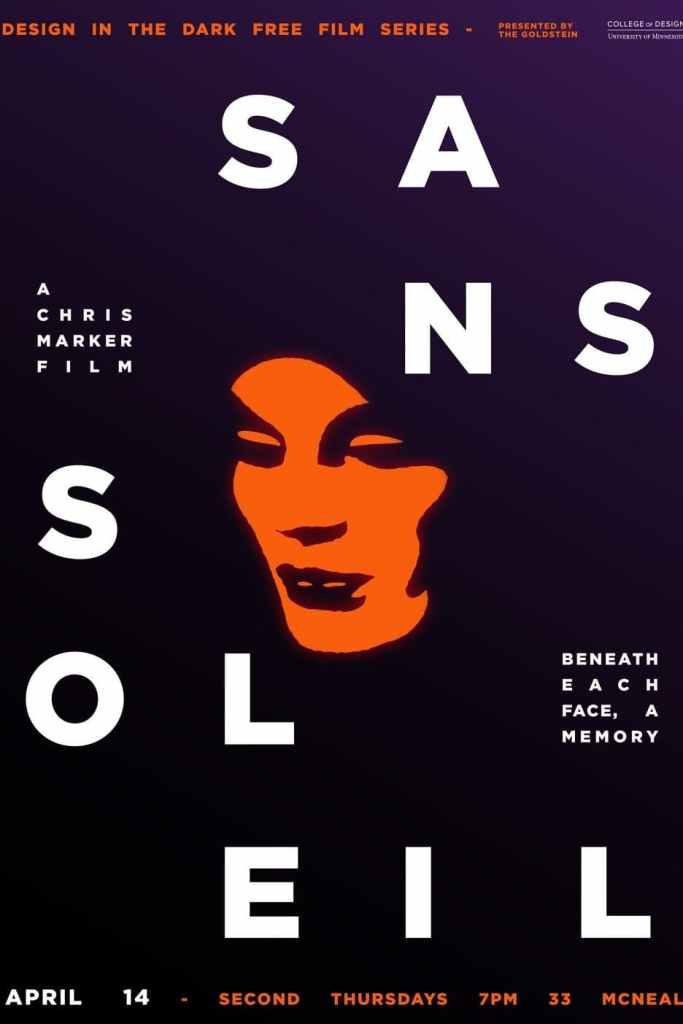


Chris Marker’s speculative travelogue-essay, reflecting on culture and history in narrated letters from Guinea to Japan to Iceland. A poetic documentary tour of Tokyo, Guinea-Bissau, Iceland and San Francisco, Sans Soleil mingles personal reflections with the history of the world. The female narrator reads letters sent by fictional Sandor Krasna, writing from ‘another world’. The spoken word, synthesized sound and haunting visuals investigate relationships between developed and developing societies. Virtuoso editing and special effects conjure the disorientation of a world traveller, journeying through cultures, secret rituals and confusions of time.
“The consummate cine-essay, framed as reportage from a roving cineaste, built mainly from Marker’s observations of the ‘empire of signs’ that is modern Japan and the poverty endemic in Guinea Bissau. Entertainingly provocative speculations on the ‘post-political’ world, haunted by the piano music of Mussorgsky.” Tony Rayns “A treatise on travel, on history, on art and on life, Marker’s film unfolds like an epistolary novel in dialogue with itself. His virtuosity with the camera is matched by the brilliance of the montage.” Bruce Jenkins
Text reproduced from https://www.bfi.org.uk/film/a9bab1d5-f6df-51d3-bdda-5e1beba14602/sans-soleil (accessed 08/03/24)

Psychogeography: In recent years this term has been used to illustrate a bewildering array of ideas from ley lines and the occult, to urban walking and political radicalism. But where does it come from and what exactly does it mean? This book examines the origins of psychogeography in the Paris of the 1950s, exploring the theoretical background and its political application in the work of Guy Debord and the Situationists. Psychogeography continues to find retrospective validation in much earlier traditions, from the visionary writing of William Blake and Thomas De Quincey to the rise of the flâneur and the avant-garde experimentation of the Surrealists. These precursors to psychogeography are discussed here alongside their modern counterparts, for today these ideas hold greater currency than ever through the popularity of writers and filmmakers such as Iain Sinclair, Will Self and Patrick Keiller.
From the urban wanderer to the armchair traveller, psychogeography provides us with new ways of experiencing our environment, transforming the familiar streets of our everyday experience into something new and unexpected. Merlin Coverley conducts the reader through this process, providing an explanation of the terms involved and an analysis of the key figures and their works.
Text reproduced from Amazon

In “No Fixed Abode”, Marc Auge’s pathbreaking fictional ethnography, a man named Henri narrates his strange existence on the margins of Paris. By day he walks the streets, lingers in conversation with the local shopkeepers, and sits writing in cafes, but at night he takes shelter in an abandoned house. From here, we see a progressive erosion of Henri’s identity, a loss of bearings, and a slow degeneration of his ability to relate to others. But then he meets the artist Dominique, whose willingness to share her life with him raises questions about who he has become and what a person needs in order to be a part of society. This is a book about how we live in geographical space and how work and patterns of domicile affect our status and our inner being.

A fictional account of a walking tour through England’s East Anglia, Sebald’s home for more than twenty years, The Rings of Saturn explores Britain’s pastoral and imperial past. Its ten strange and beautiful chapters, with their curious archive of photographs, consider dreams and reality. As the narrator walks, a company of ghosts keeps him company – Thomas Browne, Swinburne, Chateaubriand, Joseph Conrad, Borges – conductors between the past and present. The narrator meets lonely eccentrics inhabiting tumble-down mansions, and hears of the furious coastal battles of two world wars. He tells of far-off China and the introduction of the silk industry to Norwich. He walks to the now forsaken harbor where Conrad first set foot on English soil and visits the site of the once-great city of Dunwich, now sunk in the sea, where schools of herring swim. As the narrator catalogs the transmigration of whole worlds, the reader is mesmerized by change and oblivion, survival and memories. Blending fiction and history, Sebald’s art is as strange and beautiful as the rings of Saturn, created from fragments of shattered moons.”–Publisher’s description