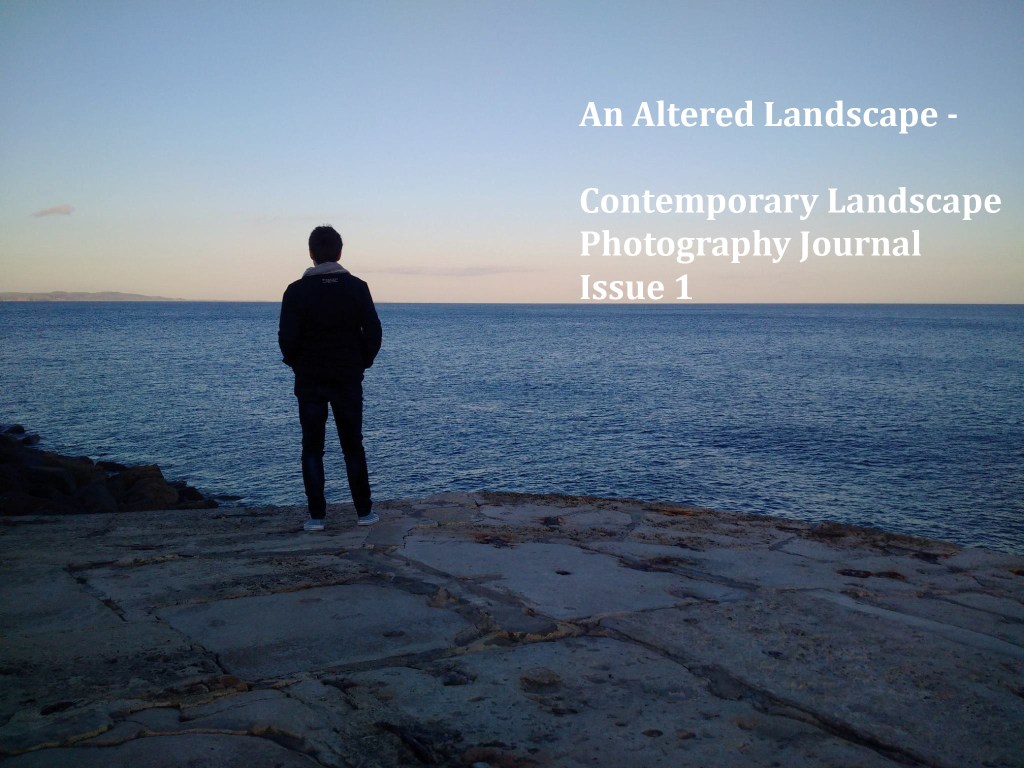
I am pleased to announce my work Hints for British Tourists has been chosen for Issue 1 of the Contemporary Landscape Photography Journal – An Altered Landscape. Hints for British Tourists is the re-staging and fictional expansion of a found pamphlet containing instructions for travel. Presented as photographic documentation the work is a meditation on travel, tourism, time and memory.
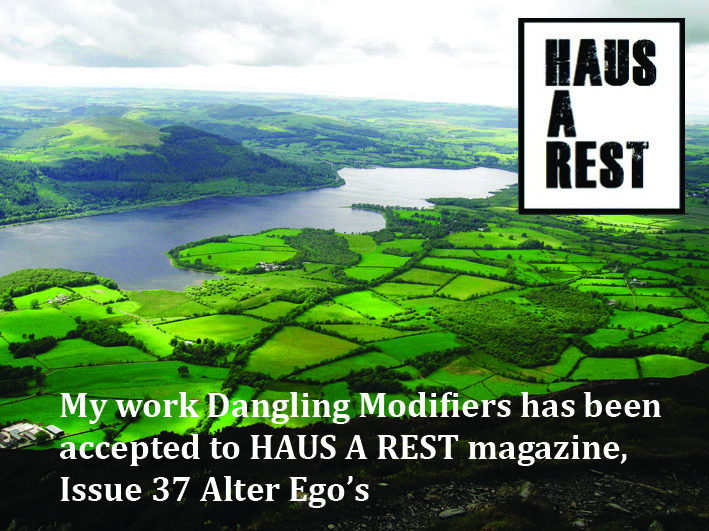
I am pleased to announce my piece “Dangling Modifiers” was accepted to HAUS A REST magazine, Issue 37 Alter Ego’s. Dangling Modifiers is the document of an ephemeral performance capturing a subject in process, a momentary ecstasis where high on a hilltop in the Lake District I attempted to dance with Paul Klee using his drawing Knotted 1920 as the performative score. I engaged in an improvised choreography whereby the drawing was translated into movement by falling, jittering, twisting, snaking, weaving and shimmying on a hilltop like a deranged walker. This performance was part of a residency where several bodies slept together in a village hall, and explored their structures, rhythms, touch, possibilities, limits, and their fragilities. This text is the only document of the performance.
Poems – by Currer, Ellis & Acton Bell is a collection of poetry written by the literary sisters Emily, Charlotte, and Anne Brontë. Published in 1846 under the pseudonyms Currer (Charlotte), Ellis (Emily), and Acton (Anne) Bell, it only sold three copies when first published. After the success of their later works, the poems have since garnered more attention and acclaim. The Brontë sisters consisted of Charlotte (1816-1855), Emily (1818-1848), and Anne (1820-1849), who belonged to a nineteenth-century literary family associated with the village of Haworth in the West Riding of Yorkshire, England. The sisters are most famous for their novels, namely Charlotte’s “Jane Eyre”, Emily’s “Wuthering Heights”, and Anne’s “The Tenant of Wildfell Hall”, each an irrefutable classic of English literature. Contents include: “Mementos”, “The Wife’s Will”, “Gilbert”, “Life”, “The Letter”, “Regret”, ” Presentiment”, “The Teacher’s Monologue”, “Passion”, “Preference”, “Evening Solace”, “Stanzas”, “Parting”, “Faith And Despondency”, “Stars”, “The Philosopher”, “Remembrance”, “A Death-Scene”, “Song”, “Anticipation”, “The Prisoner”, etc. Complete with biographical notes of Emily and Anne Brontë by their sister Charlotte Brontë, along with an Essay by Virginia Woolf on the Brontë Family Home, Haworth.
[A] “When I thought about what I could show you, what I could write you, I thought of this letter.”
[D] “We will take detours along the way tracing spaces in traces, spaces in places, traces in spaces, places in traces. We will have to trust we will find our way home because from there we go out to all other places. Let us linger here together at the threshold…”
[A] “In a letter, in a sentence there are 3 things I determine. The definite things, the names, the things yet to be resolved: the questions and the things that just don’t mean anything at all. I find myself paying attention to these pauses, silences and endpoints. I wonder if I can show you what I mean, I wonder about what we’re all doing and if our thoughts overwrite each other, whether you would hear what I am saying.
How often do we say: “I see what you mean”… well do you? I cannot see what you mean I can only imagine.”
[D] “In truth there is nothing I want to make you see, there is nothing I really mean and this nothing can never be exhausted. You made a distinction between hearing and listening just as I do between seeing and looking. Perception is an act of consumption in which we hazard nothing.”
You said: “When something is conclusive it means it never started; labour does not make a work and perhaps, you wrote, the first and last form is an empty bowl…”This made me entertain a fantasy of pointlessly making bowls which means labour could make a work but only as a device to understand the failure of creating an audience.
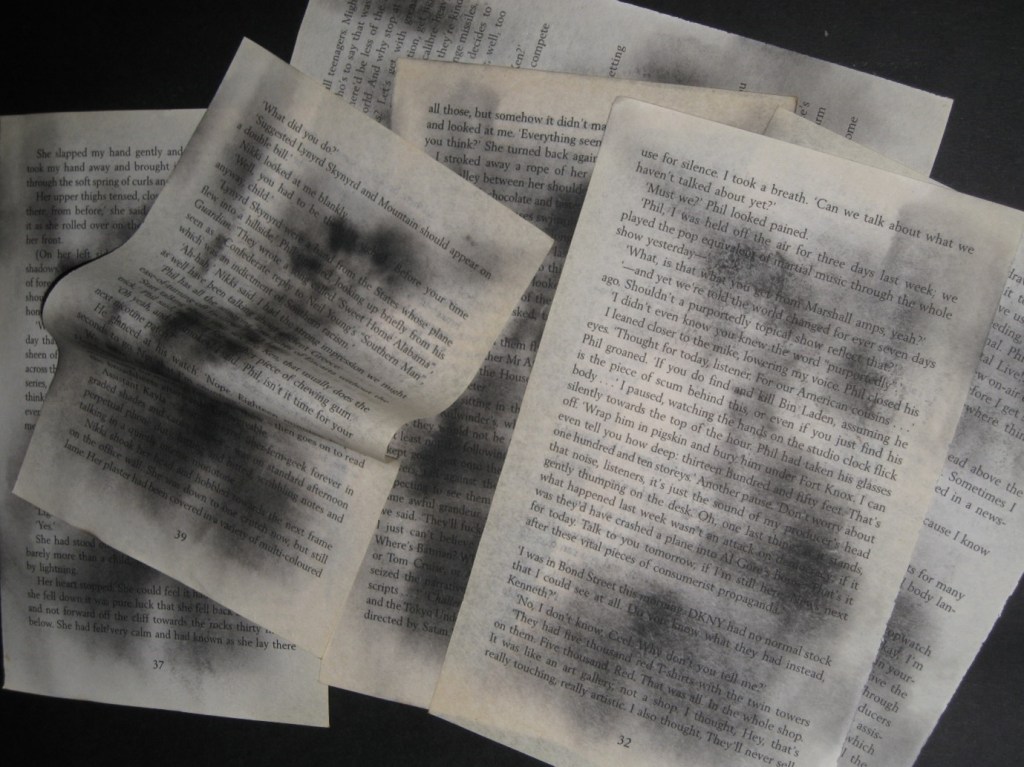
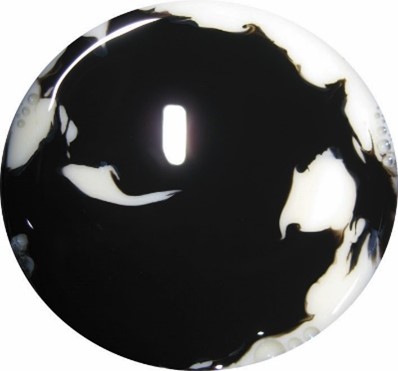
Ad Reinhardt
You wrote: Perhaps the only painting is black but there are endless possibilities in black. Old black, fresh black, lustrous black, dull black, emerald black, oil black, sunlight black, shadow black and the black of the lime tree in winter.
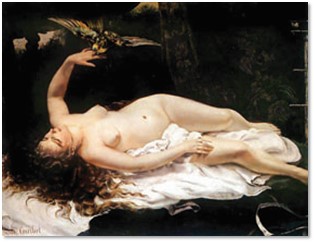
Courbet, Woman with a Parrot, 1866
You wrote: Maybe the only score is silent. What does it mean to experience silence as the essence of language?. Being silent is not the same as being mute. Silence is the only form of articulation. This is the gift of language.
I read a story about a child and a house built out of small red bricks. When construction was complete the child squatted next to it, placed a pig inside it and carefully replaced the top. Occasionally she walked away from the enclosure but always returned, opening it carefully, looking inside, emptying or filling it. This was her universe. Then you wrote me a story about a red house, a model that came to be built for real in red brick, found like a little time machine although you couldn’t determine if it goes to the past or the future. There is something tragic about the kind of architectural model created on the kitchen table. A house of meetings but also departures, its walls urge you to remember your compulsion to forget.
What does it mean to inhabit something, to capture its music? You thought about a nautilus shell for a long time and I wondered how you could blend with the darkness of the sea…
Dear Black Spot…
Gazing into your liquid emerald darkness suffused with silver halide crystals of light, sinking into your inky depths, enveloped in your perfect form, in a slumber dead to the world, an eternal caress wrapt in your tender abyss.
As I write to you I can sincerely say I have lived in this house although I cannot determine whether it is the past or the future. The ghostly sublime of a chair hovers in the background then I realised it never went away because it was never there in the first place. In the distance doors exploded from their origin, nothing is being asked or explained. A serene velocity at the mirrors edge hovers in the silver of the ground.
Symptoms manifested in the smashing of windows, the rehearsal of a ventriloquist act in empty rooms constructing an emotional temperature. I have stood under the darkening sky at the strike of madness where dead fingers dance, the dark matter of corporeal poetry: a shadow soundtrack of whispering grass kicking the air.
[A] “When we believe in a concept so deeply we might make a container for it over and over again…until the object might measure half the thought or the form smothers its nucleus. Just like a faucet that leaks [D: and there is comfort in this sound] concepts survive between half full and drowning.”
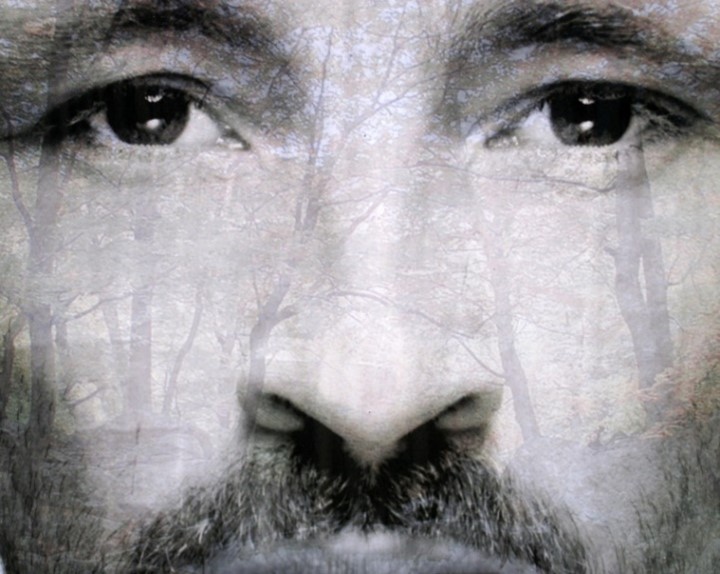
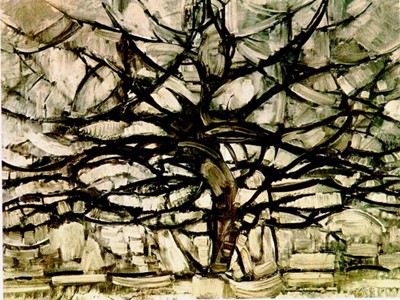
Piet Mondrian
[D] “Let us go, you and I beyond the perimeter where the Lime Tree is the tallest tree in sight, taller than the pines, the birches and willows, let us forget the names we give to the things we see.
There on the mossy bank of the lake I shall add my half empty to your half full and we shall wade out into its depths. We will forget that in spring and summer the Lime Tree was green all over and now in winter its branches are black, we will forget we are sad about that. We will forget because here in the lake we will be testing the concepts of surviving and drowning.”
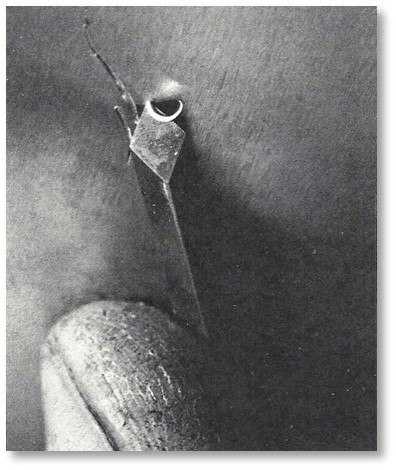
You wrote: Perhaps an artist cannot live, but only die in what he or she creates. In reality this appears to be a trifle like a paper cut and ‘when this cut is made nothing is destroyed’, but beneath the work are the cuts, sharp, clean, deep. How do you obtain relief? Breathe and keep cutting.
[A] “I wonder are you bored because time is being consumed. Boredom is when what you want is elsewhere and you are obliged to wait for it, or wait without it.” [D] This absent content is a fragment that shines like gold. There is no sound we can run to in this prototype theatre; we can only act out to the sides.
Roland Barthes writes: ‘There is a scenography of waiting: I organize it, manipulate it, cut out a portion in time in which I shall mime the loss of the loved object”… the object yet to come, the object that should have come and didn’t, the object that might never come, “provoking the effects of a minor mourning.” A Lover’s Discourse, Waiting, P.37
I am waiting for an arrival, a return, a promised sign. I have no sense of proportions. The being I am waiting for is not real. I create and re-create it over and over, starting from my capacity to love.
[A] “In a letter, in a sentence there are 3 things I determine. The definite things, the names, the things yet to be resolved: the questions and the things that just don’t mean anything at all. I find myself paying attention to these pauses, silences and endpoints.”
Fernando Pessoa writes “I think with my feelings and feel with my thoughts”.
[D] Do you see what I mean?… I imagine in this instance that you do.


 denisestartin.co.uk