Godland

Harshness is transformed into beauty and then terror by this extraordinary film from Icelandic director Hlynur Pálmason about a 19th-century Danish pastor sent to establish a new church on Iceland’s remote south-eastern coast. I left the cinema dazed and elated by its artistry; it is breathtaking in its epic scale, magnificent in its comprehension of landscape, piercingly uncomfortable in its human intimacy and severity. There is such superb compositional sense in the still life tableau shots and the almost archaeological sense of time, creating something deeply mysterious and unbearably sad. There are echoes of Werner Herzog’s Aguirre, the Wrath of God, Roland Joffé’s The Mission, Lisandro Alonso’s Jauja – and even Howard Hawks’s Red River.

Pálmason announces in the opening credits that the story was inspired by the supposed discovery in Iceland of seven glass-plate photographs of people and places taken there at the end of the 19th century. While the claim is a deadpan fiction, his screen has an almost square 1.33:1 aspect ratio, perhaps in honour of the still photograph motif. This smaller-size, in such contradistinction to the movie’s CinemaScope ambition and spectacle, gives a density to the viewing experience.

Elliott Crosset Hove plays Lucas, a highly-strung young clergyman instructed by his bishop to travel to a pioneer community in Iceland (then a Danish dependency), superintend the church-building and install himself as parish priest. Lucas makes this arduous journey first by sea and then overland with horses, taking among his luggage a huge and burdensome cross, climbing mountains and fording rivers with it. But Lucas has a secular-ethnographic project to go with the imperial Christian mission: he dreams of taking the first pictures there, capturing the people with new technology. His cumbersome tripod goes on his back, its three spiked feet poking up behind his head, a version of the points of a crucifix. The camera is Lucas’s ordeal as he visits his stations of the cross.

Driven to the edge of madness by hardship and physical pain, Lucas has a thwarted friendship – or something more – with his translator (Hilmar Gudjónsson), and finally finds an erotic connection with Anna (Vic Carmen Sonne), the daughter of the local parishioner, who takes him in. But his life is dominated by his cantankerous, contemptuous Icelandic guide Ragnar, a tough, weatherbeaten veteran tremendously played by Ingvar Sigurdsson, the cop from Pálmason’s previous film A White, White Day. Palmasón shows that Lucas is humanised and possibly even redeemed by his encounters at journey’s end, particularly his relationship with his quasi-host, the level-headed widower Carl (a shrewdly judged performance from Jacob Lohmann), who is bemused by Lucas’s self-harming decision to come to Iceland in the most difficult way possible, and then suspicious of his potential designs on his eldest daughter. Anna’s younger sister Ida (Ída Mekkín Hlynsdóttir) has an attractively emollient role and her relationship with Lucas is gentle and sweet and brings out the nearest Lucas has to warmth.

The film’s mightiest figure is the implacable Ragnar. Far from helping Lucas across the terrain, Ragnar embodies it; he is the very personification of its hostility. As an Icelander, he hates the high-handed Dane with his book-learning. Lucas comes in turn to hate and fear him. And yet Pálmason shows that Ragnar softens imperceptibly even as he sabotages Lucas; he needs someone to confess his terror of God to while exorcising a lifetime of buried rage. In Godland, these emotions are projected out on to the stunning, daunting landscape to the accompaniment of spine-meltingly beautiful choral music. That austere, boxy screen looks like a window on to a vast, unfathomable world.

https://www.theguardian.com/film/2023/apr/05/godland-review-hlynur-palmason (accessed 08/12/23)

Currently Reading

Deep maps are finely detailed, multimedia depictions of a place and the people, buildings, objects, flora, and fauna that exist within it and which are inseparable from the activities of everyday life. These depictions may encompass the beliefs, desires, hopes, and fears of residents and help show what ties one place to another. A deep map is a way to engage evidence within its spatio-temporal context and to provide a platform for a spatially-embedded argument. The essays in this book investigate deep mapping and the spatial narratives that stem from it. The authors come from a variety of disciplines: history, religious studies, geography and geographic information science, and computer science. Each applies the concepts of space, time, and place to problems central to an understanding of society and culture, employing deep maps to reveal the confluence of actions and evidence and to trace paths of intellectual exploration by making use of a new creative space that is visual, structurally open, multi-media, and multi-layered.

Currently reading

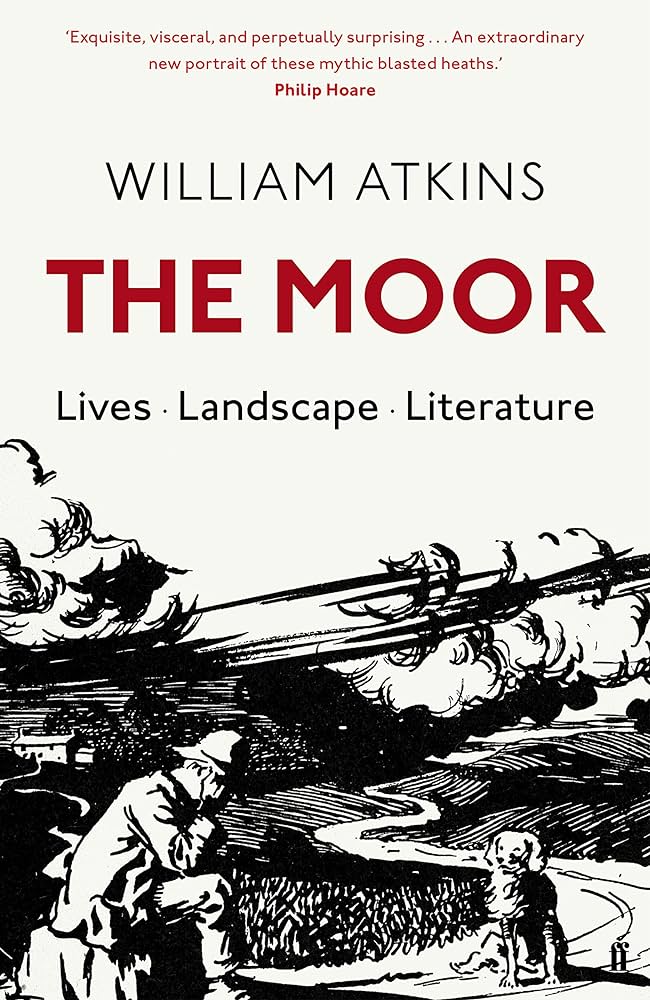
In this journey across England’s most forbidding and mysterious terrain, William Atkins takes the reader from south to north, exploring moorland’s uniquely captivating position in our history, literature and psyche. Atkins’ journey is full of encounters, busy with the voices of the moors, past and present. He shows us that, while the fierce terrains we associate with Wuthering Heights and The Hound of the Baskervilles are very human landscapes, the moors remain daunting and defiant, standing steadfast against the passage of time.

Robinson in Ruins

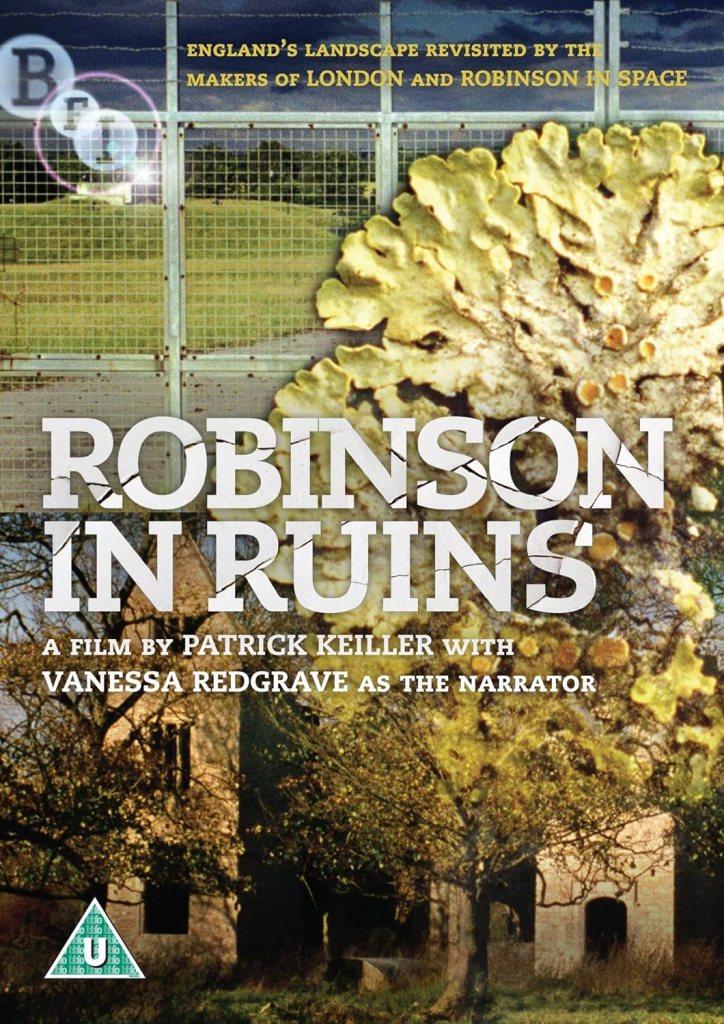
“The opening sentence of Patrick Keiller’s new film, voiced with laconic precision and italic irony by Vanessa Redgrave, is calculated to quicken the hearts of admirers of Keiller’s enigmatic oeuvre: “When a man named Robinson was released from Edgecote open prison, he made his way to the nearest city and looked for somewhere to haunt.” Robinson in Ruins is the third of Keiller’s feature-length essay-fictions to deposit his eccentric protagonist among the relics of millennial England, where he functions once more as the comically half-deluded conduit for the director’s own brand of visionary scholarship. As a fictional invention, the autodidact aesthete Robinson, whom we only ever encounter via the films’ narrators’ vexed relations with him, is an absurd sort of wraith, tricked up from reminders of Defoe and Céline, but surely also a descendant of the Regency showman Robertson, inventor of the proto-cinematic phantasmagoria. In Robinson in Ruins, his spectral patch is the landscape around Keiller’s own home in Oxford: its industrial heritage, its residual romanticism, the weird energies of Englishness at a time of global economic collapse.

In successive close-ups, a patch of lichen on an Oxford road sign comes to resemble the profile of Goethe. Robinson, at large among the relics of military-industrial technology, eventually settles on a disused cement works, crumbling into romantic ruin, as the potential site of a new utopian community. The history of clearances and land riots ghosts the new landscape of PFI follies, unpeopled agribusiness and the amnesiac transformation of every fraught patch of land (Greenham Common included) into a Site of Special Scientific Interest. All of this is rendered, meanwhile, with Keiller’s customarily austere but rapt visual style – though in this case, as suits a film partly about the persistence of pastoral in the face of rapacious land grabs, the shots are longer. The camera tarries with fields of oil seed rape, nodding foxgloves and shivering primroses until they start to look monstrous, every bit as alien as the relics of 19th-century architecture and décor that so exercised the surrealists. Before Keiller’s (or Robinson’s) prophetic gaze, the English countryside is a monument to itself, and ripe for revolutionary appropriation.”

Text reproduced from https://www.theguardian.com/film/2010/nov/20/robinson-ruins-patrick-keiller-dillon (accessed 18/09/23)

The Pilgrims Progress

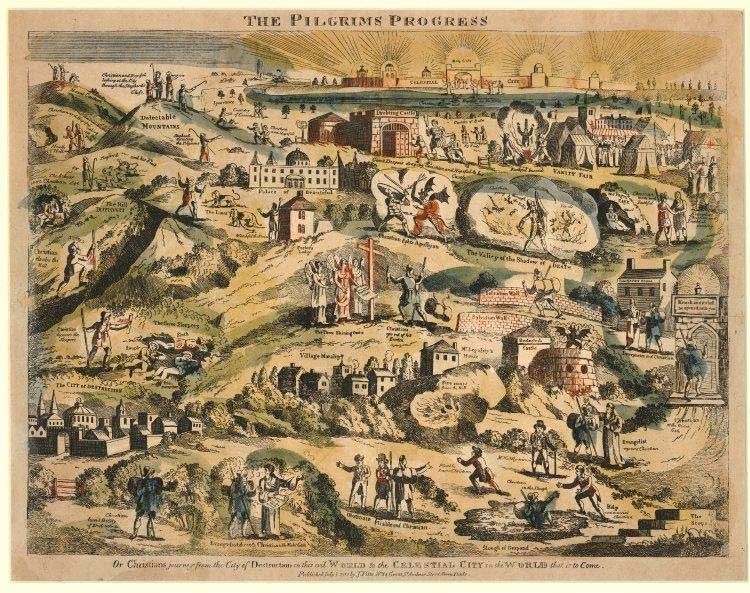
“The Pilgrims Progress, or, Christians Journey from the City of Destruction in This Evil World to the Celestial City in the World That Is to Come” ([London]: Published . . . by J. Pitts, no. 14 Great St. Andrew Street Seven Dials, July 1, 1813). Copperplate map, with added color, 34 × 45 cm, on sheet 41 × 51 cm [Historic Maps Collection].

“This anonymous map visually interprets English preacher John Bunyan’s religious allegory The Pilgrim’s Progress from This World to That Which Is to Come: Delivered Under the Similitude of a Dream, Wherein Is Discovered the Manner of His Setting Out, His Dangerous Journey, and Safe Arrival at the Desired Countrey (1678). (The book was probably written during his imprisonments for preaching without a license.) The protagonist, named Christian, faces temptations and digressions that could prevent him from reaching his goal, God’s celestial city. The symbolic nature of the work lends itself to graphic illustration: the Slough of Despond, the Valley of the Shadow of Death, Vanity Fair—such “obstacles” have become iconic in Western literature. The universal resonance of Bunyan’s work—it has been translated into more than two hundred languages—accounts for its never having been out of print.”

Image reproduced from https://www.biola.edu/blogs/good-book-blog/2019/pilgrim-s-progress-maps (accessed 14/09/23). Text reproduced from https://library.princeton.edu/visual_materials/maps/websites/thematic-maps/theme-maps/literature.html (accessed 14/09/23)