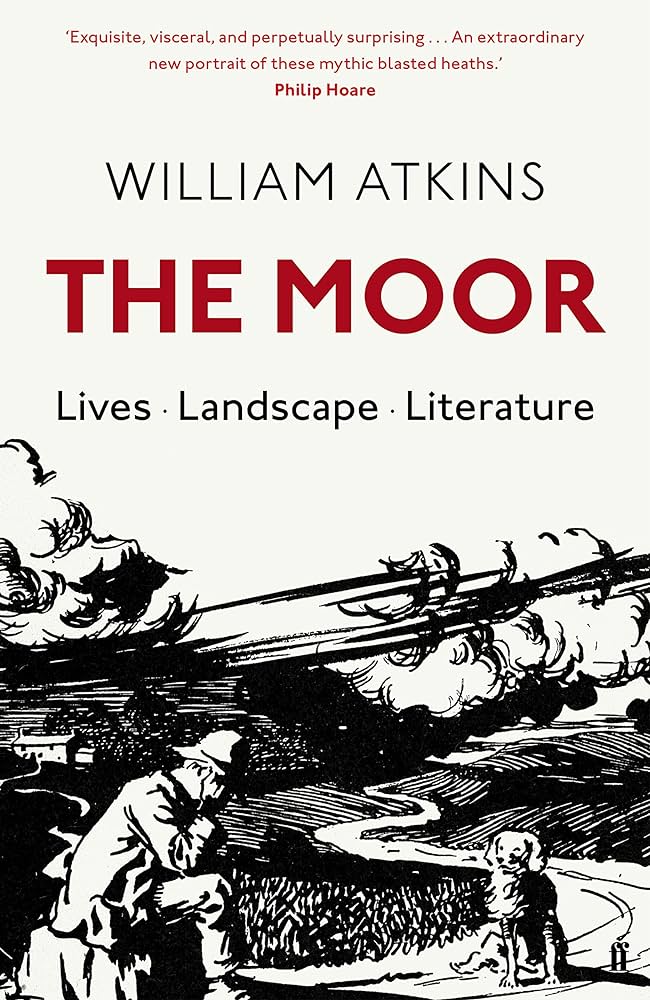
In this journey across England’s most forbidding and mysterious terrain, William Atkins takes the reader from south to north, exploring moorland’s uniquely captivating position in our history, literature and psyche. Atkins’ journey is full of encounters, busy with the voices of the moors, past and present. He shows us that, while the fierce terrains we associate with Wuthering Heights and The Hound of the Baskervilles are very human landscapes, the moors remain daunting and defiant, standing steadfast against the passage of time.
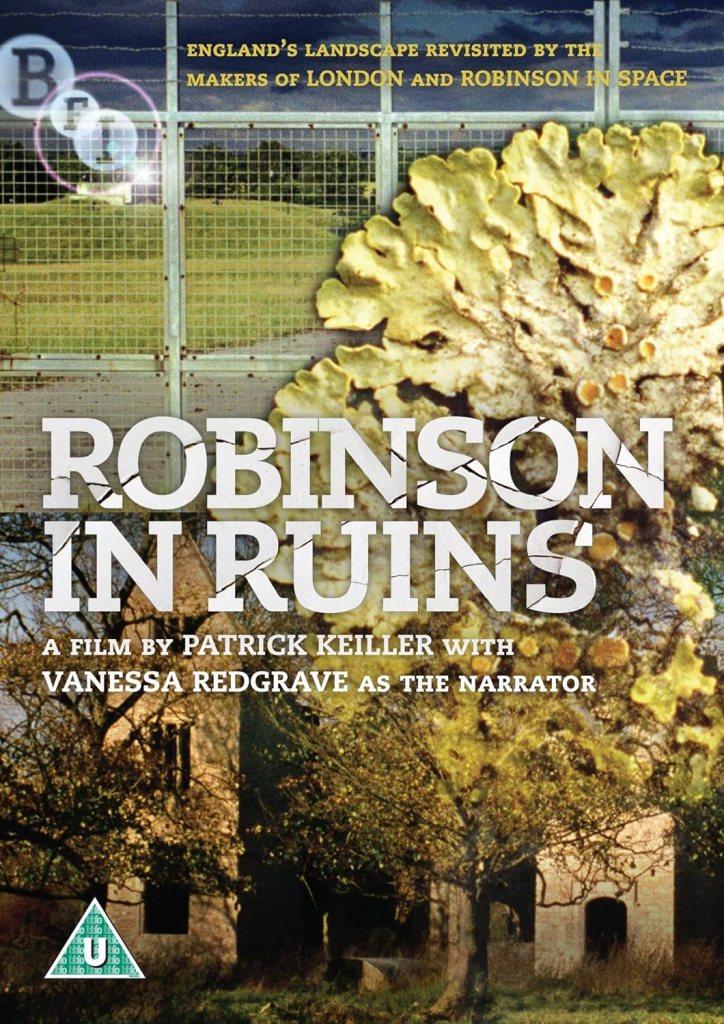
“The opening sentence of Patrick Keiller’s new film, voiced with laconic precision and italic irony by Vanessa Redgrave, is calculated to quicken the hearts of admirers of Keiller’s enigmatic oeuvre: “When a man named Robinson was released from Edgecote open prison, he made his way to the nearest city and looked for somewhere to haunt.” Robinson in Ruins is the third of Keiller’s feature-length essay-fictions to deposit his eccentric protagonist among the relics of millennial England, where he functions once more as the comically half-deluded conduit for the director’s own brand of visionary scholarship. As a fictional invention, the autodidact aesthete Robinson, whom we only ever encounter via the films’ narrators’ vexed relations with him, is an absurd sort of wraith, tricked up from reminders of Defoe and Céline, but surely also a descendant of the Regency showman Robertson, inventor of the proto-cinematic phantasmagoria. In Robinson in Ruins, his spectral patch is the landscape around Keiller’s own home in Oxford: its industrial heritage, its residual romanticism, the weird energies of Englishness at a time of global economic collapse.
In successive close-ups, a patch of lichen on an Oxford road sign comes to resemble the profile of Goethe. Robinson, at large among the relics of military-industrial technology, eventually settles on a disused cement works, crumbling into romantic ruin, as the potential site of a new utopian community. The history of clearances and land riots ghosts the new landscape of PFI follies, unpeopled agribusiness and the amnesiac transformation of every fraught patch of land (Greenham Common included) into a Site of Special Scientific Interest. All of this is rendered, meanwhile, with Keiller’s customarily austere but rapt visual style – though in this case, as suits a film partly about the persistence of pastoral in the face of rapacious land grabs, the shots are longer. The camera tarries with fields of oil seed rape, nodding foxgloves and shivering primroses until they start to look monstrous, every bit as alien as the relics of 19th-century architecture and décor that so exercised the surrealists. Before Keiller’s (or Robinson’s) prophetic gaze, the English countryside is a monument to itself, and ripe for revolutionary appropriation.”
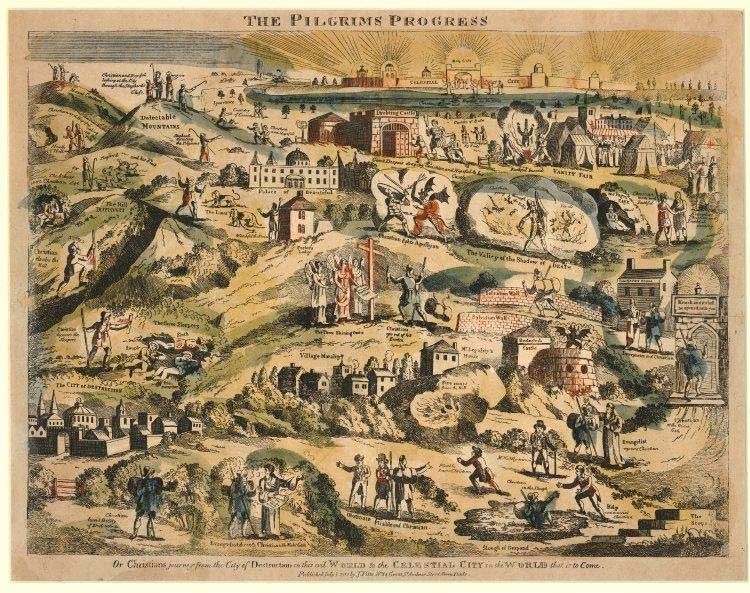
“The Pilgrims Progress, or, Christians Journey from the City of Destruction in This Evil World to the Celestial City in the World That Is to Come” ([London]: Published . . . by J. Pitts, no. 14 Great St. Andrew Street Seven Dials, July 1, 1813). Copperplate map, with added color, 34 × 45 cm, on sheet 41 × 51 cm [Historic Maps Collection].
“This anonymous map visually interprets English preacher John Bunyan’s religious allegory The Pilgrim’s Progress from This World to That Which Is to Come: Delivered Under the Similitude of a Dream, Wherein Is Discovered the Manner of His Setting Out, His Dangerous Journey, and Safe Arrival at the Desired Countrey (1678). (The book was probably written during his imprisonments for preaching without a license.) The protagonist, named Christian, faces temptations and digressions that could prevent him from reaching his goal, God’s celestial city. The symbolic nature of the work lends itself to graphic illustration: the Slough of Despond, the Valley of the Shadow of Death, Vanity Fair—such “obstacles” have become iconic in Western literature. The universal resonance of Bunyan’s work—it has been translated into more than two hundred languages—accounts for its never having been out of print.”
“Archaeology is a way of acting and thinking—about what is left of the past, about the temporality of what remains, about material and temporal processes to which people and their goods are subject, about the processes of order and entropy, of making, consuming and discarding at the heart of human experience. These elements, and the practices that archaeologists follow to uncover them, is the essence of the archaeological imagination.”
In his book Shanks offers the following definition: “To recreate the world behind the ruins on the land, to reanimate the people behind the shard of antique pottery, a fragment of the past: this is the work of the archaeological imagination, a creative impulse and faculty at the heart of archaeology, but also embedded in many cultural dispositions, discourses and institutions commonly associated with modernity. The archaeological imagination is rooted in a sensibility, a pervasive set of attitudes toward traces and remains, towards memory, time and temporality, the fabric of history.” pp.25
William Hole’s frontispiece (from the Folger Shakespeare Library [http://luna.folger.edu/luna/servlet/s/7ihql3])
“Poly-Olbion is an expansive poetic journey through the landscape, history, traditions and customs of early modern England and Wales. Originally published in two parts (1612, 1622), it is also a richly collaborative work: Michael Drayton’s 15,000-line poem, which navigates the nation county by county, is embellished by William Hole’s thirty exquisite engraved county maps, and accompanied for its first eighteen ‘songs’ by the young John Selden’s remarkable prose ‘Illustrations’. Drayton was a close associate of Shakespeare and Ben Jonson, and his Poly-Olbion crystallizes early modern ideas of nationalism, history and memory.”