Wish you Were Here: Micro Residency, Artist Researcher (Interpretation) Erddig House & Gardens

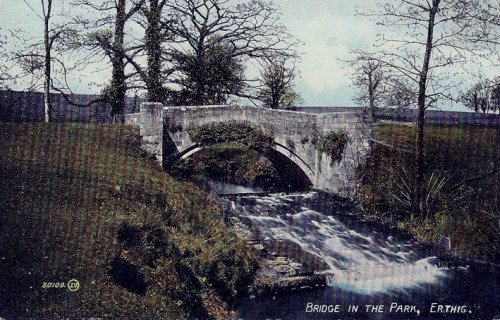
The Bridge in the Park, Erddig House & Gardens, Nr. Wrexham, Wales

The Bridge in the Park, Erddig House & Gardens, Nr. Wrexham, Wales

Micro Residency, Artist Researcher, National Trust, Archaeology Team, Erddig House & Gardens, Nr Wrexham, Wales 15th – 31st October.

In 1870-72, John Marius Wilson’s Imperial Gazetteer of England and Wales described Erddig like this:

“ERTHIG, or Erddig, a township in Gresford parish, Denbigh; on Offa’s Dyke, 2 miles SW of Wrexham. Pop., 117. Houses, 31. Erthig Hall is the seat of the Yorkes, -of whom was Philip -Yorke, author of “The Royal Tribes of Wales;” has, on the walls and ceilings of one of its rooms, the heraldic bearings of the tribes; and occupies a charming situation.” [1]

I have recently spent the week at the Yale Hostel about a mile from Erddig (pronounced Erthig) House & Gardens as Artist Researcher (Interpretation) assisting the monitoring of the Archaeological Monuments in the grounds of Erddig which has a formal walled garden and covers 485 hectares equalling 1,200 acres. The collection at Erddig is the 2nd largest in the UK, bequeathed to the Trust under the provision that no item be discarded. Supporting the Field Archaeology Team my remit is to contribute artistically to the undertaking of the Archaeological and Historic Landscape Survey at Erddig. My contribution includes A] Deep Mapping: Stories in the Landscape, B] The Map & The Territory: Utilising items in the collection to interpret the Landscape C] Documenting the Process: in a format that can be understood by the public D] Visualising and Representing the Data: making recommendations regarding the concrete representation of the Historic Buildings, Sites and Monuments Record which is essentially a digital database of the archaeological monuments in the historic parkland.

As a visual artist my artistic practice is site specific whether this site be actual, physical, textual, fictional or virtual. Both contextually and historically sensitive the role of place and place making is central to my work. Within this there is a tacit acknowledgement that the concept of place is constructed from a complex network of relations i.e symbolic, social, political, familial, local, national and historical. Place is central to the sensitive concept of belonging and home which contribute to a person’s autobiographical identity. This profoundly affects how that identity is situated and has significant impact on emotional wellbeing. Within my work I take a methodical, detailed, and extensively researched approach to the curation of material in order to construct comprehensive documents of place in the form of installed environments. In many respects I am a custodian or caretaker who respectfully recuperates, conserves and restores micro histories, narratives, objects and images that have been orphaned, discarded or forgotten. Legacy, whilst it may not always be visible, is a constant presence whether this relates to National Trust custodianship, archaeological practice, the historic parkland at Erddig, personal history or artistic practice. The rich tapestry that is art history, an artists’ conceptual trajectory, their historical timeline, the time of their work, the time of its making, the context in which one is making and their contemporaries all add up to what the literary critic Harold Bloom called, in the book of the same name, the anxiety of influence. Art does not occur in isolation, it is always made in ‘situ’. As a printmaker there is no such thing as a blank piece of paper, one always approaches it knowing that contextually, historically, artistically and technologically that it is already replete; it is a dialogue not a monologue.

Similarly the National Trust’s investment in significant cultural, historical and natural places, the people who populate them and the communities that surround them ensure our heritage is preserved as well as shared by enabling people to contribute and collaborate in its preservation. Personally speaking the research aims to investigate the intersection between art and archaeology, whereby art can also be a form of historiography that re-contextualises our relations to the past as a form of memorial or restoration. For that reason I will also be mining the art historical legacy relating to the site specific and the correlation between an aspect of historical archaeological practice and conceptual art, the concept of the grid. This concrete and in depth engagement with Erddig, generously facilitated by Kathy Laws: Archaeologist at the National Trust, will develop a more comprehensive understanding of what it means to be site specific, not just artistically & imaginatively, but historically, physically, technologically and contextually. This can only improve the depth of my work as an artist engaged with concepts of place, contexts, histories and heritage both private and public.
[1] http://www.visionofbritain.org.uk/place/3124

Choreographic Objects

||HOST||The Royal Standard as part of the Liverpool Biennial27th October - 4th November 2012

||HOST||
The Royal Standard as part of the Liverpool Biennial
27th October – 4th November 2012
Sovay Berriman, Royal College of Art Alumni 2003

Choreographic Objects by William Forsythe

An object is not so possessed by its own name that one could not find another or better therefore.
– Rene Magritte

“Choreography is a curious and deceptive term. The word itself, like the processes it describes, is elusive, agile, and maddeningly unmanageable. To reduce choreography to a single definition is not to understand the most crucial of its mechanisms: to resist and reform previous conceptions of its definition.  There is no choreography, at least not as to be understood as a particular instance representing a universal or standard for the term. Each epoch, each instance of choreography, is ideally at odds with its previous defining incarnations as it strives to testify to the plasticity and wealth of our ability to re-conceive and detach ourselves from positions of certainty. Continue reading →

Plugging Belgrade Unplugged 19-26th July, 2014

electrical-plug-md

Belgrade Unplugged

The Belgrade Theatre are stripping back their performances as Belgrade Unplugged returns this year. Hosted at various establishments across the city and beyond it’s a rare insight into the mechanics of rehearsal without all of the production values that the Belgrade brings to its shows.

Starting on Saturday 19th July at The Belgrade Theatre, Unplugged will be travelling to The Establishment in Coventry, Nicholas Chambers Almshouses, Bedworth, Upton House (part of the National Trust) in Warwickshire, The Map Room, Touchwood Shopping Centre in Solihull, Primrose Hill Park, Hillfields, Rubgy Art Gallery & Museum and the Lunt Roman Fort, Baginton. The locations offering both historic, contemporary and communal backdrops to the rehearsals and the actors whose only prop is of course the script. Performances are free (except for entry into Upton House) but advance booking is essential. Click here for more information.

Dangling Modifiers & A Curious Love Letter, Micro Performance Lectures, Ragley Hall

Dangling Modifiers & A Curious Love Letter, Micro performance Lectures, Warwickshire Open Studios, Ragley Hall, Warks

Dangling Modifiers & A Curious Love Letter, Micro Performance Lectures, Warwickshire Open Studios, Ragley Hall, Warks

 [Briefly she enters another’s space becoming a site of inscription like the blank page…
he advances towards her with short, sharp stabbing motions. Can she subject her
sensuous gesture to his nervous tic? Following the curve of her S she drops down
heavily into its base disappearing from his line of site. She sways at the bottom before
rising and finds that he has become a woodpecker, his nervous tic feverishly
inscribing the trunk of a tree.]

“Dangling Modifiers” is the textual re-performance of a physical performance. High on a hilltop in the Lake District Denise engaged in an improvised choreography attempting to dance with the artist Paul Klee (1879-1940); to coax the performer’s body and Klee’s silent drawing into speech . Klee’s rhythmic line is expressive, lyrical, poetic and figurative evoking transcriptions of music. “The letter is not directed to the body; the line however, exists only through the echo it will encounter in other bodies where it will generate itself as a danceable volume, polyphony, scene, texture, at palpitating fingertips…” [1]. Positively performing a Kleeché  (taking a line for a walk), Paul Klee’s Drawing Knotted, 1920 was utilised as the performative score translating the drawing into movement by falling, jittering, twisting, snaking, weaving and shimmying on a hilltop like a deranged walker.

“Echo who cannot be silent when another speaks. Echo who cannot speak at all unless another has spoken. Echo who always answers back.” [2]

A Curious Love Letter is equally a failed attempt at speech, letters of love to an absent and unreachable addressee, based on an original reading of a performed letter at which Denise was absent. Separated by distance, time, space and location Denise has ventriloquised the original speakers voice into her own, reconstructing and miming the unheard text. Other voices and figures have been incorporated including artists Ad Reinhardt, Piet Mondrian & Michael Craig-Martin and literary figures such as Maurice Blanchot, Roland Barthes and Fernando Pessoa. The result is a polyphonic word and image divigation and a very curious love letter indeed.

Dates & Times: Saturday 5 th July 2pm & 3pm, Sunday 6th July 2pm & 3pm – Saturday 12th July 2pm & 3pm, Sunday 13th July 2pm & 3pm.

[1] Jean-Francois Lyotard, Driftworks, Semiotext(e), Inc, (Columbia University: New York, 1984), p.86/87.
[2] Ted Hughes, Tales from Ovid (London: Faber and Faber Limited, 1997), p.75/77.

Review: CHORALE, A Sam Shepard Roadshow, The War in Heaven

thewarinheaven

The War in Heaven (Photograph: Nina Sologubenko) CHORALE: A Sam Shepard Roadshow, The Presence Theatre Company

The War in Heaven, Sam Shepard

“I died the day I was born and became an Angel on that day”

Whilst the non resolution of The Holy Ghostly was resolved powerfully both in terms of the scenography, the visual imagery and the performance by John Chancer this did not translate successfully in The War in Heaven which Usher describes as “a moving plea from both a fallen angel and a man struggling to be heard once more.” I would argue important contextual information was missing for the audience in the interpretation of this play especially following the The Holy Ghostly since the full title is The War in Heaven: Angel’s Monologue. Whilst The Animal You and The Holy Ghostly were connected conceptually and through the characters there was absolutely no connection to the final instalment except the fact that it was Sam Shepard’s work.

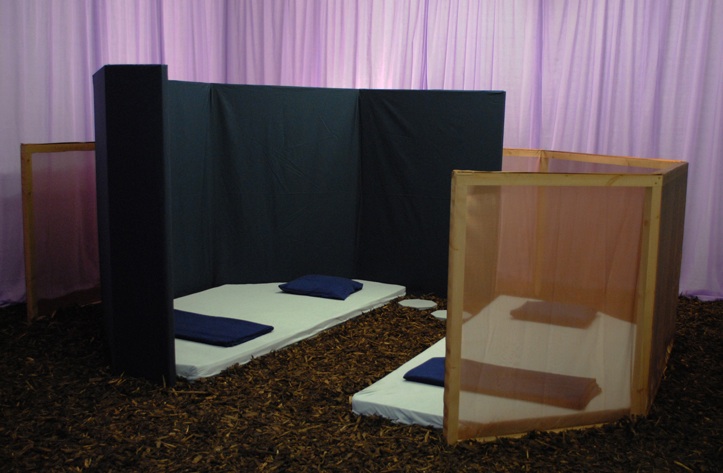
As a general rule visually I  found the scene to be completely incoherent, which in itself is not a dismissal of the aesthetic, sculptural and conceptual qualities of this kind of work and its inherent complexities however it felt largely unresolved from a formal perspective. There was simply no connection between the performers in space and the set. Clearly narrative and visual incoherence are  conceptual strategies and the production appeared to commit to this concept as an overall architecture to the work. The play itself is on many levels trying to find form through language within a stream of consciousness speech but my feeling is it didn’t go far enough and was therefore caught somewhere between the concept and the execution. If this disconnection is a formal aspect of the work it is possible to resolve the visually incoherent formally but there seemed to be a failure to commit to the intention and make it concrete.

Continue reading →