Perambulation
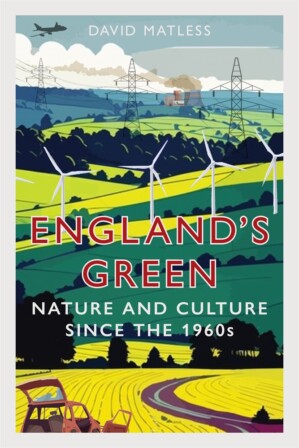
Explores English national identity and the environment, spanning agriculture, nature and culture.
England is known as a ‘green and pleasant’ land, but what does this mean? England’s Green explores how the country’s connection with the environment has shaped and reflected English national identity since the 1960s, when pollution, pesticides, industrial farming and upset ecologies were presented as signs of a world gone wrong. This book examines English cultures of nature, land, farming and other ways in which humans engage with the natural world; or with a world whose naturalness seems increasingly pressured and in question. From agriculture to nature, leisure, climate change, the folkloric, the archaeological and the mystical, David Matless uncovers the genealogies of today’s debates over land and culture, showing how twenty-first-century concerns and anxieties have been moulded by events over the past sixty years. From government policy to popular music, and from ecological polemic to television comedy, England’s Green shows the richness and complexity of English environmental culture.

“In Wuthering Heights (Oscilloscope), the English director Andrea Arnold doesn’t so much adapt Emily Brontë’s much-loved 1847 novel as reconstruct it through the fog of a fever dream. This spare, often dialogue-free tone poem is the polar opposite of a Merchant Ivory-style literary costume drama: Rather than re-upholster the familiar story of Heathcliff and Catherine’s doomed love on the moors of Yorkshire, Arnold has chosen to strip it down to the bone. Gone are the multiple nested narrators, as well as nearly the entire second half of the book. What remains is an almost abstract flow of sounds and images that envelop the viewer like sense memories from some forgotten childhood: boots tromping through fields of black muck, twigs scraping at an icy window, dogs barking in the distance, candlelight reflecting off wet skin.
If you went in to this Wuthering Heights with no knowledge of the book or any of its many film adaptations, I’m not sure the contours of the story would ever fully emerge from the literal and metaphorical fog—and if you went in primed for bodice-ripping escapism, you might very well run out gasping with boredom somewhere around the beginning of hour two. But if you can slow down your movie metabolism enough to acclimate to its world, Arnold’s naturalistic retelling grasps an elemental truth about the novel. As much as it’s a story of romantic obsession, Wuthering Heights is a saga of familial hate, an unflinching look at the way cruelty and prejudice get handed down from one generation to the next.
In Arnold’s vision, the hatred heaped on Heathcliff, a foundling adopted by the Earnshaw household as a young teenager, is more explicitly racial than it was in the book. Described by Brontë as a dark-complexioned “gipsy” or “Lascar” of uncertain origin, Heathcliff is played here by two black men (Solomon Glave as a young man, James Howson as an adult), and the epithets hurled at him by his spiteful adopted brother Hindley (Lee Shaw) include the n-word. After Earnshaw père dies suddenly, Hindley and his sister Catherine (played by Shannon Beer as a teen and Kaya Scodelario as an adult) clash over Heathcliff’s fate. Hindley insists he be ejected from the house and kept on as a lowly farmhand, while Catherine begs for Heathcliff to remain a member of the family. When the obstinate, hard-drinking Hindley won’t listen, Catherine simply spirits Heathcliff away from his chores for long tromps on the sodden, windswept moors. (It’s unclear whether their teenage love is ever consummated, but there’s a good deal of wrestling in the mud.) Eventually, Catherine is courted by their wealthy neighbor Edgar Linton (Oliver Milburn), whose proposal forces her to make a choice between civilization (or is it enervation?) and savagery (or is it freedom?).
The decision Catherine makes, and the ever-widening circle of suffering it causes, becomes the focus of much of the rest of the novel, but if Arnold’s impressionistic retelling unfolds from any one character’s point of view, it’s Heathcliff’s. The film opens on him as an adult, back at the farm known as Wuthering Heights, where he’s beating his forehead bloody against a wall that has Catherine’s name carved in it. Soon we jump back in time to learn what it is that’s left him so distraught. From there, the back story comes at us in scattered fragments of memory that seem to combine the perspective of both young lovers (fittingly enough, since, as Cathy avers in the novel, “I am Heathcliff”): the muddy hem of a skirt seen from behind as Cathy runs down a hill. The two of them after a day on the moors, laughing as Cathy identifies feathers they’ve collected. Then, more ominously, an unflinching close-up on the seemingly real slaughter of a young goat (though the credits assure us no animals were harmed in the making of this film, there will also be trapped rabbits and woefully mistreated house dogs.) The primal bond that links the young pair (half-fraternal, half-romantic) is established with no exposition and barely any dialogue—in one scene, Heathcliff’s back is covered in cuts after a savage beating from Hindley, and Cathy licks them clean with the naturalness of an animal grooming its wounded mate.
The screenplay, by Arnold and Olivia Hetreed, must have made for a slim bundle of paper to carry around the set: We hear far less human speech than we do of creaking floorboards and the howling Yorkshire winds that gave the titular farm its name. The sound design by Nicholas Becker is ingeniously layered, allowing all the homely ambient noises of Yorkshire farm life—crying babies, clattering carriage wheels—to coexist at once in the viewer’s ear, all of it bringing us information about what’s happening just outside the frame. (The film’s sonic austerity falters only in the final moments, when a contemporary folk song by the British band Mumford and Sons appears on the soundtrack.) Robbie Ryan’s cinematography (the film is shot on HD video in the same square-shaped ratio he used for Arnold’s last film, Fish Tank) is bleakly stunning. He makes the moors look at once diaphanous and earthy, using a palette so bled of color that the movie appears, at moments, to be shot in black and white.”
Image & text reproduced from https://slate.com/culture/2012/10/andrea-arnolds-wuthering-heights-reviewed-a-vivid-dreamlike-reimagining-from-the-director-of-fish-tank.html (accessed 10/01/25)
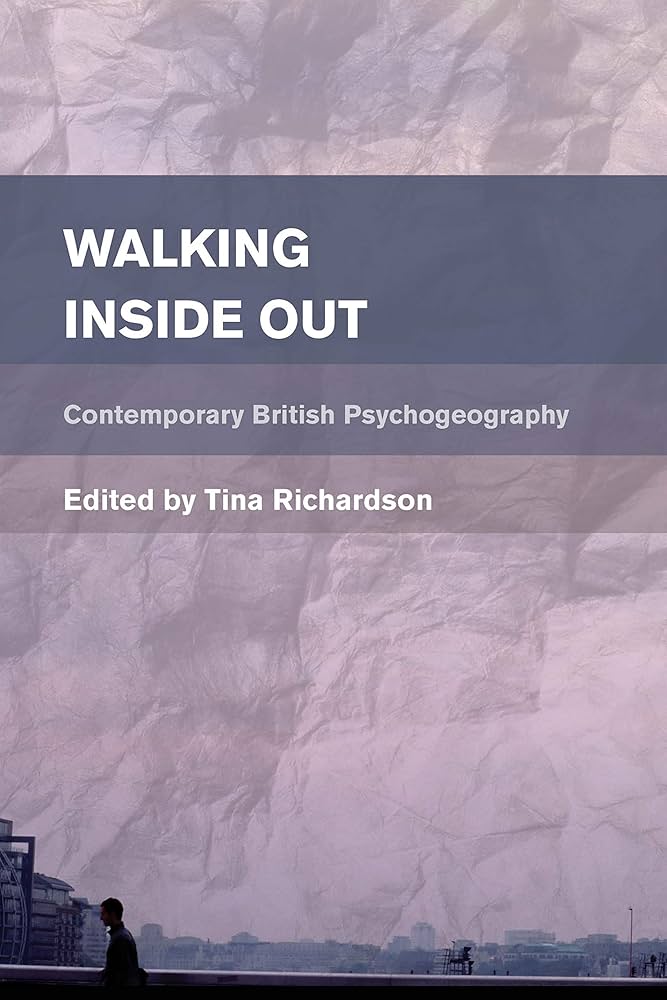
Walking Inside Out is the first text that attempts to merge the work of literary and artist practitioners with academics to critically explore the state of psychogeography today. The collection explores contemporary psychogeographical practices, shows how a critical form of walking can highlight easily overlooked urban phenomenon, and examines the impact that everyday life in the city has on the individual. Through a variety of case studies, it offers a British perspective of international spaces, from the British metropolis to the post-communist European city. By situating the current strand of psychogeography within its historical, political and creative context along with careful consideration of the challenges it faces Walking Inside Out offers a vision for the future of the discipline.
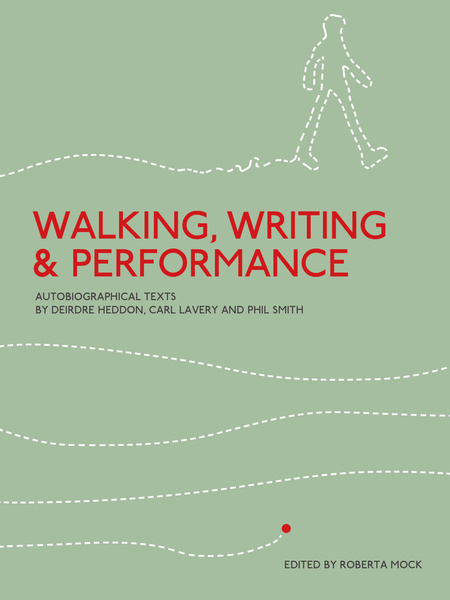
This collection charts three projects by performance-makers who generate autobiographical writing by taking walks. It includes performance texts and photographs, as well as essays by the artists that discuss processes of development, writing and performance.The Crab Walks and Crab Steps Aside are performances made by Phil Smith based on an initial exploratory walking of an area of South Devon where he was taken for childhood holidays and then on to Munich, Herm and San Gimignano. Both shows were accompanied by the distribution of maps seeking to provoke the audience to make their own exploratory walks. Mourning Walk is a performance that relates to a walk Carl Lavery made to mark the anniversary of his father’s death. Lavery shows how a secret can be both shared and hidden through the act of communication as he explores “an ethics of autobiographical performance”. In Tree, the result of a multi-disciplinary collaborative process, Dee Heddon occupies a single square foot of soil, and discovers that by standing stationary and looking closely she can travel across continents and centuries, making unexpected connections through an extroverted autobiographical practice.The work of all three artists, taken together and separately, raises important issues about memory, ritual, life writing, textuality, subjectivity, and site in performance.
Image and text reproduced from https://www.intellectbooks.com/walking-writing-and-performance (accessed 07/12/24)
 denisestartin.co.uk