I am in the process of preparing for my transfer exam next month which requires a report, a body of practice, a presentation and as a PGR candidate I undergo a viva. Here is the synopsis of my research as it stands presently:
The purpose of the PhD research is to explore and critically evaluate the contemporary relevance of chorography as a practice research method for the critical examination of place. The research aims to situate chorography as a significant and relatively under-acknowledged approach in visual art to map characteristics of the locale by examining the relations between the physical site, its numerous interpretations, and representations. It seeks to investigate the performative and embodied experience of chorographic practice as a potential original contribution to knowledge. Additionally, the research aims to develop new ways to examine artistic practices of place-making and its application in visual art by restoring, developing, and communicating a connection between chorography, past and present. Overall, the purpose of the PhD research is to contribute to the understanding and application of chorography in contemporary artistic practice and research, specifically focusing on its application to the site of Brontë country.
Critical Fragments
Research Methods: Ethnofiction

In “No Fixed Abode”, Marc Auge’s pathbreaking fictional ethnography, a man named Henri narrates his strange existence on the margins of Paris. By day he walks the streets, lingers in conversation with the local shopkeepers, and sits writing in cafes, but at night he takes shelter in an abandoned house. From here, we see a progressive erosion of Henri’s identity, a loss of bearings, and a slow degeneration of his ability to relate to others. But then he meets the artist Dominique, whose willingness to share her life with him raises questions about who he has become and what a person needs in order to be a part of society. This is a book about how we live in geographical space and how work and patterns of domicile affect our status and our inner being.
Writing Britain

“This book celebrates some of the most dazzling treasures of English literature to show how Britain’s greatest authors have been inspired by, and even redefined, their country. From Chaucer’s pilgrims journeying from Southwark to Canterbury, to the 21st century suburban hinterlands of J.G. Ballard, this book will explore how the places and landscapes of Britain permeate the nation’s great literary works and how these works have, in turn, helped shape our perception and understanding of landscape and place, both real and imagined. As well as celebrating the traditional British landscape the book will also examine the literary construction of the city, following the mysterious fog-filled streets that stretch from the London of Dickens and Robert Louis Stevenson’s Strange Case of Dr Jekyll and Mr Hyde to the urban underworlds revealed by contemporary writers such as Neil Gaiman and Iain Sinclair. Accompanying a major exhibition at the British Library, the book also features such diverse landscapes as Emily Bronte’s wild and windy Yorkshire Moors, Elizabeth Gaskell’s industrial northern towns, the seaside-turned-nightmare of Bram Stoker’s Dracula, Graham Greene’s seedy and menacing Brighton, Virginia Woolf’s Bond Street and Hanif Kureishi’s suburbia, this book will describe and illustrate the work of over 100 of the greatest British writers who have been inspired by place, spanning the Middle Ages to the 21st century.”
Text reproduced from Amazon accessed 07/05/24
Exhibition text – Hints for British Tourists

A figure in a bowler hat, waistcoat and rolled-up trousers brushes sand from their feet. They read a book in front of a painted beach hut, climb on rocks, clutch a newspaper, wait, fall asleep and lookout to sea. In one moment after another, we see tourism performed and time laid out in photographic frames like film stills.
Coventry-based artist Denise Startin presents a series of site-based performative actions, seen here via photographic documentation. The genesis of the exhibition Hints for British Tourists comprises two chance encounters: the discovery of a tourism pamphlet on eBay (also titled Hints for British Tourists) and a wall plaque on Hertford Street, Coventry, dedicated to the historic watchmaking trade that lists craftsmen Samuel Vale and George Howlette. The exhibition represents a re-staging and fictional expansion of these two very different starting points.
Vale & Howlette are adopted as dramatis personae in a wider body of work by the artist, becoming primary characters in a narrative that explores ideas of travel, leisure, time and memory performed by Startin herself and her partner. Startin’s work makes enquiries, both serious and humorous, that question what it means to be a tourist in post-Brexit England, in a world grappling with a pandemic and climate catastrophe, in a physical body that requires care and rest, and in a landlocked city more than one hundred miles from the nearest stretch of coastline.
The original pamphlet purchased by Startin was published in the former Yugoslavia in the 1970s, intended as a practical guide for travel. In it, the author observes, ‘One of the reasons I like Britain and the British, apart from liking the Sunday Times, cheese cake, Constables in the Tate, ‘apples and pears’ and not to mention the liveliness of their pubs is because their idea of a holiday is not just lying around on the beach and drinking.’ Startin’s work offers more than a nod to this ambiguous description, providing viewers with perspectives on place that appear both familiar and strange.
While also introducing historic travel mythologies relating to legendary, often unreachable places, the titles selected by Startin for the photographs shown – On the Rocks; Between a Rock and a Hard Place; Rush Hour – also point toward emotional states of being in motion, conflict, indecision or, indeed, indicate a sense of stillness. Vale & Howlette’s journey is as yet embryonic. They are on their way to who knows where.
—
Denise Startin studied at the Royal College of Art and has exhibited work at Compton Verney, Coventry Biennial and Whitechapel Gallery, London. She is the recipient of multiple awards and bursaries and has completed artist residencies in Wrexham, Surrey, Lands End and the Lake District.
Text by Anneka French
New Reading
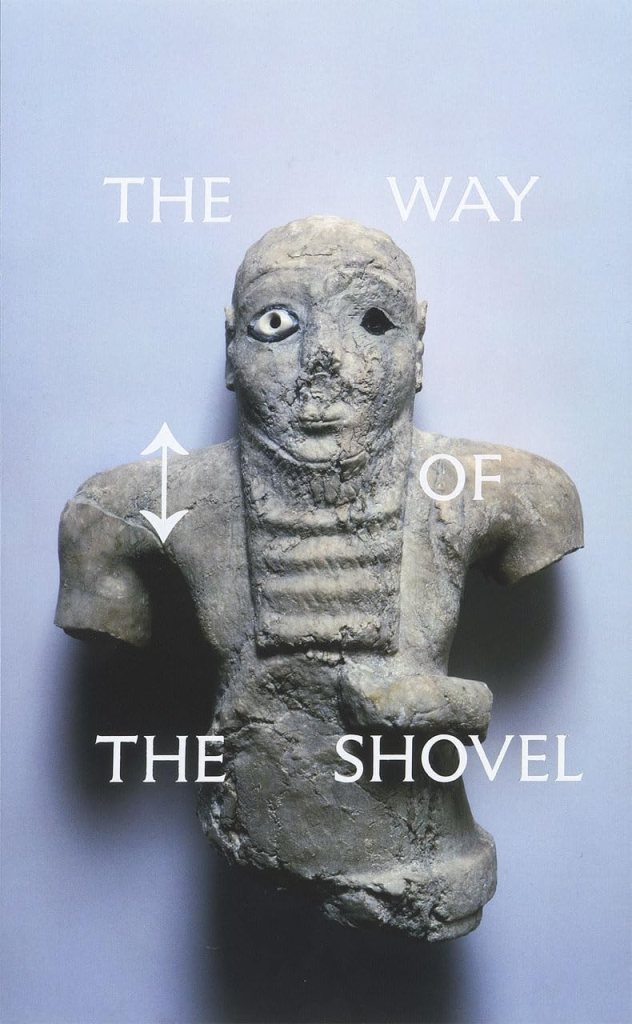
“Contemporary art is often obsessed with the new, but it has recently begun to turn to projects centering on research and delving into archives, all in the name of seeking and questioning historical truth. From filmmakers to sculptors to conceptualists, artists of all stripes are digging into the rubble of the past. In this catalog that accompanies an exhibition at the Museum of Contemporary Art Chicago in the fall of 2013, Dieter Roelstraete gathers a diverse range of international artists to explore the theme of melding archival and experiential modes of storytelling – what he calls “the archaeological imaginary” – particularly in the wake of 9/11. The Way of the Shovel offers a well-constructed balance among excursions into the situation of contemporary art, broad philosophical arguments around the subjects of history and the archive, and cultural analysis. Roelstraete’s opening essay maps the critical terrain, while Ian Alden Russell explores the roots of archaeology and its manifestations in twentieth-century art, Bill Brown examines artistic practices that involve historical artifacts and archival material, Sophie Berrebi offers a critique of the “document” as seen in art after the 1960s, and Diedrich Diederichsen writes on the monumentalization of history in European art. The book features work by both established and young artists, and thoughtful entries by Roelstraete accompany the exhibition catalog, along with statements from artists Moyra Davey, Rebecca Keller, Joachim Koester, Hito Steyerl, and Zin Taylor. The first exhibition to showcase this innovative approach to some of the most intriguing art of the past decade, The Way of the Shovel is indispensable for anyone seeking to understand the forces driving contemporary art.”

