“All one’s life is a music if one touches the notes rightly and in time” John Ruskin, The Ethics of Dust.
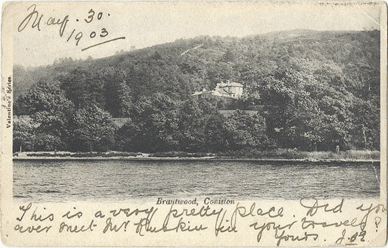
On a restorative trip to Windermere, Lake District, Cumbria we paid a visit to the humble yet handsome Brantwood, home of John Ruskin for the last 28 years of his life. I stood in Ruskin’s turret, an addition to the South West Corner of the house. The turret is simultaneously built into his bedroom and out into the landscape, overlooking Coniston Water. Autumn was ablaze, the pinnacles of the snow powdered peaks, beautifully treacherous, were reflected in the calm steel grey of Coniston Water. This strange quixotic space, a kind of architectural ecstasis, symbolises Ruskin’s ideal of the individual stepping forth encompassing one’s responsibility to oneself and to society. It is a liminal space, a threshold space, a space of transition between the enclosure and perceived comfort of the home and exposure to what lies beyond. The architecture and containment of the turret only served to heighten this sensation of struggle, physically and symbolically taking root in my imagination. I experienced something akin to “an intimate immensity”, Bachelard’s term for our imaginative capacity to inhabit a landscape internally.
“to stay what is fleeting, and to enlighten what is incomprehensible, to incorporate the things that have no measure, and immortalise the things that have no duration.” Bachelard.G The Poetics of Space
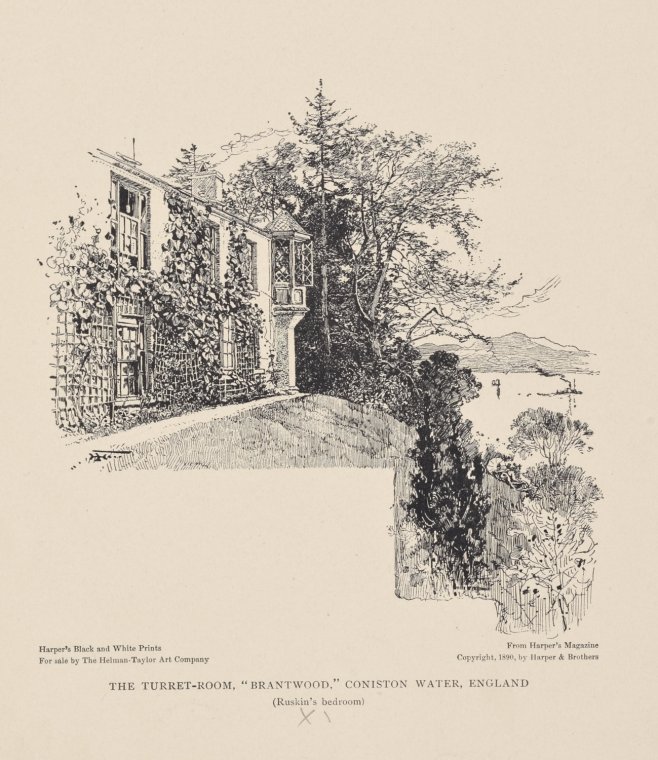
Ruskin had not lain in his bedroom for many years, a Fuselli like nightmare caused him to flee and never return. He said “One of the most provoking and disagreeable of the spectres was developed out of the firelight on my mahogany bedpost: and my fate, for all futurity, seemed continually to turn on the humour of dark personages who were materially nothing but the stains of damp on the ceiling.”(From a letter to Thomas Carlyle 23rd July 1878, Brantwood Quotations.)
Inhabiting this dichotomous space, the now public life of the once private interior, I performed a private ceremony in public, a simple gesture without fanfare – I laid my hand gently on Ruskin’s pillow seeking a resonance, a communion, whilst contemplating [….] how his prolific and nimble mind had been reduced to dust and silence after a lifetime of mental toil. His work had become his tomb. His ruined mind turned to the labour of the hand, the hand to the labour of the land, to heart and home.
It was there in the photo album on display in the adjoining room it was discovered that Ruskin’s much loved boat, painted in an electric blue, was named after the epic poem Marmion by Sir Walter Scott. Indeed since discovering Scott he has arrived unbidden at every turn, like an unwelcome visitor, that flibbertigibbet of a man! I imagined Ruskin holding court in one of his Salon’s whilst reciting Scott’s poetry which I understand he did frequently. Although it is noted by Ruskin that Scott’s house rebuilt in the Scottish baronial style is an ‘incongruous pile.”
When I spoke to Howard Hull, Director of Brantwood, and recounted my experience of the place and the connection between Ruskin, intimacy, and the performance of the private it struck a chord with him. We discussed various things including the idea of a project entitled Letters to the Landscape, which also struck a chord and we digressed into a discussion about the talismanic memory of objects, magical properties mythologised over time. Some of Ruskin’s belongings were distributed locally to the descendant’s of Ruskin’s circle but are now eventually finding their way home as the benefactors memory becomes severed through time from those who inherited them. Howard recounted an anecdote about the apparent discovery of Ruskin’s bookcases found “buried under 50 years of sawdust.” I laughed as it seemed to contain an unsettling portent as Howard said “The village undertaker tapped me on the shoulder from behind.” This immediately recalled another haunting encounter with a vanished object that had taken root in my consciousness, grabbing me with stony fingers, extending out of the gloom of history, as if to take possession…
Images reproduced from https://digitalcollections.nypl.org/items/9e279c0e-5485-d9e0-e040-e00a18067520 (accessed 07/03/22)



 denisestartin.co.uk