Passage

Coronia © Denise Startin

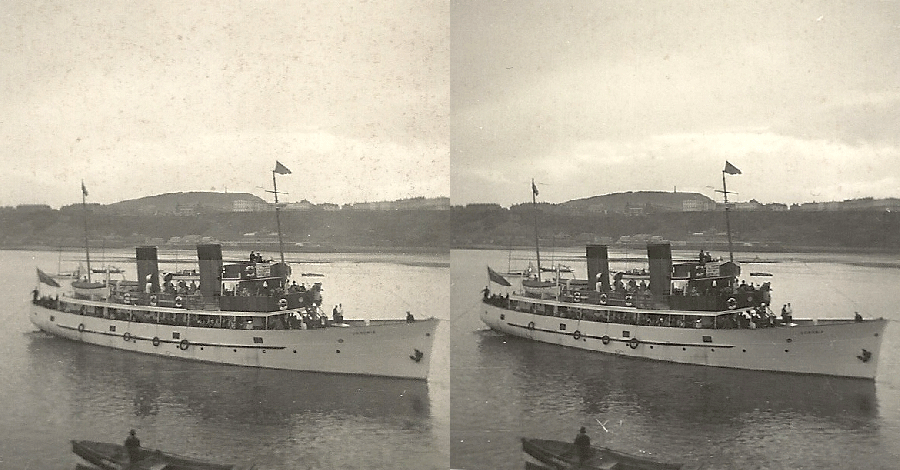
“VI A few examples: A sailor of antiquity in his boat, enjoying himself and appreciating the comfortable creations. Ancient art represents the subject accordingly. And now: the experiences of modern man, walking across the deck of a steamer: 1. his own movement, 2. the movement of the ship which could be in the opposite direction, 3. the direction and speed of the current, 4. the rotation of the earth, 5. Its orbit, and 6. The orbits of the stars and the satellites around it.

The result: an organization of movements within the cosmos centred on the man on the steamer.”

Extract from Paul Klee “Creative Credo 1920” quoted in Theories of Modern Art: A Source Book by Artists and Critics, Herschel Browning Chip, Peter Howard Selz, pp.186
The Devil’s Dictionary, Ambrose Bierce

Artist

Artist

Art, n. This word has no definition. Its origin is related as follows by the ingenious Father Gassalasca Jape, SJ.

One day a wag – what would the wretch be at? –
Shifted a letter of the cipher RAT,
And said it was a gods name! Straight arose
Fantastic priests and postulants (with shows,
And mysteries, and mummeries, and hymns,
And disputations dire that lamed their limbs)
To serve his temple and maintain the fires,
Expound the law, manipulate the wires.
Amazed, the populace the rites attend,
Believe whate’er they cannot comprehend,
And, inly edified to learn that two
Half-hairs joined so and so (as Art can do)
Have sweeter values and a grace more fit
Than Nature’s hairs that never have been split,
Bring cates and wines for sacrificial feasts,
And sell their garments to support the priests.

Text quoted from The Devil’s Dictionary by Ambrose Bierce, The Folio Society, London, 2003:pp15. Image reproduced from http://www.authorama.com/the-devils-dictionary-2.html [accessed 19072016}

One step forward/Two steps back (anon, anon, anon) – Three Steps into 2016

Left: Found Text in Samuel Butler Exhibition Catalogue ‘Travelling the Way of All Flesh’, Right: Robert Edwin Peary at the North pole by an unknown photographer

“We shall not cease from exploration
And the end of all our exploring
Will be to arrive where we started
And know the place for the first time.”

Yours for a resolute 2016

Extract from T.S Eliot’s Little Gidding, the last of Eliot‘s Four Quartets, 1942. Quote reproduced from http://www.columbia.edu/itc/history/winter/w3206/edit/tseliotlittlegidding.html