Exhibition text – Hints for British Tourists

Chalet Days I

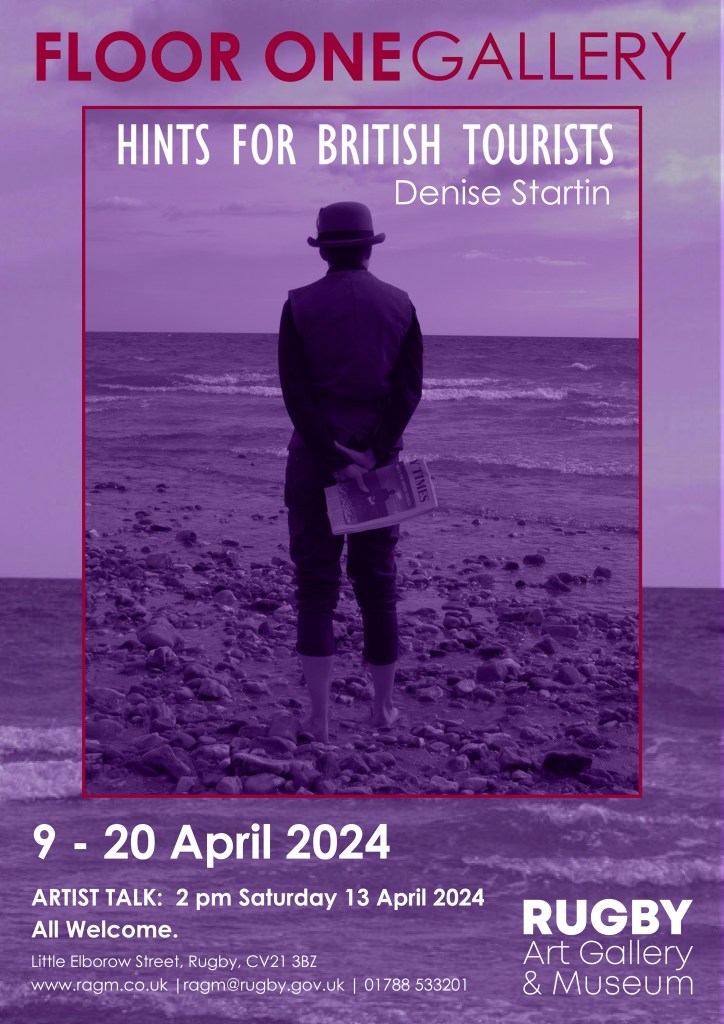
A figure in a bowler hat, waistcoat and rolled-up trousers brushes sand from their feet. They read a book in front of a painted beach hut, climb on rocks, clutch a newspaper, wait, fall asleep and lookout to sea. In one moment after another, we see tourism performed and time laid out in photographic frames like film stills.

Coventry-based artist Denise Startin presents a series of site-based performative actions, seen here via photographic documentation. The genesis of the exhibition Hints for British Tourists comprises two chance encounters: the discovery of a tourism pamphlet on eBay (also titled Hints for British Tourists) and a wall plaque on Hertford Street, Coventry, dedicated to the historic watchmaking trade that lists craftsmen Samuel Vale and George Howlette. The exhibition represents a re-staging and fictional expansion of these two very different starting points.

Vale & Howlette are adopted as dramatis personae in a wider body of work by the artist, becoming primary characters in a narrative that explores ideas of travel, leisure, time and memory performed by Startin herself and her partner. Startin’s work makes enquiries, both serious and humorous, that question what it means to be a tourist in post-Brexit England, in a world grappling with a pandemic and climate catastrophe, in a physical body that requires care and rest, and in a landlocked city more than one hundred miles from the nearest stretch of coastline.

The original pamphlet purchased by Startin was published in the former Yugoslavia in the 1970s, intended as a practical guide for travel. In it, the author observes, ‘One of the reasons I like Britain and the British, apart from liking the Sunday Times, cheese cake, Constables in the Tate, ‘apples and pears’ and not to mention the liveliness of their pubs is because their idea of a holiday is not just lying around on the beach and drinking.’ Startin’s work offers more than a nod to this ambiguous description, providing viewers with perspectives on place that appear both familiar and strange.

While also introducing historic travel mythologies relating to legendary, often unreachable places, the titles selected by Startin for the photographs shown – On the Rocks; Between a Rock and a Hard Place; Rush Hour – also point toward emotional states of being in motion, conflict, indecision or, indeed, indicate a sense of stillness. Vale & Howlette’s journey is as yet embryonic. They are on their way to who knows where.

Denise Startin studied at the Royal College of Art and has exhibited work at Compton Verney, Coventry Biennial and Whitechapel Gallery, London. She is the recipient of multiple awards and bursaries and has completed artist residencies in Wrexham, Surrey, Lands End and the Lake District.

Text by Anneka French
New Reading

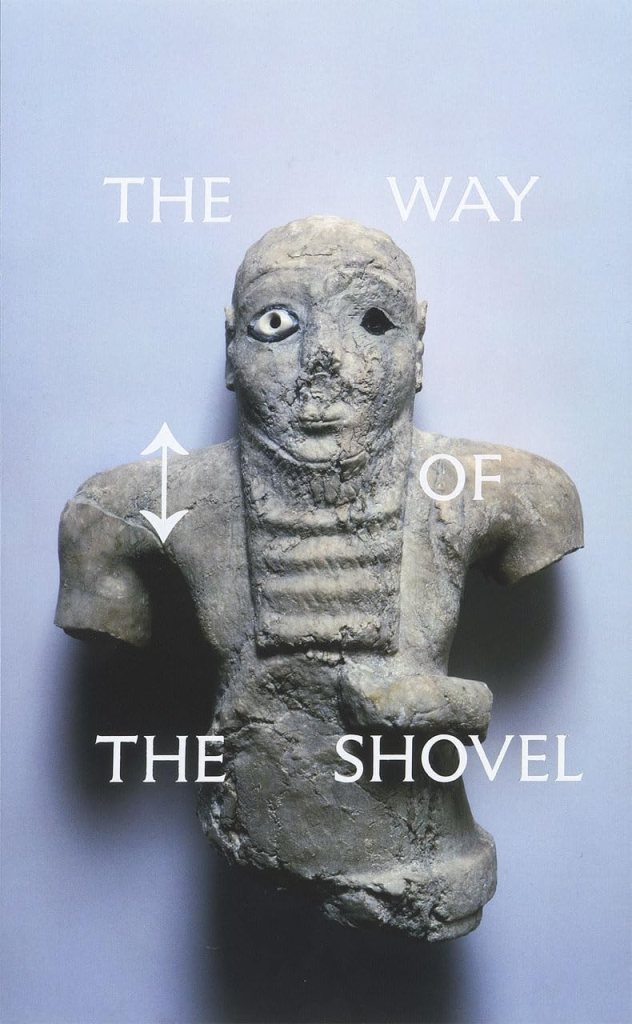
“Contemporary art is often obsessed with the new, but it has recently begun to turn to projects centering on research and delving into archives, all in the name of seeking and questioning historical truth. From filmmakers to sculptors to conceptualists, artists of all stripes are digging into the rubble of the past. In this catalog that accompanies an exhibition at the Museum of Contemporary Art Chicago in the fall of 2013, Dieter Roelstraete gathers a diverse range of international artists to explore the theme of melding archival and experiential modes of storytelling – what he calls “the archaeological imaginary” – particularly in the wake of 9/11. The Way of the Shovel offers a well-constructed balance among excursions into the situation of contemporary art, broad philosophical arguments around the subjects of history and the archive, and cultural analysis. Roelstraete’s opening essay maps the critical terrain, while Ian Alden Russell explores the roots of archaeology and its manifestations in twentieth-century art, Bill Brown examines artistic practices that involve historical artifacts and archival material, Sophie Berrebi offers a critique of the “document” as seen in art after the 1960s, and Diedrich Diederichsen writes on the monumentalization of history in European art. The book features work by both established and young artists, and thoughtful entries by Roelstraete accompany the exhibition catalog, along with statements from artists Moyra Davey, Rebecca Keller, Joachim Koester, Hito Steyerl, and Zin Taylor. The first exhibition to showcase this innovative approach to some of the most intriguing art of the past decade, The Way of the Shovel is indispensable for anyone seeking to understand the forces driving contemporary art.”

John Ogilby Brittania 1675

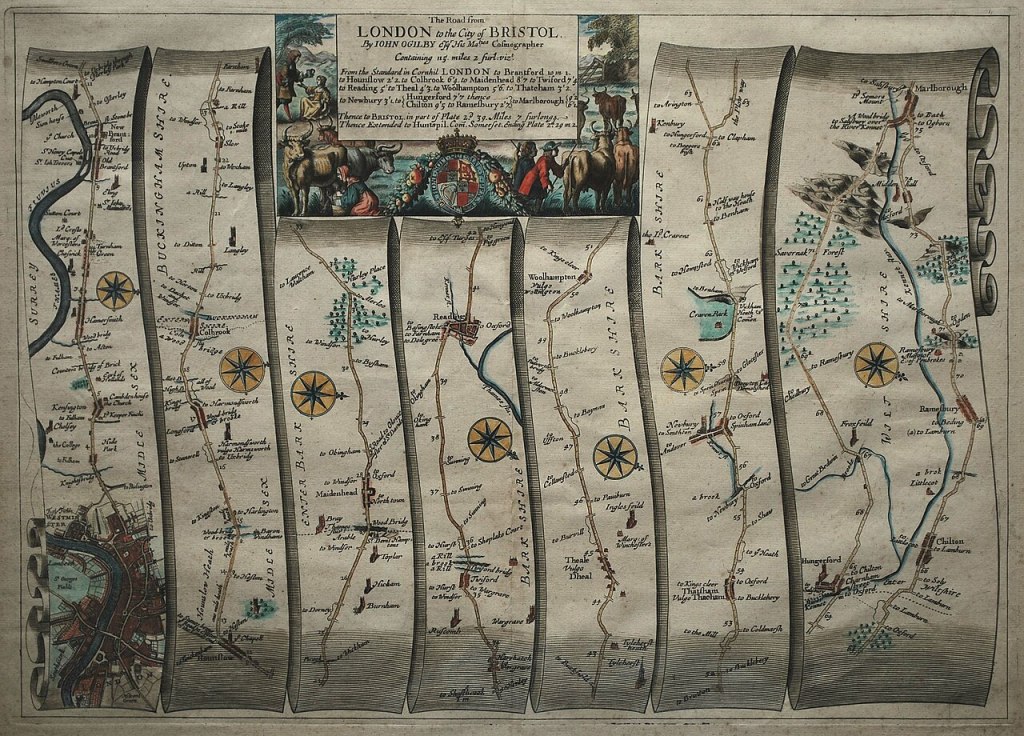
“John Ogilby, was born in Scotland in 1600, and held many different careers in his life; a dancing-master, theater owner, poet, translator, publisher and cartographer. He is most remembered for bringing English cartography into the scientific age with his 1675 road atlas of England and Wales titled, Britannia. To create the wonderfully detailed strip maps that displayed the topographical features and distances of the roads, Ogilby’s team of surveyors worked with the precise and easy-to-use perambulator or measuring wheel to record the distance of the roads in miles; implementing the standardized measurement of 1,760 yards per mile as defined by a 1592 Act of Parliament. They also used the surveyor’s compass or theodolite to better record the changes in the directions of the roads. Besides the use of scientific instruments, Britannia was also the first published work to use the scale of one inch equaling one mile, which became the prevailing scale for cartography. Through the use of detailed illustrations and precise technology, Ogilby’s Britannia became the first comprehensive and accurate road atlas for England and Wales, making it the prototype for almost all English road books published in the following century.”

1st image and text reproduced from https://blogs.lib.ku.edu/spencer/ogilbys-britannia-bringing-english-cartography-into-the-scientific-age/ (accessed 10/03/24). Map https://commons.wikimedia.org/wiki/Category:John_Ogilby_%281675%29_Britannia_Atlas#/media/File:John_Ogilby_-_The_Road_from_London_to_the_City_of_Bristol_(1675).jpg (accessed 10/03/24)

Currently Reading

This is a book about English art like no other.
Forget the tired rogues’ gallery of lords and ladies, forget the tall ships and haywains. These images cut to the heart of England’s psychic landscapes to portray an Albion unhinged, where magic and rebellion and destruction are the horses to which the country is hitched. On these fabled shores we are all castaways, whether our family has lived here for four thousand years or for four. Stephen Ellcock unleashes the magic and rebellion of England’s psychic landscapes through the power of images.  

Here you will find depictions of ancient trackways, chalk carvings and standing stones, of animal-masked community rituals, of streets set ablaze in protest, of occult dreams and psychedelic prophecies. There are over 200 images by artists ranging from William Blake, J.M.W. Turner and Samuel Palmer to Paul Nash, Louis Wain, Bill Brandt, Derek Jarman and Ithell Colquhoun to present-day visionaries such as Paula Rego, Cathy de Monchaux, George Shaw, Jamie Reid, Matt Collishaw, Tacita Dean, Lina Iris Viktor, Yinka Shonibare, Nick Waplington, Dan Hillier, Nicola Tyson, Sutapa Biswas and Chila Kumari Burman. The mind-blowing selection of images is accompanied by short texts by Mat Osman, exploring magic and mazes, ghosts and gardens, shipwrecks and cities. These poetic renderings of a spectral isle, together with Stephen Ellcock’s hallucinatory visual journey, reclaim Albion as an eternally inspiring and anarchic domain – an England on fire. 

Text reproduced from https://shop.tate.org.uk/england-on-fire-a-visual-journey-through-albions-psychic-landscape/35083.html (accessed 24/02/24)