Paper 9: Michael Drayton’s Topographies: Ideas Mirrour (1594) and Poly-Olbion (1612-1622), María Vera-Reyes

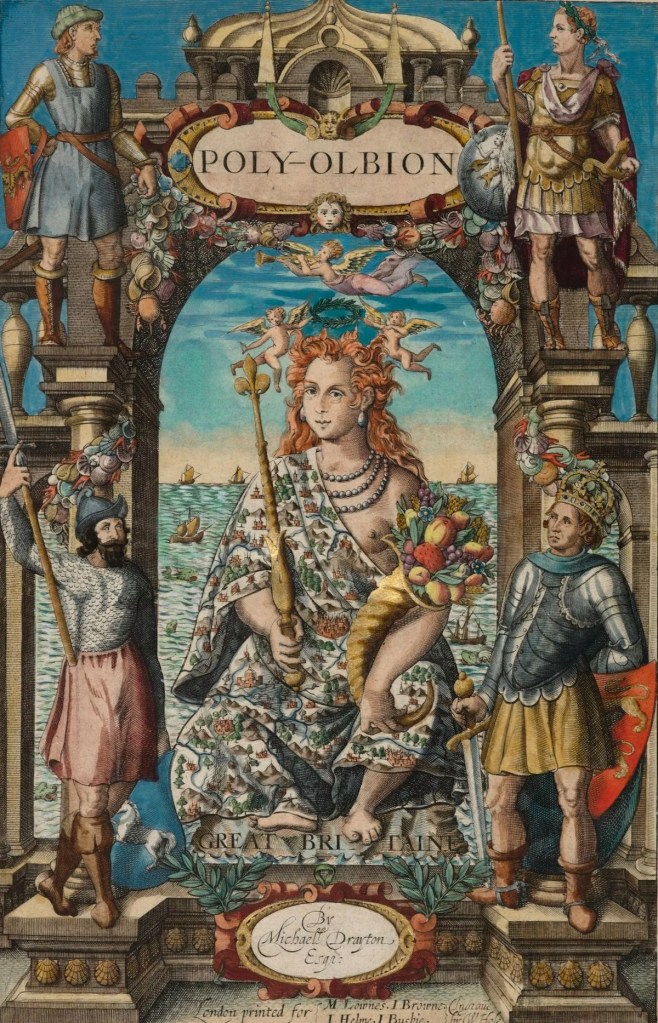
Poly-Olbion frontispiece

INTRODUCTION:

The purpose of this article is a comparative analysis of Drayton’s poems Ideas Mirrour and Poly-Olbion tracing echoes of the former in his latter richly chorographical work. For the purpose of this analysis the main focus is on Poly-Olbion as a prime exemplar of a chorographic work and I also aim to draw out strands that specifically follow the concept of the body as it pertains to one of my research questions: If a sensory physical mapping of place occurs prior to representation where is the body in the process of chorography and how do we address the political implications of the embodied in the act of representation? It appears this question is complex as bodies often appear symbolically in rich and intricate intertextual and iconotextual relationships. The body it seems emerges as a chimera hiding in plain sight like Poe’s purloined letter. A chorographic text such as Poly-Olbion offers tangible clues as to how this problematic might be addressed through practice.

POLY-OLBION (1612-1622):

Poly-Olbion is an expansive poetic journey through the landscape, history, traditions and customs of early modern England and Wales. Originally published in two parts (1612, 1622), it is also a richly collaborative work: Michael Drayton’s 15,000-line poem navigates the nation county by county and is embellished by William Hole’s thirty engraved county maps. It is accompanied for its first eighteen ‘songs’ by John Selden’s prose illustrations. Drayton was a contemporary of Shakespeare and Ben Jonson, and Poly-Olbion crystallizes early modern ideas of nationalism, history and memory.

Drayton’s Early Sonnets, Poly-Olbion and Chorography:

Reyes outlines how Drayton’s epic Poly-Olbion was influenced and connected to his earlier sonnets particularly Ideas Mirrour (1594) later published as Idea (1599-1631) which both reflect and explore his interest in the history and topography of his country and celebrate ‘the discovery of England.p.1002The central trope in the allegorical Idea is fluvial and Drayton draws on ‘chorographic techniques to represent the beloved.’ p.1003 The central figure Idea, as an ideal representation of woman contained within the ideal geography of the English landscape, is embedded in the River Anker which runs through Drayton’s home county of Warwickshire and later appears in Poly-Olbion ‘where the poet finds the woman that he had originally praised under the poetic name of Idea.’p.1014

In Poly-Olbion Reyes identifies close connections to distant genres including sonnet, sequence, perspective, pastoral, epic, the heroic, lyrical and topographical as Poly-Olbion comes to represent the ‘eroticisation of the landscape’. whilst simultaneously trying to reify Drayton’s English identity. p.1003 Developments at the time facilitated this vision in the ‘revival of geographical writings and advancements in cartography’ and the renaissance of chorographic works in the 16th-17th Centuries, the most notable exemplar of the genre being William Camden’s Brittania (1586) pp.1003-4. Other proponents of the descriptive and primarily textual approach to history and travel narrative included the antiquarian works of John Leland’s Itinerary (1549) and William Lambarde’s A perambulation of Kent (1576). The rise of the ‘body politic’ and the ‘vision of the allegorical body’ supported ‘a spatial construction of national identity.’ p.1004 The rediscovery of Strabo and Ptolemy presupposed the encyclopedist approach to the genre but one whose methodologies ‘favoured a qualitative and localist point of view with a pictorial quality.’  P.1004

Reyes states that ‘Drayton’s interest in topography and the human body was driven by the Golden age of cosmography and cartography in England […] and reflected the idea of a human being as a microcosmos.’ p..1006 According to D K Smith (XXXX no date given) in the 16th-17th Centuries this ‘resulted in a new cartographical epistemology and a cartographic imagination that provided English authors with a new set of metaphors and rhetorical tropes related to space and it’s embodiment.’ P.1006 Reyes states ‘the conception of the body as space determined the aesthetics of Poly-Olbion’. She cites Traub (XXXX no date given) ‘the description of human figures became a common aesthetic in Renaissance cartographies – ‘maps began to imply that bodies may be a terrain to be charted and is responsible for the chorographic function of human figures.’ P.1006 The ‘representation of the human body came to be seen as a ‘conglomerate of delimited spaces’. P1006 According to Reyes this explains the ‘anthropomorphizing representations of rivers, hills, mountains and forests’ in the maps of Poly-Olbion and that this representation of space is commensurate with a topographical representation of the body. P.1006 Between Ideas Mirrour and Poly-Olbion there is a ‘reciprocal movement from the topographical representation of the human body and the personification of the landscape’. P.1006. This personification of the landscape is represented in the above engraving, the frontispiece to Poly-Olbion which Helgerson (XXXX no date given) states is ‘a goddess like woman dressed in a map’ holding the horn of plenty, which symbolizes prosperity, and who stands as ‘a living embodiment of nature.’ P.1010

Map of Yorkshire, England, 1622 from Poly-Olbion

Fig.1

Image reproduced from https://www.walesonline.co.uk/news/wales-news/trend-grown-up-colouring-been-11487014 (accessed 06/02/24)

Fig.2

https://fineartamerica.com/featured/poly-olbion-map-of-yorkshire-england-1622-michael-drayton.html (accessed 07/02/24)

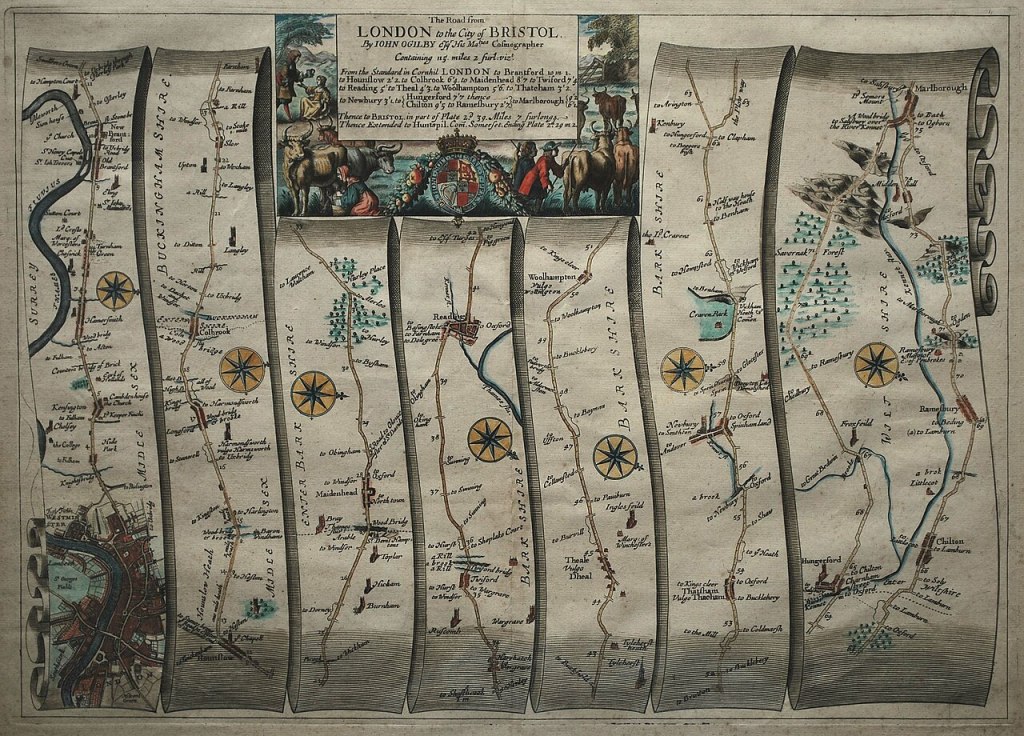
John Ogilby Brittania 1675

“John Ogilby, was born in Scotland in 1600, and held many different careers in his life; a dancing-master, theater owner, poet, translator, publisher and cartographer. He is most remembered for bringing English cartography into the scientific age with his 1675 road atlas of England and Wales titled, Britannia. To create the wonderfully detailed strip maps that displayed the topographical features and distances of the roads, Ogilby’s team of surveyors worked with the precise and easy-to-use perambulator or measuring wheel to record the distance of the roads in miles; implementing the standardized measurement of 1,760 yards per mile as defined by a 1592 Act of Parliament. They also used the surveyor’s compass or theodolite to better record the changes in the directions of the roads. Besides the use of scientific instruments, Britannia was also the first published work to use the scale of one inch equaling one mile, which became the prevailing scale for cartography. Through the use of detailed illustrations and precise technology, Ogilby’s Britannia became the first comprehensive and accurate road atlas for England and Wales, making it the prototype for almost all English road books published in the following century.”

1st image and text reproduced from https://blogs.lib.ku.edu/spencer/ogilbys-britannia-bringing-english-cartography-into-the-scientific-age/ (accessed 10/03/24). Map https://commons.wikimedia.org/wiki/Category:John_Ogilby_%281675%29_Britannia_Atlas#/media/File:John_Ogilby_-_The_Road_from_London_to_the_City_of_Bristol_(1675).jpg (accessed 10/03/24)

Poly-Olbion

William Hole’s frontispiece (from the Folger Shakespeare Library [http://luna.folger.edu/luna/servlet/s/7ihql3])

“Poly-Olbion is an expansive poetic journey through the landscape, history, traditions and customs of early modern England and Wales. Originally published in two parts (1612, 1622), it is also a richly collaborative work: Michael Drayton’s 15,000-line poem, which navigates the nation county by county, is embellished by William Hole’s thirty exquisite engraved county maps, and accompanied for its first eighteen ‘songs’ by the young John Selden’s remarkable prose ‘Illustrations’. Drayton was a close associate of Shakespeare and Ben Jonson, and his Poly-Olbion crystallizes early modern ideas of nationalism, history and memory.”

Image and text reproduced from https://poly-olbion.exeter.ac.uk/ (accessed 09/07/23)

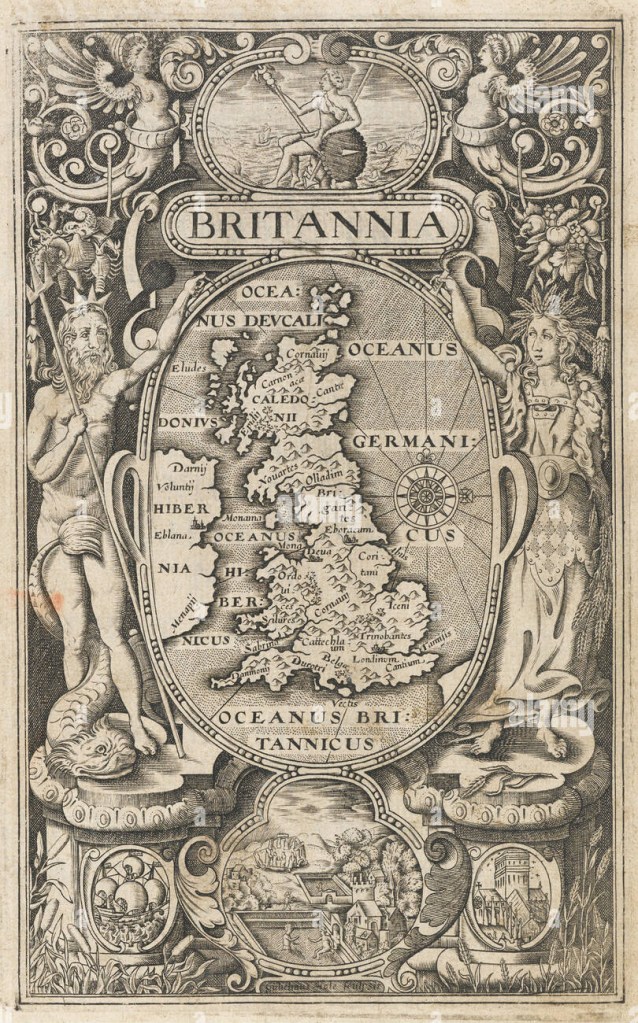
William Camden’s Brittania

“A map of England, Wales, Scotland eastern Ireland, in an oval supported by Neptune and Ceres, with vignettes of Britannia sitting on a rock, a ship, St Paul’s Cathedral, and Stonehenge and the Roman Baths. On the map London and York are marked, but most of the other names are tribes. This frontispiece was one of three maps engraved by William Rogers (c.1545-c.1604) for the 1600 edition of William Camden’s ‘Britannia’, the fifth edition of the work, yet the first to contain maps. It was not until 1607 that a full suite of county maps was included, alongside a larger version of this map, engraved by William Hole.”

Chorography designates “a regional map in Renaissance geographic texts and the artistic description of regions” viewed and experienced from within linking “regional events at the time of occurrence in pictorial representations.” (Olwig 2001 and Curry 2005 cited in Päivi Kymäläinen and Ari A. Lehtinen 2010: 252). Chorography or place‐writing forms an aspect of the tri‐partite structure belonging to a classical Geographic distinction between Topography, Chorography and Geography, Päivi kymäläinen and Ari A. Lehtinen (2010). Chorography, defined by the polymath Ptolemy in the Geographike Hyphegesis (c.149AD) takes region as its lens. This field-based approach and detailed descriptor of place qualitatively maps characteristics of the locale by examining the constituent parts of that place “to describe the smallest details of places.” Morra J, Smith M (2006: 17-18). Cormack states “Chorography was the most wide ranging of the geographical subdisciplines, since it included an interest in genealogy, chronology, and antiquities, as well as local history and topography…unit[ing] an anecdotal interest in local families and […] genealogical and chronological research.” (Cormack 1991 cited in Rohl 2011: 22).

Chorography was re-discovered in Renaissance Geography and British Antiquarianism 16th -17th centuries. Historically William Camden’s Brittania (1586) or a Chorographicall Description of the most flourishing Kingdomes, England, Scotland, and Ireland is an encyclopaedic approach to a geographic, historical topographical survey of the British Isles which has been identified as a classic exemplar of the renaissance of a chorographic work “connecting past and present through the medium of space, land, region or country.” (Rohl 2011: 22). Camden’s place in this changing historiographical framework of the English Renaissance is critical to elevating the field of historical studies in tandem with scientific documentation as a new and original contribution to knowledge and the discovery of ‘England’ and a sense of ‘Englishness’ (Richardson 2204: 112).

With its overriding pre-occupation with place Camden’s Brittania (1586), arranged chronologically, is a county-by-county survey of England & Wales which travels from the South to the North and represents a new ‘topographical-historical method’ (Mendyk 1986 cited in Rohl 2011: 22). The science of map making was still in it’s infancy but Camden was linked to its development and utilised it when it became available (Richardson 2004:117). Cartographic representations however “aim at synchronic representation”, chorographic descriptions of the countryside, by contrast, opt instead for the diachronic.” Reconstructing a topographically organised historical account in a specific area. Hence in Marchitello’s formulation “Chorography is the typically narrative and only occasionally graphic practice of delineating topography not exclusively as it exists in the present moment, but as it has existed historically. This means not only describing surface features of the land (rivers, forests, etc.), but also the “place” a given locale has held in history, including the languages spoken there, the customs of it’s people, material artefacts the land may hold, and so forth.” Marchitello in (Swann 2001, p.101). British Antiquarianism therefore retrieved chorography and recreated it in an expanded field, re-interpreting its legacy, ensuring its survival, restoration and continuing communication. Susan Stewart discusses the antiquarian as being “moved by a nostalgia of origin and presence” whose “function is to validate the culture of ground.” (1984:153)

Text reproduced from https://www.abebooks.co.uk/servlet/BookDetailsPL?bi=31158455803&cm_mmc=ggl--UK_Shopp_RareStandard--product_id=bi%3A%2031158455803-_-keyword=&gclid=CjwKCAiApvebBhAvEiwAe7mHSKrgSaHbIJ-gLMONnS4zfobOGGL_kNcSs86HQENjxVf97aIYKEEEchoCF4YQAvD_BwE (accessed23/11/22)

Image reproduced from https://www.alamy.com/frontispiece-map-of-britannia-from-the-early-printed-book-entitled-britain-or-a-chorographical-description-of-the-most-flourishing-kingdoms-england-scotland-and-ireland-and-the-lands-adjoining-out-of-the-depth-of-antiquity-beautified-with-maps-of-the-several-shires-of-england-written-by-william-camden-william-camden-may-2-1551-november-9-1623-was-an-english-antiquarian-historian-and-topographer-image246621803.html (accessed 23/11/22)