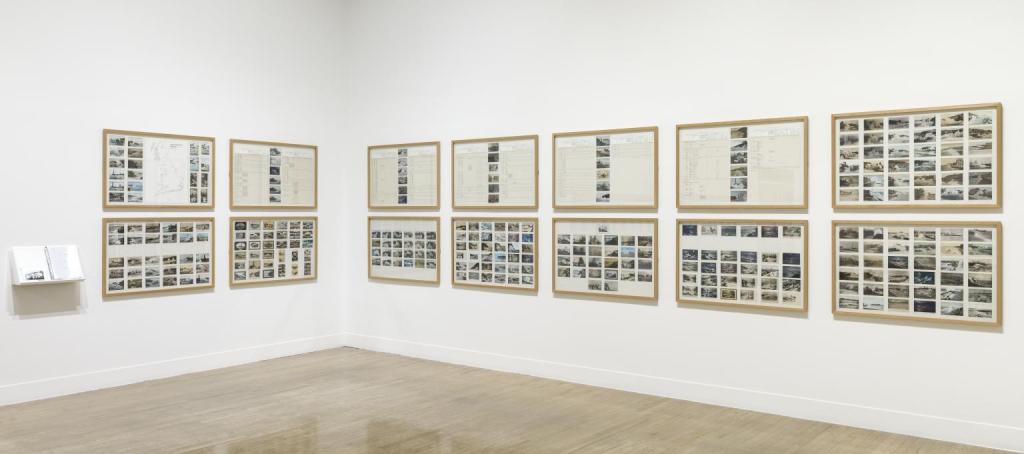
“Dedicated to the Unknown Artists 1972–6 consists of fourteen panels containing over three hundred original postcards depicting waves crashing onto shores around Britain. A large map annotated with each of the locations featured in the postcards is included in the first panel. The remaining panels have been subjected to what the artist has described as her ‘methodical-methodological approach’ (quoted in ‘Second Sight’ 2007, accessed 14 June 2018) and are organised into grids of postcards and tabulated details such as location, caption, legend, in vertical or horizontal format. Accompanying these panels are two additional components: a copy of a postcard-sized artist’s book and a dossier with supporting material, in which the artist describes herself as a curator presenting an exhibition of these overlooked cultural artefacts.
In 1977 Hiller discussed the work in the following way:
Dedicated to the Unknown Artists was designed as an exhibition piece with myself in the role of curator, collaborating with/extending the work of the unknown artists who created the Rough Sea ‘set’ of postcards. The ‘coincidental’ pairings of alternative descriptive languages – verbal and visual – are sustained as levels of presentation throughout the piece. While the charts may look like models of objectivity and the visual images like expressions of subjective internalizations, they lead to a series of paradoxes involving the unexpressed but intended vs. the expressed but unintended.
(Quoted in Tate Britain 2011, p.76.)
The work illustrates Hiller’s interest in the subject of memory and memorials. The title identifies the work as a tribute to the overlooked and forgotten artists who painted, photographed or hand-tinted the numerous seaside images in the postcards she collected. By making such commonplace objects the subject of a dedicated and extensive presentation, Hiller gives new status to the mundane and provides the viewer with a familiar access point from which to engage with the work. Dedicated to the Unknown Artists has also been described as a work about invisibility (see ‘Second Sight’ 2007, accessed 14 June 2018). The group of postcards only came to exist as a ‘set’ by the artist’s act of collecting them, and the visual correspondences that the collection highlights would have been previously unseen.
Hiller’s choice of sublime or picturesque seaside motifs – with their subtext of romantic desire, the soul in turmoil, and a longing for nature – contrasts with a strict conceptual methodology. Coloured images in particular were generally excluded from contemporaneous conceptual artworks, and yet for this work Hiller opted to make the genre of popular colour postcards of the British seaside her prime focus. However, the grid formation, the serial presentation and the typed labelling all recall the language of conceptualism. Writer Brian Dillon has noted: ‘That Hiller effected a study of the invisible precisely by exhibiting objects of such ravishing (and also kitsch) visual texture is surely exactly what made the work, at the time, such a scandal for adherents of an austerely linguistic Conceptualism.’ (Brian Dillon in Tate Britain 2011, p.52.)”
Further reading
Susan Hiller, exhibition catalogue, Tate Liverpool 1996, reproduced pp.12–13.
Susan Hiller, exhibition catalogue, Tate Britain, London 2011, reproduced pp.52–5.
‘Second Sight’, Frieze, no.109, September 2007, https://frieze.com/article/second-sight-1, accessed 14 June 2018.
Helen Delaney
May 2011
Image and text reproduced from https://www.tate.org.uk/art/artworks/hiller-dedicated-to-the-unknown-artists-t13531 accessed 02/01/24

 denisestartin.co.uk