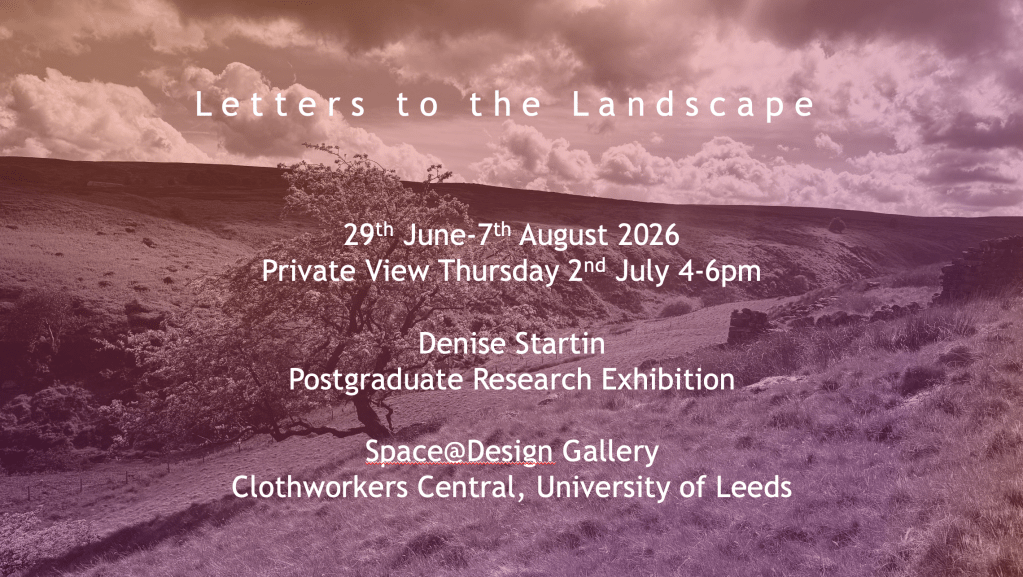
Letters to the Landscape Exhibition

Letters to the Landscape investigates the entangled relations between Brontë Country and the imaginative terrain of Emily Brontë’s Wuthering Heights (1847), situating the moorland as a site where cultural memory, literary inheritance, and embodied fieldwork converge. Operating at the intersection of autobiography, polyphony, and archival drift, the project examines how landscapes function as repositories of memory and projection, and how they mediate the unstable boundaries between fact, fiction, and historical imagination.

The research develops a mode of performative archival practice that reframes the archive as a haunted, migratory space rather than a fixed repository. Through the gathering and reanimation of postcards, letters, photographs, and field notes, the project mobilises archival fragments as gestures — provisional, affective, and resistant to evidentiary closure. These materials are activated through a choreography of walking, (re)collecting, re‑enacting, writing, reciting, and remembering, producing a form of speculative historiography in which remnants refuse to settle and meaning remains in motion.

The film adopts an episodic structure that mirrors the temporal and spatial logic of fieldwork. Its meditations and detours on place, collecting, pilgrimage, and return enact a methodology grounded in drift, repetition, and the recursive labour of remembering. The moorland is approached as landscape as witness — a terrain that absorbs and refracts cultural narratives, and a medium through which memory is contested, re‑authored, and felt.

Central to the research is the fictional artist duo Vale & Howlette, who operate as narrative interlocutors, structuring devices, and speculative tools. Their pseudonymous perspectives enable a slippage between researcher and archive, past and present, document and invention. As explorers, (mis)guides, and mnemonic surrogates, they facilitate a mode of inquiry that is materially grounded yet imaginatively expansive, allowing the archive to function as a site of resonance, resistance, and re-imagination.

The project privileges fragment, rupture, and affective resonance over institutional fixity, proposing a methodology of situated refusal — a way of inhabiting the archive and the Brontë imaginary without claiming it. Letters to the Landscape contributes to practice‑based research by articulating how embodied fieldwork, fictional apparatus, and archival speculation can generate new modes of historiographic thinking and new forms of artistic knowledge.
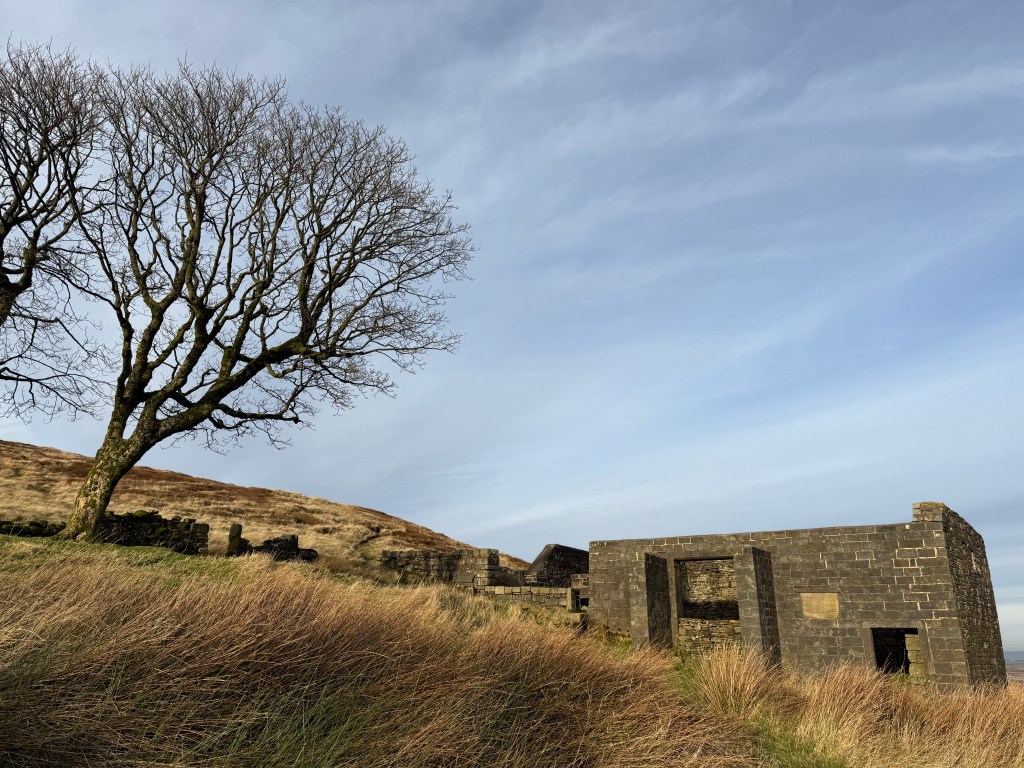
Episode 3 The Reluctant Pilgrim

Top Withens, reputed site of Wuthering Heights (Brontë, 1847), photograph by Samuel Vale, Executive Producer and Director of Photography

The ice on the path snapped, crackled and splintered underneath the soles of their walking boots. The ground was frozen solid. She felt as though she were walking with two blocks of ice strapped to her feet. She could feel the ground in her knees. The sound of her boots walking on frozen ground was like the crunching of bones. The chill of the wind sweeping across the moors caused her teeth to chatter in her head like a pair of castanets. Emily writes, she writes: “I lingered under that benign sky watched the moths fluttering among the heather and harebells, listened to the soft wind breathing through the grass”. I remembered there is a spot mid barren hills where winter howls still, bringing a chill to the marrow.

By this time her toes were numb and every step was agony, her boots were rather too small, she made a reluctant pilgrim. She had lost track of time by stopping to take photographs on the way but photographs of what exactly? A seemingly vast, empty and undifferentiated landscape that she experienced as a rupture or a disjunction. The landscape was not easy to assimilate. it remained resolute and other. She was in the middle of it but couldn’t get into it, so she remained steadfastly on it for the duration of the walk. Time and space expanded in multiple directions on the Moors like the ripples on a pond. Three hours of walking felt like three years of living. The closer they got to Top Withens the further away it seemed to. Be. For an age it remained a tiny speck on the horizon.

He disappeared over a mound and briefly she found herself alone with naught but a wuthering wind whistling around her eardrums and flapping against her face. How exactly was she to report any of this back to George? She was famished.

On the 18th of May 1893, Top Withens was struck by lightning during a thunderstorm. Holes were made in the wall, the roof was partially torn off, flags were cracked, and around 30 windows were almost completely removed. A portion of slate was thrown far from the house by the wind, and in the kitchen the blade of a knife had been fused by the heat.

Overview of Practice

This research is grounded in an interdisciplinary, practice-led approach that stages chorography as both methodology and mode of inquiry, privileging process, embodiment, and creative experimentation. In practice, this approach is realised through a body of work spanning moving-image, photography, installation, site-specific intervention, and performance writing, all situated at the intersection of embodied fieldwork, archival play, and speculative narrative. Through these forms, I interrogate how archival fragments, textual, visual, and artefactual, can be (re)collected, reinterpreted, and reanimated via sensory gestures, narrative slippage, and acts of embodied citation. Central to this practice is the activation of dramatis personae who act as narrative interlocutors, structuring devices and speculative figures that enable a slippage between researcher and archive, past and present, fact and fiction. These rhetorical figures operate as explorers, (mis)guides, and mnemonic surrogates, enabling a mode of fieldwork that is both materially grounded and imaginatively expansive. Through them, the archive becomes a vehicle of resonance, resistance, and reimagination, staging historiographic instability and opening up space in the archive for embodied speculation, where gestures of citation are enacted rather than merely recorded. In doing so, my work reframes the archive not as a static repository but as a haunted, migratory space that moves across media, bodies, and temporalities where landscapes, bodies and narratives converge.

A significant aspect of this approach is the construction of a vernacular archive sourced from eBay, whose algorithmically curated collections of letters, postcards, and photographs stand in deliberate contrast to institutional archives. This contingent, everyday archive both initiates and shapes the fieldwork, foregrounding the fragmentary, ephemeral, and unpredictable nature of memory, collection, and research. Through a performative archival practice, walking, (re)collecting, re-enacting, writing, re-citing, reciting and remembering, the landscape is activated as a mnemonic terrain and the archive as a live site of negotiation, resonance, and resistance, where memory is contested, reanimated, and re-authored. This project is situated in Brontë Country, West Yorkshire, a landscape dense with literary, historical, and affective resonances. Here, I privilege fragment, rupture, and affective encounter over any claims the archive might have to institutional fixity or control by adopting a methodology of situated refusal, a way of inhabiting the archive without claiming it. This approach foregrounds the politics of memory, whose stories are told, whose gestures preserved while advancing chorography as a feminist, performative, and practice-led methodology for reimagining place, history, cultural memory and the performative construction of identity.