Currently Reading

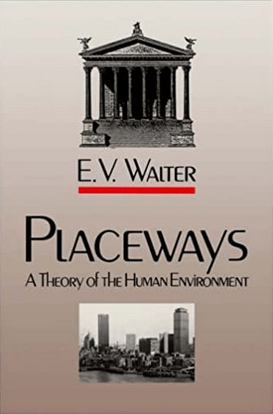
“Placeways is a philosophical and historical interpretation of the experience and meaning of place. Searching for a way of knowing and living in the world that does not fragment experience or exploit the environment, E. V. Walter explores the way people in other cultures and other times have experienced place. The book develops Walter’s theory of topistics – a holistic way of grasping a place as the location of shapes, powers, feelings, and meanings. Exploring the common ground of such diverse fields as philosophy, history, urban planning, classics, cultural geography, architecture, sociology, and environmental psychology, Walter provides theoretical resources for readers who want to rescue the human environment from the loss of feeling and meaning. Walter discusses a wide variety of places, from prehistoric caves, the Australian desert, and classical Greece to medieval towns, Renaissance cities, and modern slums. He examines the changing realities of expressive space and reveals the nonrational, symbolic, and intuitive features in our experience of places – elements taken for granted by archaic peoples but discounted by modern civilization. The current crisis of environmental degredation, according to Walter, is also a crisis of places. For the first time in human history, people are systematically building meaningless places. If we are to comprehend and reverse the ruin and dislocation of our cities, we must develop another way of understanding the built environment and the natural landscape. True renewal, Walter says, will require a change in the way we structure experience and a return to an ancient paradigm for understanding both the natural land and the constructed world.”

Text and image reproduced from https://www.amazon.co.uk/Placeways-Theory-Environment-V-Walter/dp/0807842001 (accessed 01/10/22)

Chorophilia – choros and topos

Antigone by Frederic Leighton, 1882

“To differentiate certain special features in the experience of places many Greek writers used two separate words – chora and topos – as distinct verbal representations. Ptolemy’s perspective, which assigns to chorography the “quality” of places includes the oldest significance of the term chora. The word, the prefix of “chorography” meant place, and in different contexts it also signified region, or country, or space. The word topos, prefix of “topography,” also meant place, but the subtle and changing relations between choros and topos makes an important chapter of intellectual history. Chora stands out as the oldest Greek word for place, appearing in Homer & Hesiod. Topos emerged initially in the work of Aeschylus, that is, not until around 470 B.C.

In antiquity a writer could say chorophilia for love of place but never topophilia. In the classical language, topos tended to suggest mere location of the objective features of a place, and Aristotle made it into an abstract term signifying pure position. The older word chora -or sometimes choros– retained subjective meanings in the classical period. It appeared in emotional statements about places, and writers were inclined to call a sacred space a chora instead of a topos […] Sometimes the two words appeared together.

For example, in the opening of Sophicles’ Oedipus at Colonus, Antigone and her blind father, Oedipus, stop at a resting place, and she says “As for this choros it is clearly a holy one.” He enquires where they are. She replies she does not know the choros, but also asks him if she should go and find out what topos it is. Later in the play, he tells Theseus that he will show him the choros where Oedipus must die, but warns Theseus not to reveal the topoi in which it lies. Here, topos stands for the mere location or the container of the sacred choros, the grave.”

Walter, E,V. (1998) Placeways: A Theory of the Human Environment, USA: UNC Press Books, pp.120. Chapter 6, The Energies of Places. Image Antigone by Frederic Leighton, 1882, reproduced from https://en.wikipedia.org/wiki/Antigone (accessed 03/10/22).