So I’m really struggling with the writing since I have so many drafts, edits and supervisor comments, I’ve gone a bit word blind so I will periodically be posting the writing here so I can see how it scans in a publishing space. This is either the Introductory Chapter or it could possibly be a Literature Review or Methodology Chapter. I just thought I should write an introduction to give myself a framework and set the scope of the chapter.
Synopsis for Thesis
Chapter X establishes the conceptual and methodological foundations for the thesis, positioning chorography as a dynamic and speculative tool for contemporary artistic research. Tracing chorography’s genealogy from its classical origins through Renaissance and British Antiquarianism to its re-emergence in performance and archaeology, the chapter reframes it as a site-responsive, feminist, and performative practice. Organised around four thematic clusters, Cartography and Representation; Regional Histories, Literary and Experiential chorography; and Spatial Representation and Deep Mapping, it provides a framework for analysing how artists collect, narrate, re-present, and perform place. The chapter critically engages with figures such as William Camden, Daniel Defoe, John Macky, Walter Scott, and Emily Brontë, as well as previously marginalised women, to outline a literary and artistic lineage informing the thesis’s approach to landscape and cultural memory. It argues that chorography, when resituated within artistic practice, offers new ways to stage landscape, perform memory, and construct cultural identity. It introduces key methodological and theoretical terms such as performative archival practice (as a practice-led methodology), positionality (Alcoff 1988), and speculative feminist historiography, an emergent analytical lens that the practice research performs or gestures toward. These approaches will be enacted through a range of methods, including moving image, performance writing, script, installation and multimodal practice. The chapter also identifies gaps in the literature, notably the exclusion of female chorographers, and advances chorography as a ‘travelling concept’ (Bal, 2002) capable of crossing disciplinary and temporal boundaries, setting the stage for the practice-led explorations that follow in the thesis.
Chapter X Mapping the Territory: Situated Cartographies of Method, Memory, and Material Trace
“Reflecting eighteenth-century antiquarianapproaches to place which included history, folklore, natural history, the deep map attempts to record and represent the grain and patina of place through juxtapositions and interpenetrations of the historical and the contemporary, the political and the poetic, the factual and the fictional, the discursive, the sensual, the conflation of oral testimony, anthology, memoir, biography, natural history and everything you might want to say about a place”
(Pearson & Shanks, 2001, pp.64-65).
This chapter establishes the contemporary relevance and methodological potential of chorography for artistic research, particularly in relation to the core themes of the PhD: landscape, cultural memory, history, performativity, and identity. This excavation is not merely historical; it is methodological and speculative. Rather than treating chorography as a purely historical practice, I reanimate it as a site-responsive, feminist, and performative mode of inquiry, one capable of excavating overlooked narratives, reanimating vernacular memory, and creating symbolic resonances. By tracing chorography’s layered genealogy from its classical origins (Ptolemy, 149 AD), through the Renaissance and British Antiquarianism (Camden, 1586), to its re-emergence in contemporary discourse, I highlight its renewed significance in the work of Pearson (2006) and Rohl (2011, 2012, 2014), who explicitly engage with chorography, as well as in the collaborative work of Theatre/Archaeology (Pearson & Shanks, 2001) and contemporary Archaeology (Shanks & Witmore, 2010), where chorography becomes a means of mapping memory, materiality, and narrative within landscapes While Pearson and Shanks (2001) do not always explicitly invoke chorography, their interdisciplinary practice, particularly through the development of deep mapping and the performative investigation of place, exemplifies many of its core principles and demonstrates its potential for mapping memory, materiality, and narrative within landscapes. I therefore position chorography as both a conceptual lens and a methodological framework. This approach enables a situated exploration of artistic, archival, and embodied engagements with landscape, mapping the entanglements of place, narrative, and cultural memory.
The history of chorography spans centuries and encompasses a range of definitions, practices, and disciplinary interpretations. Given the scale and complexity of the field, often reflected in encyclopaedic and multi-volume works, a comprehensive account is beyond the scope of this thesis. To navigate this density and complexity, I have identified four thematic clusters drawn from a close reading of the literature. This chapter is therefore organised around: Cartography and Representation; Regional Histories, Literary and Experiential chorography; and Spatial Representation and Deep Mapping (Heat-Moon, 1991; McLucas, 2015; Roberts, 2016; Biggs, 2014; Bodenhamer, 2015). Unlike conventional mapping, deep mapping engages with place through a process that is dynamic, iterative and performative. It treats the landscape not as a static backdrop but as a multilayered tapestry of stories, memories, and events, revealed and reimagined through the act of mapping. Deep mapping is the contemporary analogue of chorography (Pearson and Shanks 2001). These clusters elucidate chorography’s methodological richness and interdisciplinary flexibility, and offer a manageable, conceptually coherent framework for approaching chorography within contemporary artistic research. Structuring the conceptual field, they offer a basis for analysing how artists collect, narrate, re-present, and perform place. This research also draws on the chorographic approaches developed in the epistolary and tour writings of Daniel Defoe (1724) and John Macky (1714) (Connell, 2015), as well as on the contributions of marginalised women whose performative, epistolary, pseudonymous, and collaborative approaches have yet to be recognised within the field, but whose work this project argues has the potential to reshape chorographic practice. Emphasising practices of fieldwork, correspondence, first-person narration, and collaboration in their work, reframes chorography as a speculative, dialogic, and performative methodology for mapping landscape and memory. Critical engagement with figures such as Scottish novelist, poet, historian and ‘literary’ antiquarian Walter Scott, particularly his poem The Lay of the Last Minstrel (1805) and English novelist and poet Emily Brontë, who was influenced by Scott, enables the tracing of a literary and artistic lineage that informs this thesis’s approach to place-making and narrative construction. While Scott’s historical novels, such as The Heart of Midlothian (1818), construct landscapes as mnemonic archives, spaces where fiction and history coalesce to produce a vernacular sense of place, his poetry exemplifies an early chorographic impulse: to map cultural memory through storytelling (Shanks & Witmore, 2010).
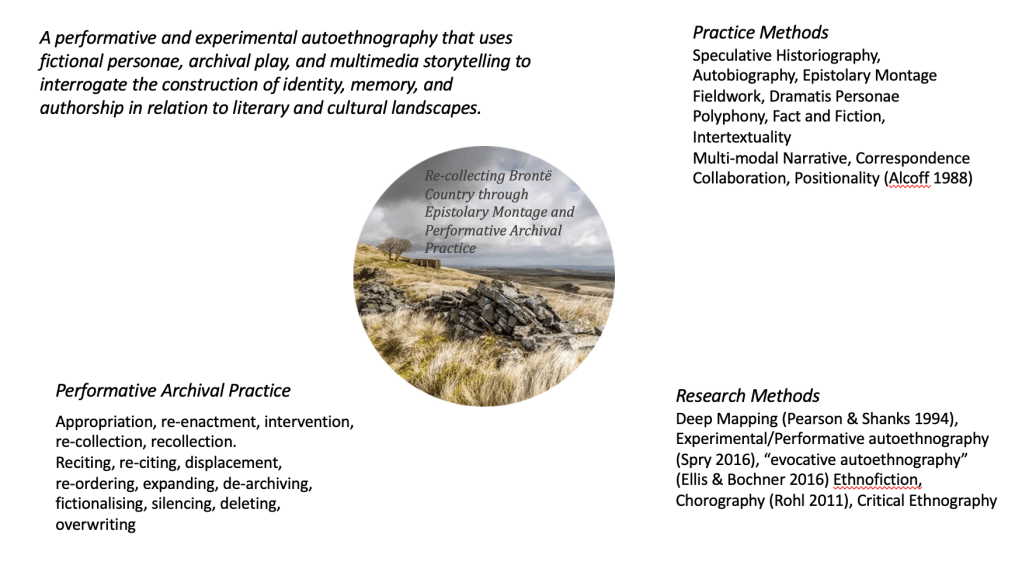
Brontë’s Wuthering Heights (1847), by contrast, presents a gothic landscape where the moor becomes a site of affective intensity, feminine resistance, and narrative fragmentation, using letters and nested narratives in ways that anticipate later feminist reimaginings of terrain and memory (Rose, 1993; Massey, 2005). Their works, along with those of later 20th-century writers such as W.G. Sebald, provide historical and speculative precedents for the methodologies developed in the practice-led research that follows. Clarifying the conceptual terrain this chapter introduces key methodological and theoretical terms such as performative archival practice (as a practice-led methodology), positionality (Alcoff 1988), and speculative feminist historiography, an emergent analytical lens that the practice research performs or gestures toward. These approaches will be enacted through a range of methods, including moving image, performance writing, script, installation and multimodal practice. It also identifies gaps in the literature, notably the exclusion of female chorographers, and advances chorography as a ‘travelling concept’ (Bal, 2002)capable of crossing disciplinary, temporal, and epistemological boundaries. This chapter proposes that, when resituated within contemporary artistic practice, chorography becomes a method to stage landscape, perform memory, and inscribe oneself into the terrain of cultural identity by drawing on Cosgrove’s (1984) exploration of landscape as a cultural and symbolic construct and Massey’s (2005) theorisation of space as gendered, dynamic, inherently social and key to the formation of identity. Chorography is positioned not just as a representational tool, as it was historically practised and understood, either as a pictorial map (Renaissance geography) or as a written text (British antiquarianism), but also as a performative and speculative methodology.Here, place is not just represented, but actively inhabited, enacted, and reimagined, setting the stage for the speculative, feminist, and practice-led explorations that follow. The thesis explores this through embodied fieldwork, archival gestures, and the creation of fictional personae who traverse the moorland landscapes of Brontë Country and beyond.
 denisestartin.co.uk