“I am large, I contain multitudes” Walt Whitman

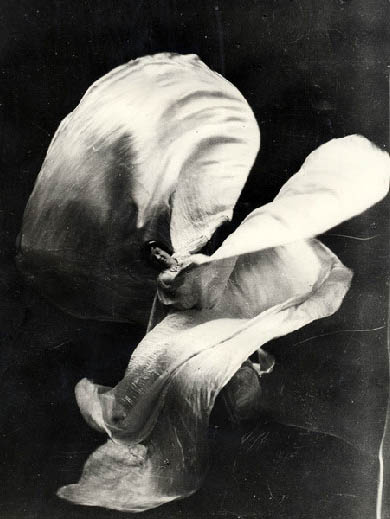
Loïe Fuller, Le Dans du Lys, ca.1902. Photo: W.Isaiah Taber

“In relation to Loïe Fuller insofar as she spreads round about, with veils attached her person by the action of dance, everything has been said in articles, at times in poems. Exercise as invention, without employ, admits of an artistic rapture and at the same time an industrial accomplishment.

In the terrific bath of fabrics there swoons, radiant, cold, the dancer who illustrates many a giratory theme in which a distant fulsome woof tautens, giant petal and butterfly, unfurling all in a clear-cut and elementary order.

Her fusion with swift nuances shedding their hydroxic fantasmagoria of twilight and of grotto, such rapidities of passions, delight, mourning, ire: to move them, prismatic, with violence or diluted, the dizziness is needed of a soul like an airing of artifice. That a woman may associate the flying off of vestments with dance, potent or vast, to the point of sustaining them, infinitely as her expansion. The Lesson depends on this spiritual effect.”

Text Stéphane Mallarmé, National Observer, 1893 quoted from Art and Utopia, Restricted Action, pp.86

Book

Jasper Johns, Book 1957, Encaustic on book and wood

Jasper Johns, Book 1957, Encaustic on book and wood

“The book’s obviousness, its palpable presence, is thus such that we have to say that it exists and is present since without it nothing could ever be present, and yet that it never quite conforms to the conditions of real existence.” Maurice Blanchot

Text reproduced from A Survey of materiality in Literature by James Stuart, for the rest of the article click here

Image reproduced from The disappearance of objects: New York art and the rise of the postmodern city

Thinking on Paper

“A radical experiment in design and typography Stéphane Mallarmé’s poem Un Coup De Des (A Throw of the Dice will Never Abolish Chance 1897) privileges form over content or rather form as content , such that blank space, varied typography and the material folds of the book augment and even transform the semantics of the text. As Mallarmé writes in his preface to the first issue of the poem:

“The paper intervenes every time an image on its own, ceases or retires within the page, accepting the succession of the others, and it is not a question unlike the usual state of affairs, of regular sound effects or verses – rather of prismatic subdivisions of the idea, the instant when they appear and during which their cooperation lasts , in some exact mental setting. The text imposes itself in various places, near or far from the latent guiding thread, according to what seems to be the probable sense.”

(For the French version and (albeit different) English translation click here.

Text reproduced from http://directory.eliterature.org/node/573 Image reproduced from http://www.wookmark.com/image/8624/crumpled-white-paper-texture-by-melemel-jpeg-2048-1536

Friedrich Nietzsche

“The assumption of a single subject is perhaps unneccesary: perhaps it is just as permissible to assume a multiplicity of subjects whose interaction and struggle is the basis of our thought and our consciousness in general? A kind of ‘aristocracy of cells’ in which dominion resides? To be sure, an aristocracy of equals, used to ruling jointly and understanding how to command? My hypothesis: The subject as multiplicity. ” (Nietzsche 1968: 270)

For a short but informative passage about Nietzsche and the musical rythms (Also pursued in different ways by Phillip Lacoue-Labarthe and Julia Kristeva) in his texts click here

Text reproduced from Elizabeth Grosz, Volatile Bodies, Toward a Corporeal Feminism, Indiana University Press, 1994: p.122

Image reproduced from http://philossophy.wordpress.com/2010/04/10/modernity/