“When I thought about what I could write you, what I could show you I thought of this letter…”
epistolary
Letters to the Landscape 2025 – About

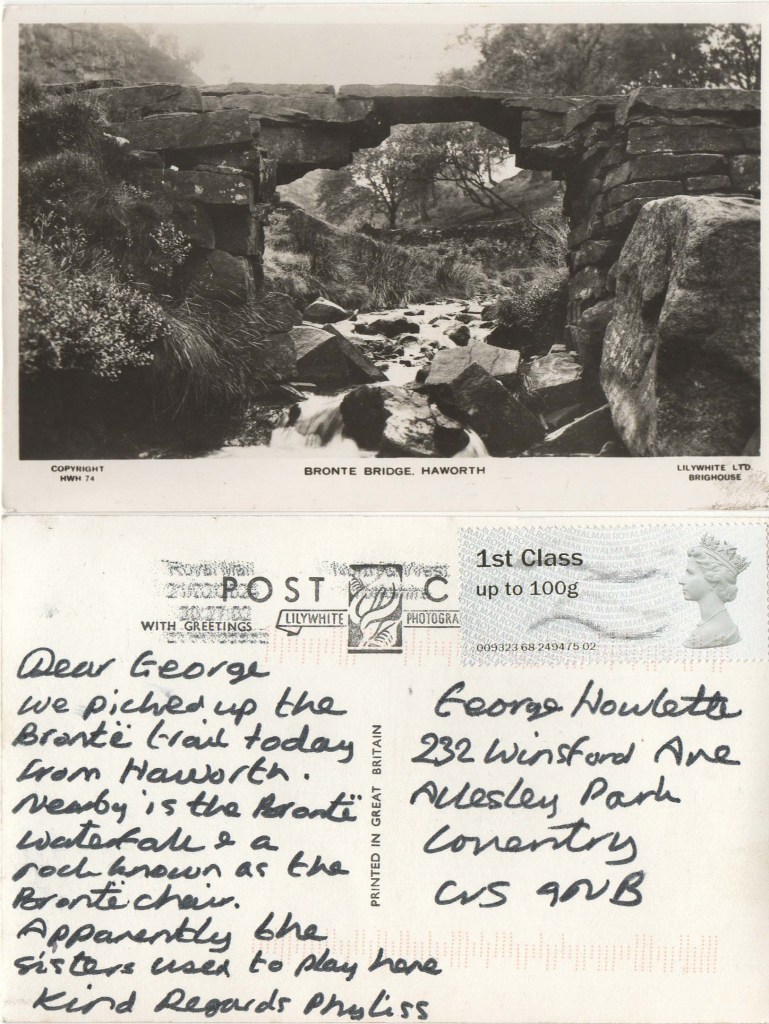
Letters to the Landscape is an epistolary dialogue and travelogue exploring the relations between Brontë Country and Emily Brontë’s Wuthering Heights (1847). The artist uses various strategies of production including polyphony, narrative, autobiography, fact and fiction and the intimate to interrogate authorship, authenticity, and the role of narrative and collections in shaping cultural memory. This cinematic essay incorporates postcards, letters, pinhole photography, digital photography, found images, found texts and Super 8. The script is non-linear and hangs together as a series of episodes or meditations and incorporates other writers and voices including J.G Ballard, René Daumal, actress Merle Oberon, Elizabeth Gaskell, Charlotte Bronte’s biographer and Emily Brontë to name a few. The work has been constructed and fabricated through the interaction of several pseudonyms who constitute the research team and the film crew, operating under the fictional artist duo Vale & Howlette. Adopting these dramatis personae in a broader narrative framework, Vale & Howlette become primary characters in a narrative that explores the performance of identity through ideas of place, history, travel, time and memory. This body of work is entitled The Chronicles of Vale & Howlette (2021 to date). The fictional artist duo Vale & Howlette interrogate authorship and authenticity, the work explores how identity, place, and memory are performed and constructed through a multi-media approach incorporating narrative, image, collections and the archive.
The work is initiated through a fictional conceit as the response to a ‘found’ collection of old photographic equipment (utilised in the film), personal letters and photographs and over 300 postcards of Brontë Country which are used both for the fieldwork and to punctuate the films episodic narrative. This series of episodes or meditations include episode 1: Epistles, a meditation on the epistolary and the act of letter writing, Episode 2: To Have and to Hold is a meditation on the collection and the act of collecting, Episode 3: A Reluctant Pilgrim is a meditation on the journey to Top Withins (reputed inspiration for Wuthering Heights, Emily Brontë, 1847). Episode 4: A Lovers Spat re-imagines and re-writes the relationship between the two main protagonists in Wuthering Heights, Cathy & Heathciff and Episode 5 is a personal meditation on the act of dying which also symbolically represents the death of the female protagonist, Cathy in Wuthering Heights and the death of Emily Brontë. By foregrounding the fictional personas of Vale & Howlette, the work invites audiences to question the boundaries between fact and fiction, artist and character, author and place. It invites reflection on how artistic practice can be used to question historical narratives and reimagine place-based storytelling through the act of collecting.

Fiona Tan – Footsteps 2023-2024

“Footsteps (2022) is a 97-minute video installation made by Fiona Tan at the invitation of Amsterdam’s Eye Filmmuseum. The work combines archival film footage from the museum’s collection with a voiceover of letters written to the artist by her father while she was a student in the late 1980s. Tan added a soundtrack to the film material that reflects the action and events taking place, bringing the century-old footage to life. As we listen to the artist’s father (voiced by actor Ian Henderson) write about the fall of the Soviet Union, civil unrest in China, and the everyday lives of the artist’s relatives in Australia, we watch men and women toil the land and harvest the sea, we see cows in the field and old men smoking pipes, sailboats moving across the horizon, and the emergence of industry and urbanisation.
Assembled from hundreds of hours of footage spanning 1896 to the late 1920s, Footsteps begins with the haunting sound of a church bell accompanied by a sequence of moving images: sun and clouds, a crowd on a beach, a young girl in traditional Dutch dress, vividly hand-coloured, and the gloomy churn of the sea. Soon we hear the voice of a man utter ‘August 2nd, 1988’, a date that is almost a century after the earliest footage in the film, followed by the first of the letters from Tan’s father. A tapestry of life in early twentieth-century Netherlands unfolds, after about 30 minutes we witness the rise of factories and technology on an industrial scale, the inevitable creep of modernity. The film portrays a society being overwhelmed by enormous, relentless machines and the need to feed and service them. The letters to the artist from her father discuss their family, the global political situation, his own memories of learning Dutch geography and history while growing up in Indonesia while also encouraging the young Fiona Tan as she goes through periods of self-doubt.
Although the footage captures a nation as it makes a transition from an agrarian to an industrial society, what emerges from the film is not a portrait of the Netherlands at the dawn of modernity nor an autobiography of the artist, but a poignant study of how anyone might contend with political and technological change. Although the letters are intimate, they are also as historically compelling as the archival footage. The juxtaposition of the personal and global invites the viewer to reflect on both the significance and the ephemerality of all lives – at the dawn of the century, in the recent past, and in the present day.
Exhibited alongside Footsteps are two prints from Tan’s Technicolor Dreaming series, which relate closely to the film. Tan selected the images for the prints by instinct; some of them are taken from the film, others from the Eye Filmmuseum’s archive. The images have an ethnographical quality, capturing daily life in the Netherlands in the early 20th century. The prints are informed by Tan’s interest in early filmmakers’ obsession with colour, when frames were hand coloured in a lengthy, elaborate process using small brushes and stencils. Unlike in printmaking, perfect registration was not possible. Likewise, in the prints, ‘the colours have their own life, dancing on top of the image’, as Tan describes it. The prints were created in a two-step process: first the black-and-white photographic material was printed from a photogravure plate; in a second step, carefully considered selections of the images were printed in colour from a second, smaller copper plate hand-painted using spit bite.”

Images and text reproduced from https://www.frithstreetgallery.com/exhibitions/223-fiona-tan-footsteps/ (accessed 18/01/24)
Chris Marker Sans Soleil (Sunless)
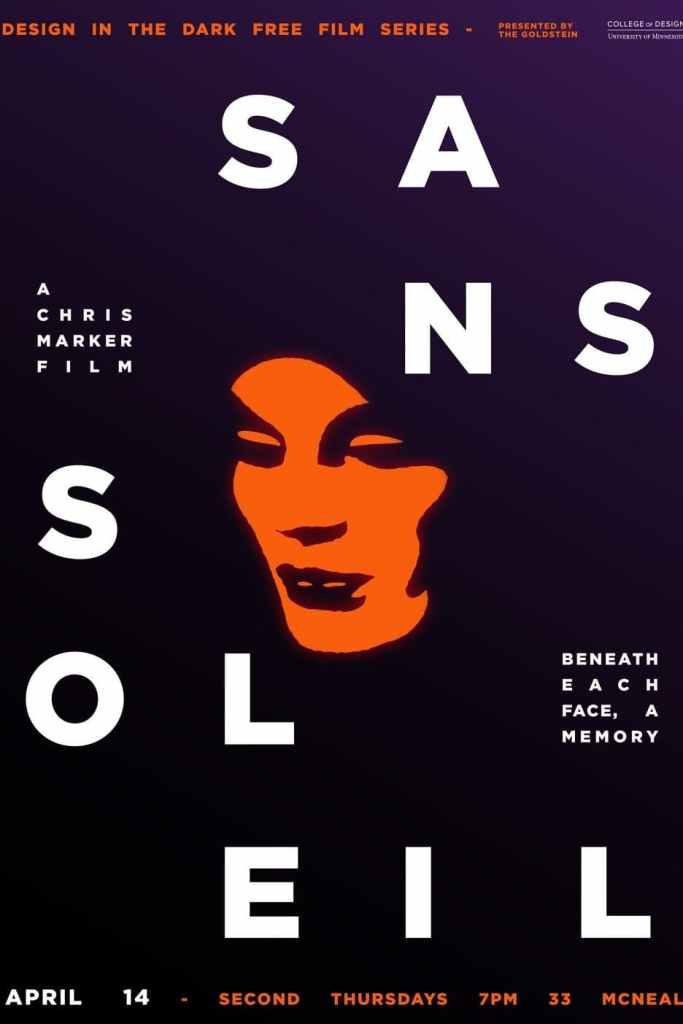
Chris Marker’s speculative travelogue-essay, reflecting on culture and history in narrated letters from Guinea to Japan to Iceland. A poetic documentary tour of Tokyo, Guinea-Bissau, Iceland and San Francisco, Sans Soleil mingles personal reflections with the history of the world. The female narrator reads letters sent by fictional Sandor Krasna, writing from ‘another world’. The spoken word, synthesized sound and haunting visuals investigate relationships between developed and developing societies. Virtuoso editing and special effects conjure the disorientation of a world traveller, journeying through cultures, secret rituals and confusions of time.
“The consummate cine-essay, framed as reportage from a roving cineaste, built mainly from Marker’s observations of the ‘empire of signs’ that is modern Japan and the poverty endemic in Guinea Bissau. Entertainingly provocative speculations on the ‘post-political’ world, haunted by the piano music of Mussorgsky.” Tony Rayns “A treatise on travel, on history, on art and on life, Marker’s film unfolds like an epistolary novel in dialogue with itself. His virtuosity with the camera is matched by the brilliance of the montage.” Bruce Jenkins
Text reproduced from https://www.bfi.org.uk/film/a9bab1d5-f6df-51d3-bdda-5e1beba14602/sans-soleil (accessed 08/03/24)
 denisestartin.co.uk