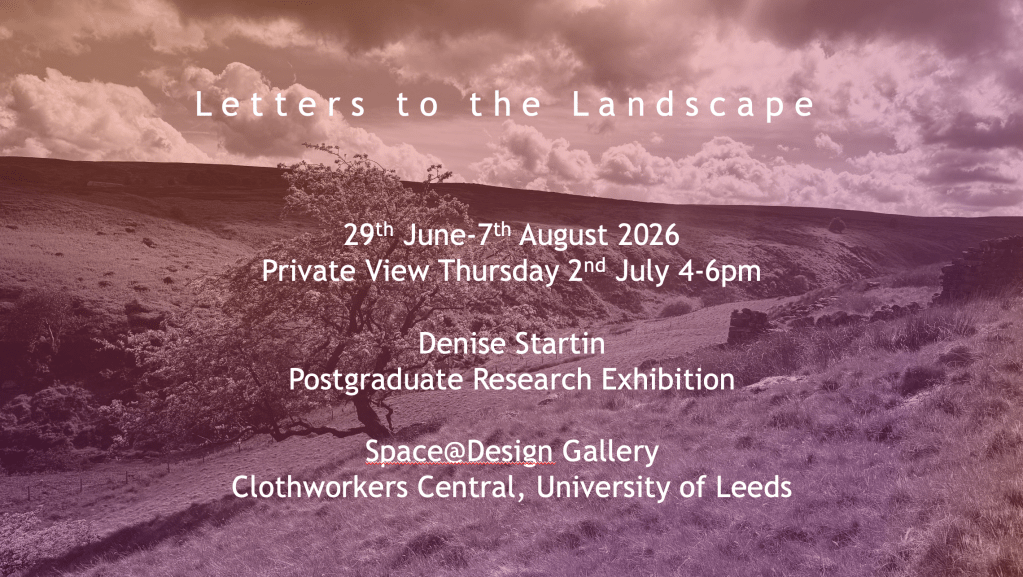
Letters to the Landscape investigates the entangled relations between Brontë Country and the imaginative terrain of Emily Brontë’s Wuthering Heights (1847), situating the moorland as a site where cultural memory, literary inheritance, and embodied fieldwork converge. Operating at the intersection of autobiography, polyphony, and archival drift, the project examines how landscapes function as repositories of memory and projection, and how they mediate the unstable boundaries between fact, fiction, and historical imagination.
The research develops a mode of performative archival practice that reframes the archive as a haunted, migratory space rather than a fixed repository. Through the gathering and reanimation of postcards, letters, photographs, and field notes, the project mobilises archival fragments as gestures — provisional, affective, and resistant to evidentiary closure. These materials are activated through a choreography of walking, (re)collecting, re‑enacting, writing, reciting, and remembering, producing a form of speculative historiography in which remnants refuse to settle and meaning remains in motion.
The film adopts an episodic structure that mirrors the temporal and spatial logic of fieldwork. Its meditations and detours on place, collecting, pilgrimage, and return enact a methodology grounded in drift, repetition, and the recursive labour of remembering. The moorland is approached as landscape as witness — a terrain that absorbs and refracts cultural narratives, and a medium through which memory is contested, re‑authored, and felt.
Central to the research is the fictional artist duo Vale & Howlette, who operate as narrative interlocutors, structuring devices, and speculative tools. Their pseudonymous perspectives enable a slippage between researcher and archive, past and present, document and invention. As explorers, (mis)guides, and mnemonic surrogates, they facilitate a mode of inquiry that is materially grounded yet imaginatively expansive, allowing the archive to function as a site of resonance, resistance, and re-imagination.
The project privileges fragment, rupture, and affective resonance over institutional fixity, proposing a methodology of situated refusal — a way of inhabiting the archive and the Brontë imaginary without claiming it. Letters to the Landscape contributes to practice‑based research by articulating how embodied fieldwork, fictional apparatus, and archival speculation can generate new modes of historiographic thinking and new forms of artistic knowledge.

