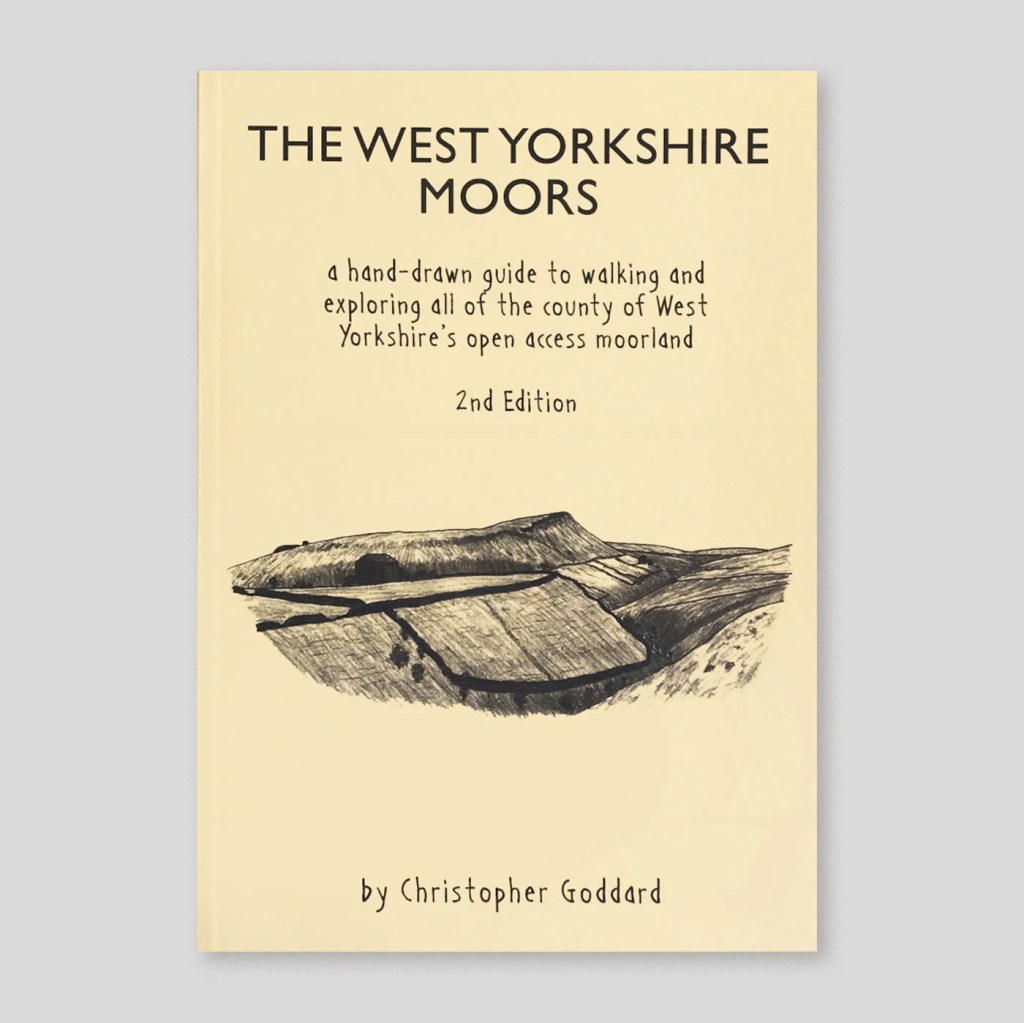
The West Yorkshire Moors is an original cartographic guide to the moorlands of West Yorkshire. The book traces old and new paths, unearths lost names and discovers hidden features on even the most apparently empty corner of these moors. There are extensive notes and sketches of the area’s history, wildlife, folklore and etymology. Twenty-nine suggested routes are included, most of which are accessible by public transport. These moors stretch from Ilkley, Keighley and Bingley in the north to Holmfirth, Marsden and Meltham in the south. This new edition of the book features amended and digitally remastered maps, and several new sketches. All the routes have been updated, with two brand new ones added.
Introduction: Analysis of the following articles have revealed problems in defining the field of chorography as well as methods, theories and insights which warrant further examination. These summaries identify, illuminate and reflect on these issues and their implications in theory and practice.
Paper 1: Rohl, Darell J (2011) The Chorographic Tradition and Seventeenth-and-Eighteenth Century Scottish Antiquaries, Journal of Art Historiography 5: 1-18.
Chorographic practice and theory according to Darrel J.Rohl
The aim of this paper is to provide an overview of the relations between British Antiquarianism and chorography. Rohl’s primary objective is the role of chorography in the lesser known Scottish Antiquarian’s. He also situates chorography in a wider field of contemporary discourse, including archaeology, which he fails to introduce or identify in the paper. This complicates his paper and disorients the reader, undermining an article which is aimed at clarifying the field whilst simultaneously criticizing competing definitions in contemporary usage. Ironically this adds to his own observation of imprecise language within various historical, practical and theoretical discourses and a lack of clarity for a precise chorographic definition.
Rohl translates chorography unproblematically stating his definition is located within the terms etymology, employing the chorographic corpus to support his arguments. Chorography is commonly interpreted by way of its Greek origins in Classical Geography, which Rohl discusses, yet translations exist across various theoretical discourses resulting in a plethora of interpretations which he does not address i.e. Ancient Philosophy. He posits a broad yet ‘reluctant’ definition of chorography as the ‘representation of place or space’ providing an accessible entry point. Whilst this may ultimately be productive the conflation of these terms is problematic due to their complex philosophical and theoretical histories where they are often employed interchangeably. This undermines or problematizes his definition; what does Rohl mean by space, to what type of space is he referring and how does one represent space?
Through a close reading of classical texts Rohl provides a summary of chorography’s history, terminology and methodology demonstrating the significance and influence of chorographic practice ‘synonymous’ with the antiquarian approach. Based on his own definition he identifies twelve basic observations which constitute a chorographical way of thinking, developing a more thorough exposition drawn from and supported by a variety of historic and contemporary sources including Polybius, Strabo and Ptolemy. Presented as an explanatory list they include “representation of place/space, multi-media presentation, it is spatio-hisorical, connection of past and present, it highlights the interdependence of human and environment, chorography de-centres and re-centres perspective, uses authorial voice, contains a degree of native knowledge, is about experience, memory and meaning, chorography is also generative of place, calling them into being, it is transdisciplinary and is both qualititvely and quantitively empirical and critical (p.6). Rohl eventually states these principles are representative of the chorographic corpus. These valuable insights warrant further investigation for the application of chorographic thinking to artistic practice.
Archaeology is then introduced in relation to chorographic methods as if self-evident; Rohl is an archaeologist. He locates chorographic methods in archaeological practice from his reading of British Antiquarianism, although he does not explain their historical relation, the latter being archaeology’s historical precursor. Rohl then outlines ten chorographic principles of archaeological practice including “regional field survey, inquiry, collection of facts, stories and objects, detailed description/measurement, listing of historic events, analysis, visualisation, historiographic method, critical thinking and presentation” (p.7). To the uninitiated he is explicitly referring to Landscape Archaeology in contradistinction to the better known practice of excavation. This distinct and separate strand involves fieldwork and interpretation, which I have experienced directly, however it is necessary to state Landscape Archaeologists are not performing chorography. These methods provide a clear, though not uncontested route, to conducting primary site research.
Finally, he performs a comparative analysis of works by the privileged Sir Robert Sibbald and the marginalised Alexander Gordon, contrasting their chorographic methods and the presence of differing attitudes in practice. The former via the distance of the questionnaire, survey, list and inventory, the latter performing a personal, yet critical, peripatetic engagement. Their outputs combine multiple layers of textual and visual material providing a rich topography of detail. Both, according to Rohl, are united in material engagements and documenting relations between past and present, geography, historiography, archaeological remains and positioning the local in relation to the regional or national construction of identity. He concludes that the legacy of antiquarianism in relation to chorography is being developed within the contemporary practices of heritage and archaeology.


 denisestartin.co.uk