New research – Andrew Kötting

“Andrew Kötting recreates scenes of the fascinating and melancholy 90-mile walk undertaken in 1841 by the nature poet John Clare, in a bizarre documentary. Film-maker Andrew Kötting again takes inspiration from that great psycho-geographer Iain Sinclair – with whom he recorded an unclassifiably strange journey by pedalo in the 2012 film Swandown. Now he has been inspired by Sinclair’s book Edge of the Orison, about the fascinating and melancholy 90-mile walk undertaken in 1841 by the nature poet John Clare, from a mental asylum in Epping to Northampton, on a pilgrimage to find Mary Joyce, the woman with whom he believed himself to be in love. 

Kötting has Toby Jones recreate the scenes of Clare’s great journey or ordeal, often amid bizarrely alienating and alienated scenes of modern life. Jones recites some of Clare’s work in voiceover, and Kötting also asks Jones’s father Freddie Jones to recreate his performance as Clare from a 1970 Omnibus documentary, from which he samples the patronising narration assuring us that Clare “was a minor nature poet who went mad”. Engagingly, oddly, and rather disturbingly, Kötting himself dresses as a “straw bear” who ambles about the place like some occult folk sacrifice and Sinclair undertakes an interview on the subject of Clare with Alan Moore, who describes Northampton as so drenched with literary and poetic association that it is “a kind of vision-sump”. Kötting’s critical reading of Clare emphasises his transgressive quality but the film allows us to suspect that Clare was quite as sophisticated and self-aware as anyone making this film.”

Image and text reproduced from https://www.theguardian.com/film/2015/oct/01/by-our-selves-review-john-clare-andrew-kotting-toby-jones?CMP=share_btn_tw (accessed 15/08/24)
Currently Reading

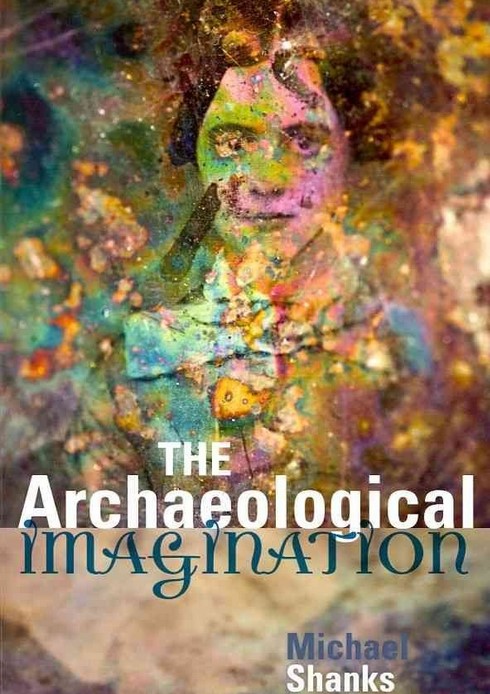
“Archaeology is a way of acting and thinking—about what is left of the past, about the temporality of what remains, about material and temporal processes to which people and their goods are subject, about the processes of order and entropy, of making, consuming and discarding at the heart of human experience. These elements, and the practices that archaeologists follow to uncover them, is the essence of the archaeological imagination.”

In his book Shanks offers the following definition: “To recreate the world behind the ruins on the land, to reanimate the people behind the shard of antique pottery, a fragment of the past: this is the work of the archaeological imagination, a creative impulse and faculty at the heart of archaeology, but also embedded in many cultural dispositions, discourses and institutions commonly associated with modernity. The archaeological imagination is rooted in a sensibility, a pervasive set of attitudes toward traces and remains, towards memory, time and temporality, the fabric of history.” pp.25

Text reproduced from https://www.google.co.uk/books/edition/The_Archaeological_Imagination/a6tJDAAAQBAJ?hl=en&gbpv=0 (accessed 13/08/23)

A Perambulation of Kent

“A Perambulation of Kent is the first English county history. It was written by William Lambarde, an Elizabethan antiquarian and lawyer. Lambarde wrote the text in 1570 but it was not printed until 1576. The book describes a journey through Kent and describes the antiquities of the county and its influence on English history. The text also includes a copy of Lambarde’s map of the ‘Heptarchy’ or the kingdoms of Anglo-Saxon England that he had first included in a collection of Anglo-Saxon laws he published in 1568.”

Text reproduced from https://www.rct.uk/collection/1072284/perambulation-of-kent, image reproduced from https://www.stellabooks.com/publisher/adams-amp-dart (accessed 13/06/23)

Current PhD Research

Bringing together contributions by artists, writers and theorists, ‘Fieldwork for Future Ecologies’ addresses the role that art practice and art-based research plays in expanding notions of fieldwork. At once a handbook for research and practice and a philosophical speculation, this book offers the unique opportunity to explore ways of working within vastly diverse climates and terrains using image, sound, movement and other sensing technologies. It also offers more creative and speculative interventions into the idea and location of the ‘field’ itself.

Focusing on a range of projects from across different geographic locations and situations, the book highlights the crucial contribution that art can make to environmental and climate studies offering a valuable intervention into current discussions of artistic practice and research. ‘Fieldwork for Future Ecologies’ presents a series of propositions and speculations … radical practices for radical times.

Contributing authors: Angus Carlyle, Alliance of the Southern Triangle/AST (D Bauer, F Grodin, P M Hernandez, E Kedan), Bianca Hester, Bridget Crone, David Burns, Henriette Gunkel and Eline McGeorge, Imani Jacqueline Brown, Julie Gough, Kate Pickering, Kreider + O’Leary, Kristen Sharp, Melody Jue, Nicholas Mangan, Philip Samartzis, Polly Stanton, Ruth Maclennan, Sam Nightingale, Saskia Beudel, Simon O’Sullivan, Susan Schuppli, Therese Keogh.

Text reproduced from https://www.onomatopee.net/exhibition/fieldwork-for-future-ecologies/ (accessed 24/04/23)