Andrew Kötting – The Whalebone Box

A whalebone box found washed up on the shore. Is it an enigmatic object containing a secret? A survivor from a shipwreck? It was given to Iain Sinclair, Kötting’s walking companion on his latest jaunt themed film. They set out on an expedition to take this box to its place of origin, a beach on the Isle of Harris in Scotland’s Outer Hebrides. Artist Eden Kötting helps shape the film, and in many ways it’s an ode to her indomitable spirit. Shot using mainly super 8 and super 8 apps and incorporating elements of archive and pinhole photography, The Whalebone Box celebrates the notion of the home-made but is also an idiosyncratic road map.

Review from the Guardian

“His latest offering is more like a dream – or rather a conjunction of dreams, occupying that liminal space between waking and sleep (“half one thing, half the other”) where the land meets the sea, past meets present, and lo-fi home-made cinema brushes against something sublime. As with so many of Kötting’s films, the central conceit involves a journey – a quest apparently undertaken to restore the titular artefact to the place of its making in the Outer Hebrides, and thereby cure an amorphous “unwellness”. I have no idea how much of what is documented here is “true”; suffice to say that it all feels profoundly truthful.

We’re told that the whalebone box was made over 30 years ago (“it belonged to another time, another place”) by sculptor Steve Dilworth, who fashioned it from the skeleton of a whale that washed up on the Isle of Harris. Tied with the twine from a herring net, lined with the lead of melted weights, and filled with “calm water”, the box came into the possession of Iain Sinclair, the author and “psychogeographer” (“a walker and talker”), who has become a regular Kötting collaborator. Sinclair called the box his “animal battery”, and for years it sat by his desk while he wrote. But at some point he decided that it should be returned to its home and buried in the sand where the whale was beached. And so, aided by pinhole photographer Anonymous Bosch, Sinclair and Kötting embarked upon a “reversed pilgrimage” to do just that.

Part of The Whalebone Box is a typically fragmented account of that journey, venturing in a chronological fashion from the psychic aerial of Sway Tower in the New Forest to the standing stones of Lewis (via diversions through the Pyrenees), all recorded in a variety of DIY formats, both physical and digital, and interspersed with archive footage, still photography and animation. The other part is a journey into the dreams of Eden Kötting, the remarkable artist who has long been the muse and inspiration of her father, Andrew. In these sections we find Eden seated like a regal seer in a forest, a gun across her lap, holding a pair of binoculars to search for whales. In her dreams, Eden has fashioned an imitation of the whalebone box, a papery contraption that lacks the physical heft of its namesake. Yet somehow, this dream-box has found its way into the “real” world. Or maybe it’s the other way round?

Borrowing intertitles from Leviathan by Philip Hoare (the author who also informs and structures this odyssey), The Whalebone Box muses on familiar themes of folklore, history, mysticism and “happenstance”, as it meanders across disparate landscapes, several journeys becoming one. En route we encounter the graves of Basil Bunting (“Poet of Northern England”) and Sorley MacLean (“Poet of Northern Scotland”), and hear the poet-artist MacGillivray perform her spine-tingling murdered mermaid song in a church, sounding for all the world like a whale out of water, crying plaintively into the abyss. At each stage, the box (in both its incarnations) seems to become heavier, charged with “insane energy”, carrying the accumulated psychic weight of its journey.

Thrown into the mix are discussions of other boxes: Pandora’s box; the flight recorders from doomed aeroplanes; the mysterious container from Kiss Me Deadly (“what’s in the box?”); the conceptual box in which Schrödinger’s cat is simultaneously alive and dead – a subject that also haunted Carol Morley’s tangentially comparable Out of Blue. Beneath it all, an ambient soundtrack ebbs and flows, from low pulsing throbs to rhythmic beats and floating melodies, interspersed with whispered words (“I love you inside out”) and fragments of other movies – the voiceover from Sunset Boulevard; the trailer for John Carpenter’s The Thing. You can feel the ghost of Derek Jarman in Kötting’s work: the use of collage; the investigation of memory; the allusions to Shakespeare’s The Tempest; the deconstruction of cinema itself. Yet, The Whalebone Box has something even more personal in its subtle exploration of the bond between father and daughter, an expression of love that had me laughing one moment and crying the next. With such a tender, beating heart, this is in some ways Kötting’s most unexpectedly accessible work. And, as Eden says more than once in her subtitled voiceover: “It’s true!”

Text reproduced from https://www.theguardian.com/film/2020/apr/05/the-whalebone-box-review-andrew-kotting-iain-sinclair (accessed 11/09/24)

Psychogeography

Psychogeography: In recent years this term has been used to illustrate a bewildering array of ideas from ley lines and the occult, to urban walking and political radicalism. But where does it come from and what exactly does it mean? This book examines the origins of psychogeography in the Paris of the 1950s, exploring the theoretical background and its political application in the work of Guy Debord and the Situationists. Psychogeography continues to find retrospective validation in much earlier traditions, from the visionary writing of William Blake and Thomas De Quincey to the rise of the flâneur and the avant-garde experimentation of the Surrealists. These precursors to psychogeography are discussed here alongside their modern counterparts, for today these ideas hold greater currency than ever through the popularity of writers and filmmakers such as Iain Sinclair, Will Self and Patrick Keiller.

From the urban wanderer to the armchair traveller, psychogeography provides us with new ways of experiencing our environment, transforming the familiar streets of our everyday experience into something new and unexpected. Merlin Coverley conducts the reader through this process, providing an explanation of the terms involved and an analysis of the key figures and their works.

Text reproduced from Amazon

PhD Abstract

I am in the process of preparing for my transfer exam next month which requires a report, a body of practice, a presentation and as a PGR candidate I undergo a viva. Here is the synopsis of my research as it stands presently:

The purpose of the PhD research is to explore and critically evaluate the contemporary relevance of chorography as a practice research method for the critical examination of place. The research aims to situate chorography as a significant and relatively under-acknowledged approach in visual art to map characteristics of the locale by examining the relations between the physical site, its numerous interpretations, and representations. It seeks to investigate the performative and embodied experience of chorographic practice as a potential original contribution to knowledge. Additionally, the research aims to develop new ways to examine artistic practices of place-making and its application in visual art by restoring, developing, and communicating a connection between chorography, past and present. Overall, the purpose of the PhD research is to contribute to the understanding and application of chorography in contemporary artistic practice and research, specifically focusing on its application to the site of Brontë country.

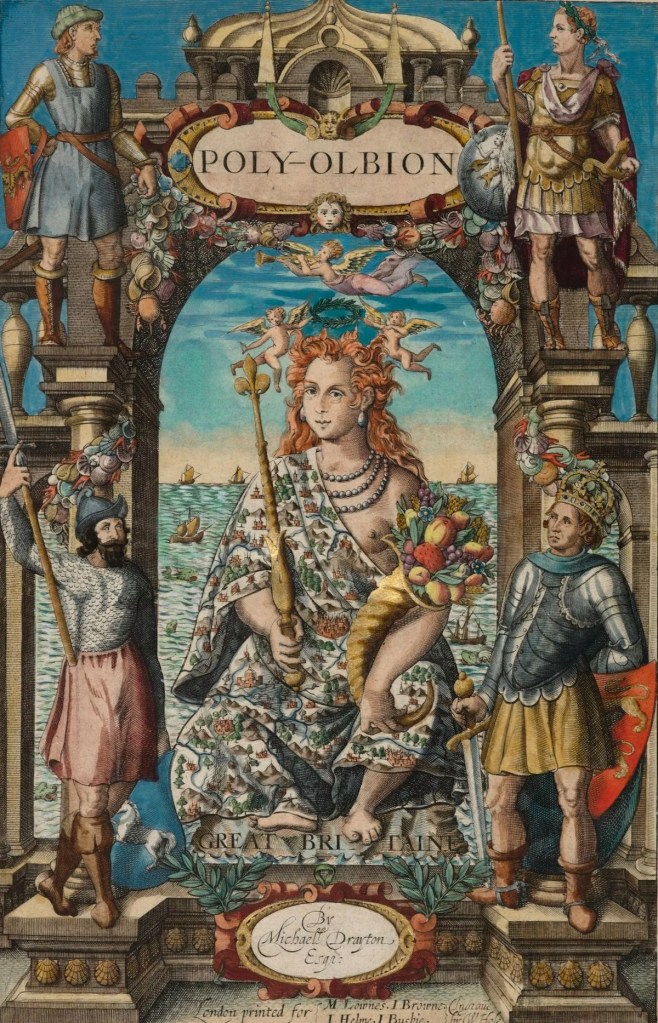
Paper 9: Michael Drayton’s Topographies: Ideas Mirrour (1594) and Poly-Olbion (1612-1622), María Vera-Reyes

Poly-Olbion frontispiece

INTRODUCTION:

The purpose of this article is a comparative analysis of Drayton’s poems Ideas Mirrour and Poly-Olbion tracing echoes of the former in his latter richly chorographical work. For the purpose of this analysis the main focus is on Poly-Olbion as a prime exemplar of a chorographic work and I also aim to draw out strands that specifically follow the concept of the body as it pertains to one of my research questions: If a sensory physical mapping of place occurs prior to representation where is the body in the process of chorography and how do we address the political implications of the embodied in the act of representation? It appears this question is complex as bodies often appear symbolically in rich and intricate intertextual and iconotextual relationships. The body it seems emerges as a chimera hiding in plain sight like Poe’s purloined letter. A chorographic text such as Poly-Olbion offers tangible clues as to how this problematic might be addressed through practice.

POLY-OLBION (1612-1622):

Poly-Olbion is an expansive poetic journey through the landscape, history, traditions and customs of early modern England and Wales. Originally published in two parts (1612, 1622), it is also a richly collaborative work: Michael Drayton’s 15,000-line poem navigates the nation county by county and is embellished by William Hole’s thirty engraved county maps. It is accompanied for its first eighteen ‘songs’ by John Selden’s prose illustrations. Drayton was a contemporary of Shakespeare and Ben Jonson, and Poly-Olbion crystallizes early modern ideas of nationalism, history and memory.

Drayton’s Early Sonnets, Poly-Olbion and Chorography:

Reyes outlines how Drayton’s epic Poly-Olbion was influenced and connected to his earlier sonnets particularly Ideas Mirrour (1594) later published as Idea (1599-1631) which both reflect and explore his interest in the history and topography of his country and celebrate ‘the discovery of England.’ p.1002The central trope in the allegorical Idea is fluvial and Drayton draws on ‘chorographic techniques to represent the beloved.’ p.1003 The central figure Idea, as an ideal representation of woman contained within the ideal geography of the English landscape, is embedded in the River Anker which runs through Drayton’s home county of Warwickshire and later appears in Poly-Olbion ‘where the poet finds the woman that he had originally praised under the poetic name of Idea.’p.1014

In Poly-Olbion Reyes identifies close connections to distant genres including sonnet, sequence, perspective, pastoral, epic, the heroic, lyrical and topographical as Poly-Olbion comes to represent the ‘eroticisation of the landscape’. whilst simultaneously trying to reify Drayton’s English identity. p.1003 Developments at the time facilitated this vision in the ‘revival of geographical writings and advancements in cartography’ and the renaissance of chorographic works in the 16th-17th Centuries, the most notable exemplar of the genre being William Camden’s Brittania (1586) pp.1003-4. Other proponents of the descriptive and primarily textual approach to history and travel narrative included the antiquarian works of John Leland’s Itinerary (1549) and William Lambarde’s A perambulation of Kent (1576). The rise of the ‘body politic’ and the ‘vision of the allegorical body’ supported ‘a spatial construction of national identity.’ p.1004 The rediscovery of Strabo and Ptolemy presupposed the encyclopedist approach to the genre but one whose methodologies ‘favoured a qualitative and localist point of view with a pictorial quality.’  P.1004

Reyes states that ‘Drayton’s interest in topography and the human body was driven by the Golden age of cosmography and cartography in England […] and reflected the idea of a human being as a microcosmos.’ p..1006 According to D K Smith (XXXX no date given) in the 16th-17th Centuries this ‘resulted in a new cartographical epistemology and a cartographic imagination that provided English authors with a new set of metaphors and rhetorical tropes related to space and it’s embodiment.’ P.1006 Reyes states ‘the conception of the body as space determined the aesthetics of Poly-Olbion’. She cites Traub (XXXX no date given) ‘the description of human figures became a common aesthetic in Renaissance cartographies – ‘maps began to imply that bodies may be a terrain to be charted and is responsible for the chorographic function of human figures.’ P.1006 The ‘representation of the human body came to be seen as a ‘conglomerate of delimited spaces’. P1006 According to Reyes this explains the ‘anthropomorphizing representations of rivers, hills, mountains and forests’ in the maps of Poly-Olbion and that this representation of space is commensurate with a topographical representation of the body. P.1006 Between Ideas Mirrour and Poly-Olbion there is a ‘reciprocal movement from the topographical representation of the human body and the personification of the landscape’. P.1006. This personification of the landscape is represented in the above engraving, the frontispiece to Poly-Olbion which Helgerson (XXXX no date given) states is ‘a goddess like woman dressed in a map’ holding the horn of plenty, which symbolizes prosperity, and who stands as ‘a living embodiment of nature.’ P.1010

Map of Yorkshire, England, 1622 from Poly-Olbion

Fig.1

Image reproduced from https://www.walesonline.co.uk/news/wales-news/trend-grown-up-colouring-been-11487014 (accessed 06/02/24)

Fig.2

https://fineartamerica.com/featured/poly-olbion-map-of-yorkshire-england-1622-michael-drayton.html (accessed 07/02/24)

Exhibition text – Hints for British Tourists

Chalet Days I

A figure in a bowler hat, waistcoat and rolled-up trousers brushes sand from their feet. They read a book in front of a painted beach hut, climb on rocks, clutch a newspaper, wait, fall asleep and lookout to sea. In one moment after another, we see tourism performed and time laid out in photographic frames like film stills.

Coventry-based artist Denise Startin presents a series of site-based performative actions, seen here via photographic documentation. The genesis of the exhibition Hints for British Tourists comprises two chance encounters: the discovery of a tourism pamphlet on eBay (also titled Hints for British Tourists) and a wall plaque on Hertford Street, Coventry, dedicated to the historic watchmaking trade that lists craftsmen Samuel Vale and George Howlette. The exhibition represents a re-staging and fictional expansion of these two very different starting points.

Vale & Howlette are adopted as dramatis personae in a wider body of work by the artist, becoming primary characters in a narrative that explores ideas of travel, leisure, time and memory performed by Startin herself and her partner. Startin’s work makes enquiries, both serious and humorous, that question what it means to be a tourist in post-Brexit England, in a world grappling with a pandemic and climate catastrophe, in a physical body that requires care and rest, and in a landlocked city more than one hundred miles from the nearest stretch of coastline.

The original pamphlet purchased by Startin was published in the former Yugoslavia in the 1970s, intended as a practical guide for travel. In it, the author observes, ‘One of the reasons I like Britain and the British, apart from liking the Sunday Times, cheese cake, Constables in the Tate, ‘apples and pears’ and not to mention the liveliness of their pubs is because their idea of a holiday is not just lying around on the beach and drinking.’ Startin’s work offers more than a nod to this ambiguous description, providing viewers with perspectives on place that appear both familiar and strange.

While also introducing historic travel mythologies relating to legendary, often unreachable places, the titles selected by Startin for the photographs shown – On the Rocks; Between a Rock and a Hard Place; Rush Hour – also point toward emotional states of being in motion, conflict, indecision or, indeed, indicate a sense of stillness. Vale & Howlette’s journey is as yet embryonic. They are on their way to who knows where.

—

Denise Startin studied at the Royal College of Art and has exhibited work at Compton Verney, Coventry Biennial and Whitechapel Gallery, London. She is the recipient of multiple awards and bursaries and has completed artist residencies in Wrexham, Surrey, Lands End and the Lake District.

Text by Anneka French