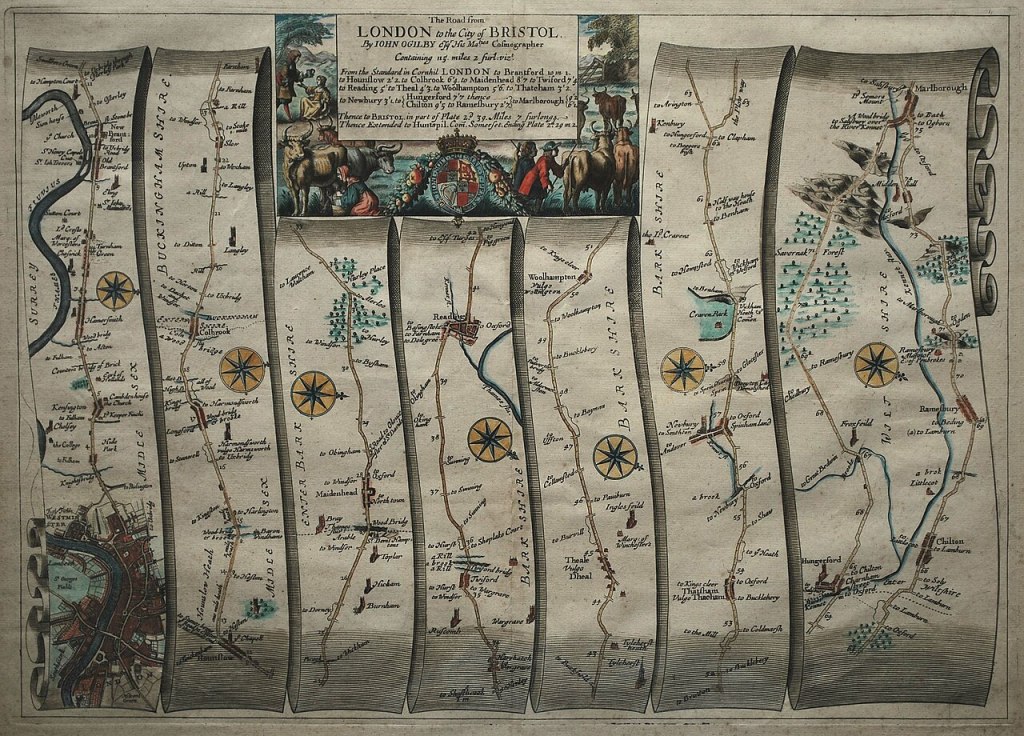
John Ogilby Brittania 1675

“John Ogilby, was born in Scotland in 1600, and held many different careers in his life; a dancing-master, theater owner, poet, translator, publisher and cartographer. He is most remembered for bringing English cartography into the scientific age with his 1675 road atlas of England and Wales titled, Britannia. To create the wonderfully detailed strip maps that displayed the topographical features and distances of the roads, Ogilby’s team of surveyors worked with the precise and easy-to-use perambulator or measuring wheel to record the distance of the roads in miles; implementing the standardized measurement of 1,760 yards per mile as defined by a 1592 Act of Parliament. They also used the surveyor’s compass or theodolite to better record the changes in the directions of the roads. Besides the use of scientific instruments, Britannia was also the first published work to use the scale of one inch equaling one mile, which became the prevailing scale for cartography. Through the use of detailed illustrations and precise technology, Ogilby’s Britannia became the first comprehensive and accurate road atlas for England and Wales, making it the prototype for almost all English road books published in the following century.”

1st image and text reproduced from https://blogs.lib.ku.edu/spencer/ogilbys-britannia-bringing-english-cartography-into-the-scientific-age/ (accessed 10/03/24). Map https://commons.wikimedia.org/wiki/Category:John_Ogilby_%281675%29_Britannia_Atlas#/media/File:John_Ogilby_-_The_Road_from_London_to_the_City_of_Bristol_(1675).jpg (accessed 10/03/24)

Currently Reading

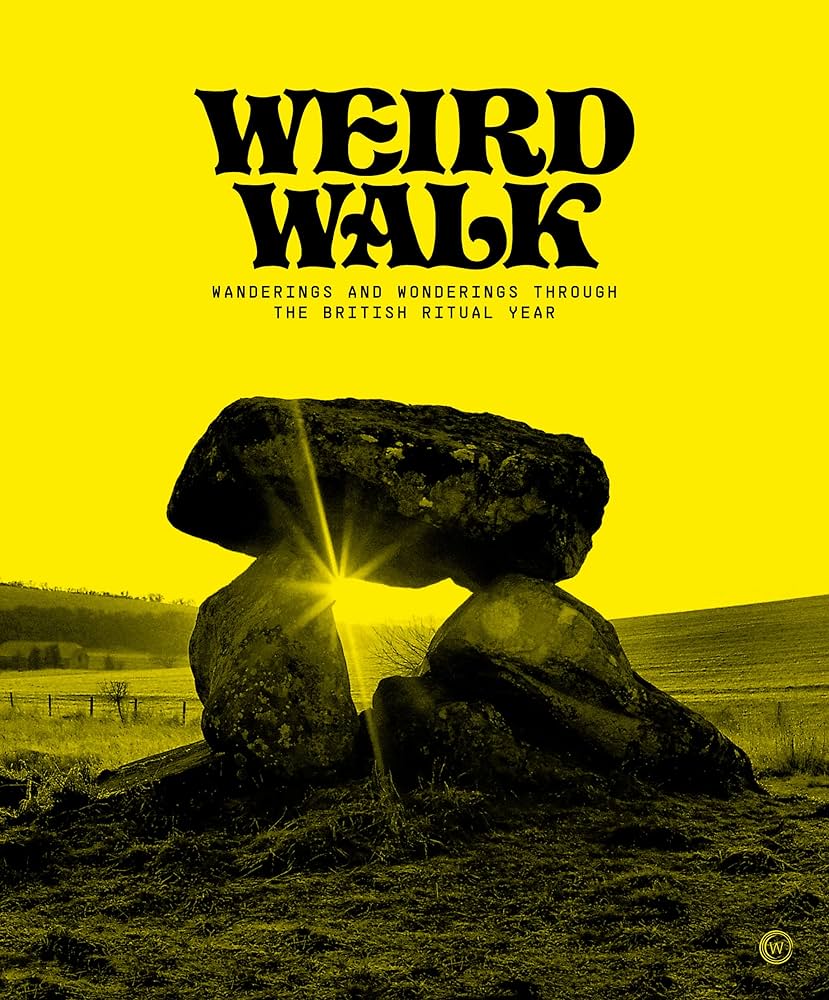
By walking the ancient landscape of Britain and following the wheel of the year, we can reconnect to our shared folklore, to the seasons and to nature. Let this hauntological gazetteer guide you through our enchanted places and strange seasonal rituals. SPRING- Watch the equinox sunrise light up the floating capstone of Pentre Ifan and connect with the Cailleach at the shrine of Tigh nam Bodach in the remote Highlands. SUMMER- Feel the resonance of ancient raves and rituals in the stone circles of southwest England’s Stanton Drew, Avebury and the Hurlers. AUTUMN- Bring in the harvest with the old gods at Coldrum Long Barrow, and brave the ghosts on misty Blakeney Point. WINTER- Make merry at the Chepstow wassail, and listen out for the sunken church bells of the lost medieval city of Dunwich. The first book by iconic zine creators and cultural phenomenon Weird Walk. This is a superbly designed guide to Britain’s strange and ancient places, to standing stones and pagan rituals, and to the process of re-enchantment via weird walking.

Text reproduced from https://www.weirdwalk.co.uk/ (accessed 04/03/24)

Seeing England

In the seventeenth century antiquarianism was a well-respected profession and antiquarian works were in demand, particularly amongst the gentry, who were especially interested in establishing lineage and the descent of land tenure. Although intended primarily as a source of information about who owned what and where, they often contained fascinating descriptions of the English landscape. Charles Lancaster has examined the town and county surveys of this period and selected the most interesting examples to illustrate the variety and richness of these depictions. Organised by region, he has provided detailed introductions to each excerpt. Including such writers as John Stow, William Dugdale, Elias Ashmole, Daniel Defoe, Gilbert White and Celia Fiennes, this is a book that will appeal to anyone with an interest in both national and local history and to lovers of English scenery.

Text reproduced from https://www.google.co.uk/books/edition/Seeing_England/6E87AwAAQBAJ?hl=en&gbpv=0 (accessed 14/01/24)