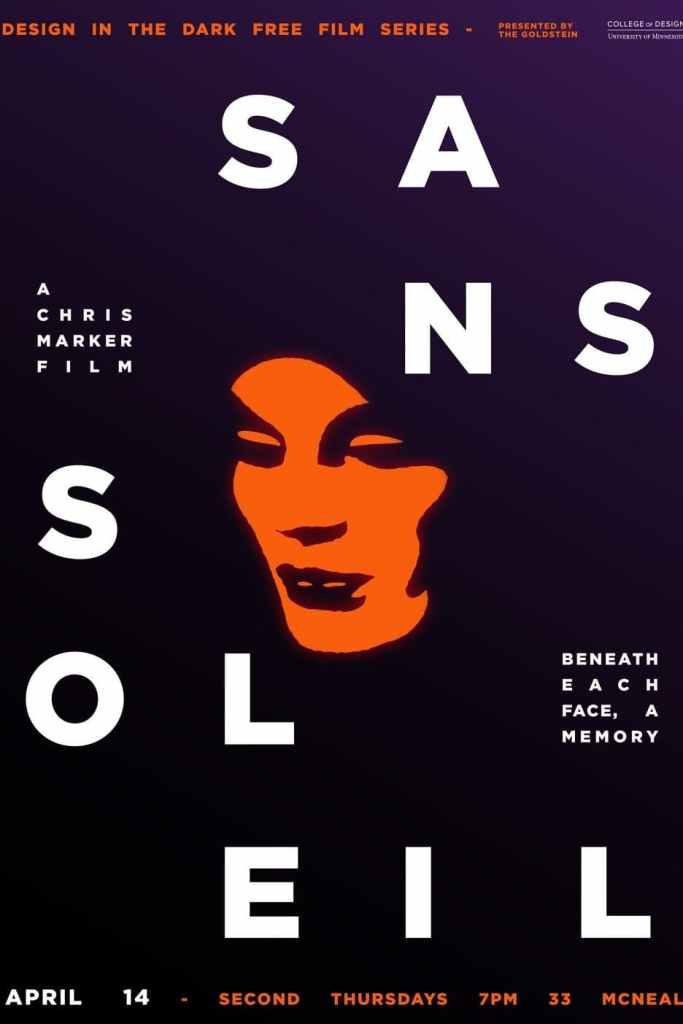
Chris Marker Sans Soleil (Sunless)

Chris Marker’s speculative travelogue-essay, reflecting on culture and history in narrated letters from Guinea to Japan to Iceland. A poetic documentary tour of Tokyo, Guinea-Bissau, Iceland and San Francisco, Sans Soleil mingles personal reflections with the history of the world. The female narrator reads letters sent by fictional Sandor Krasna, writing from ‘another world’. The spoken word, synthesized sound and haunting visuals investigate relationships between developed and developing societies. Virtuoso editing and special effects conjure the disorientation of a world traveller, journeying through cultures, secret rituals and confusions of time.

“The consummate cine-essay, framed as reportage from a roving cineaste, built mainly from Marker’s observations of the ‘empire of signs’ that is modern Japan and the poverty endemic in Guinea Bissau. Entertainingly provocative speculations on the ‘post-political’ world, haunted by the piano music of Mussorgsky.” Tony Rayns “A treatise on travel, on history, on art and on life, Marker’s film unfolds like an epistolary novel in dialogue with itself. His virtuosity with the camera is matched by the brilliance of the montage.” Bruce Jenkins

Text reproduced from https://www.bfi.org.uk/film/a9bab1d5-f6df-51d3-bdda-5e1beba14602/sans-soleil (accessed 08/03/24)

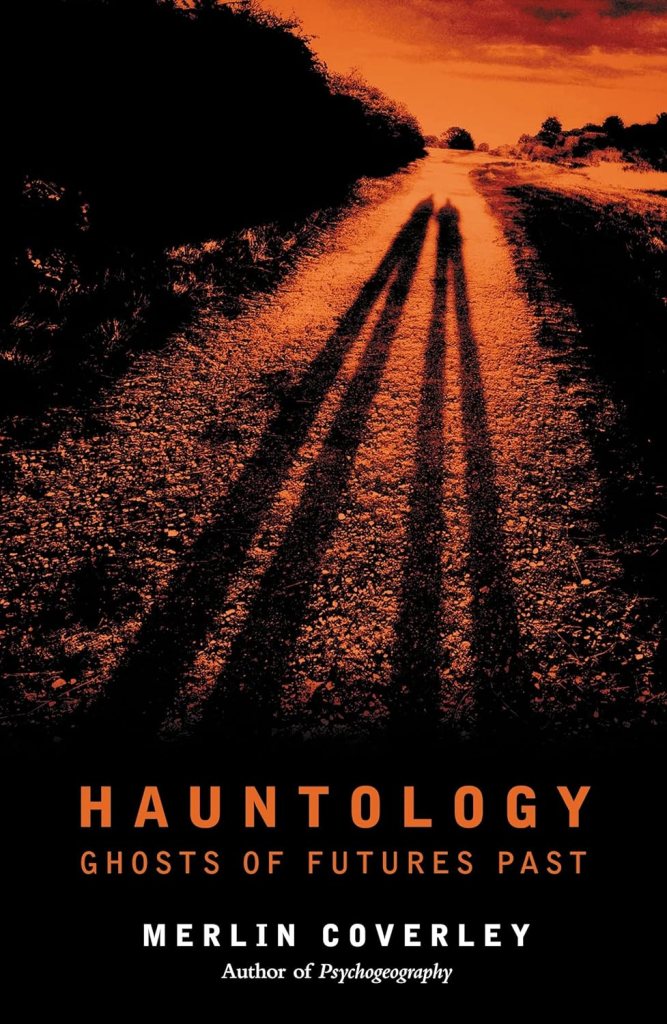
Hauntology

“Ghosts and spectres, the eerie and the occult. Why is contemporary culture so preoccupied by the supernatural, so captivated by the revenants of an earlier age, so haunted? The concept of Hauntology has evolved since first emerging in the 1990s, and has now entered the cultural mainstream as a shorthand for our new-found obsession with the recent past. But where does this term come from and what exactly does it mean? This book seeks to answer these questions by examining the history of our fascination with the uncanny from the golden age of the Victorian ghost story to the present day. From Dickens to Derrida, MR James to Mark Fisher; from the rise of Spiritualism to the folk horror revival, Hauntology traces our continuing engagement with these esoteric ideas. Moving between the literary and the theoretical, the visual and the political, Hauntology explores our nostalgia for the cultural artefacts of a past from which we seem unable to break free.”

Text reproduced from https://www.amazon.co.uk/dp/0857304194/?coliid=I35KVFXNT9E223&colid=1G9PTRYRJ8YMC&psc=1&ref_=list_c_wl_lv_ov_lig_dp_it (accessed 12/09/24

PhD Abstract

I am in the process of preparing for my transfer exam next month which requires a report, a body of practice, a presentation and as a PGR candidate I undergo a viva. Here is the synopsis of my research as it stands presently:

The purpose of the PhD research is to explore and critically evaluate the contemporary relevance of chorography as a practice research method for the critical examination of place. The research aims to situate chorography as a significant and relatively under-acknowledged approach in visual art to map characteristics of the locale by examining the relations between the physical site, its numerous interpretations, and representations. It seeks to investigate the performative and embodied experience of chorographic practice as a potential original contribution to knowledge. Additionally, the research aims to develop new ways to examine artistic practices of place-making and its application in visual art by restoring, developing, and communicating a connection between chorography, past and present. Overall, the purpose of the PhD research is to contribute to the understanding and application of chorography in contemporary artistic practice and research, specifically focusing on its application to the site of Brontë country.

Currently Reading

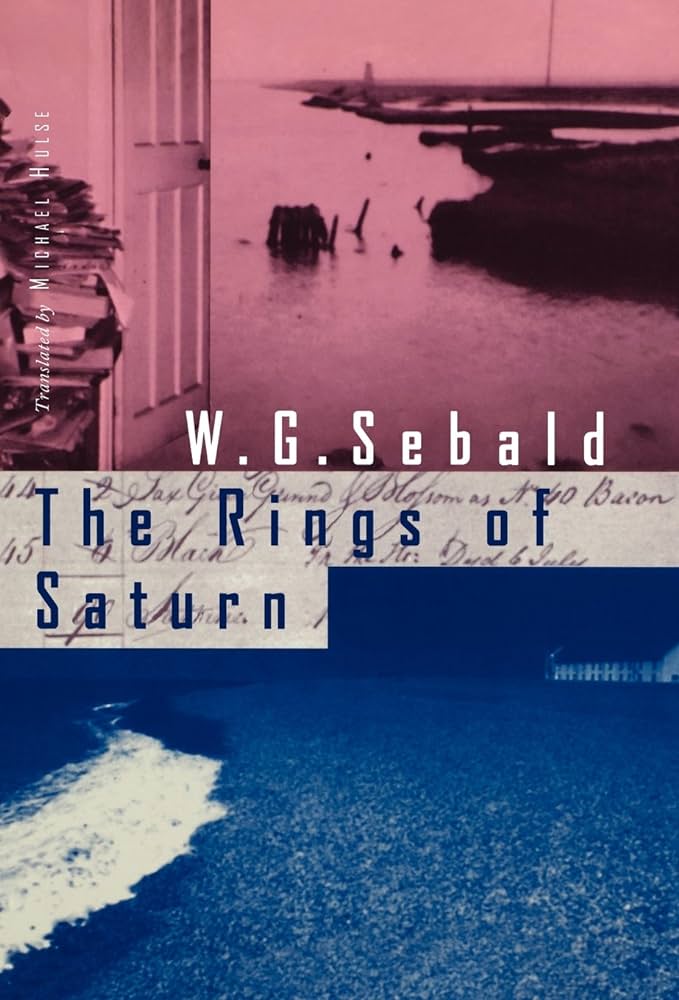
A fictional account of a walking tour through England’s East Anglia, Sebald’s home for more than twenty years, The Rings of Saturn explores Britain’s pastoral and imperial past. Its ten strange and beautiful chapters, with their curious archive of photographs, consider dreams and reality. As the narrator walks, a company of ghosts keeps him company – Thomas Browne, Swinburne, Chateaubriand, Joseph Conrad, Borges – conductors between the past and present. The narrator meets lonely eccentrics inhabiting tumble-down mansions, and hears of the furious coastal battles of two world wars. He tells of far-off China and the introduction of the silk industry to Norwich. He walks to the now forsaken harbor where Conrad first set foot on English soil and visits the site of the once-great city of Dunwich, now sunk in the sea, where schools of herring swim. As the narrator catalogs the transmigration of whole worlds, the reader is mesmerized by change and oblivion, survival and memories. Blending fiction and history, Sebald’s art is as strange and beautiful as the rings of Saturn, created from fragments of shattered moons.”–Publisher’s description

Writing Britain

“This book celebrates some of the most dazzling treasures of English literature to show how Britain’s greatest authors have been inspired by, and even redefined, their country. From Chaucer’s pilgrims journeying from Southwark to Canterbury, to the 21st century suburban hinterlands of J.G. Ballard, this book will explore how the places and landscapes of Britain permeate the nation’s great literary works and how these works have, in turn, helped shape our perception and understanding of landscape and place, both real and imagined. As well as celebrating the traditional British landscape the book will also examine the literary construction of the city, following the mysterious fog-filled streets that stretch from the London of Dickens and Robert Louis Stevenson’s Strange Case of Dr Jekyll and Mr Hyde to the urban underworlds revealed by contemporary writers such as Neil Gaiman and Iain Sinclair. Accompanying a major exhibition at the British Library, the book also features such diverse landscapes as Emily Bronte’s wild and windy Yorkshire Moors, Elizabeth Gaskell’s industrial northern towns, the seaside-turned-nightmare of Bram Stoker’s Dracula, Graham Greene’s seedy and menacing Brighton, Virginia Woolf’s Bond Street and Hanif Kureishi’s suburbia, this book will describe and illustrate the work of over 100 of the greatest British writers who have been inspired by place, spanning the Middle Ages to the 21st century.”

Text reproduced from Amazon accessed 07/05/24