
Work in Progress 2025: Letters to the Landscape

“In Wuthering Heights (Oscilloscope), the English director Andrea Arnold doesn’t so much adapt Emily Brontë’s much-loved 1847 novel as reconstruct it through the fog of a fever dream. This spare, often dialogue-free tone poem is the polar opposite of a Merchant Ivory-style literary costume drama: Rather than re-upholster the familiar story of Heathcliff and Catherine’s doomed love on the moors of Yorkshire, Arnold has chosen to strip it down to the bone. Gone are the multiple nested narrators, as well as nearly the entire second half of the book. What remains is an almost abstract flow of sounds and images that envelop the viewer like sense memories from some forgotten childhood: boots tromping through fields of black muck, twigs scraping at an icy window, dogs barking in the distance, candlelight reflecting off wet skin.
If you went in to this Wuthering Heights with no knowledge of the book or any of its many film adaptations, I’m not sure the contours of the story would ever fully emerge from the literal and metaphorical fog—and if you went in primed for bodice-ripping escapism, you might very well run out gasping with boredom somewhere around the beginning of hour two. But if you can slow down your movie metabolism enough to acclimate to its world, Arnold’s naturalistic retelling grasps an elemental truth about the novel. As much as it’s a story of romantic obsession, Wuthering Heights is a saga of familial hate, an unflinching look at the way cruelty and prejudice get handed down from one generation to the next.
In Arnold’s vision, the hatred heaped on Heathcliff, a foundling adopted by the Earnshaw household as a young teenager, is more explicitly racial than it was in the book. Described by Brontë as a dark-complexioned “gipsy” or “Lascar” of uncertain origin, Heathcliff is played here by two black men (Solomon Glave as a young man, James Howson as an adult), and the epithets hurled at him by his spiteful adopted brother Hindley (Lee Shaw) include the n-word. After Earnshaw père dies suddenly, Hindley and his sister Catherine (played by Shannon Beer as a teen and Kaya Scodelario as an adult) clash over Heathcliff’s fate. Hindley insists he be ejected from the house and kept on as a lowly farmhand, while Catherine begs for Heathcliff to remain a member of the family. When the obstinate, hard-drinking Hindley won’t listen, Catherine simply spirits Heathcliff away from his chores for long tromps on the sodden, windswept moors. (It’s unclear whether their teenage love is ever consummated, but there’s a good deal of wrestling in the mud.) Eventually, Catherine is courted by their wealthy neighbor Edgar Linton (Oliver Milburn), whose proposal forces her to make a choice between civilization (or is it enervation?) and savagery (or is it freedom?).
The decision Catherine makes, and the ever-widening circle of suffering it causes, becomes the focus of much of the rest of the novel, but if Arnold’s impressionistic retelling unfolds from any one character’s point of view, it’s Heathcliff’s. The film opens on him as an adult, back at the farm known as Wuthering Heights, where he’s beating his forehead bloody against a wall that has Catherine’s name carved in it. Soon we jump back in time to learn what it is that’s left him so distraught. From there, the back story comes at us in scattered fragments of memory that seem to combine the perspective of both young lovers (fittingly enough, since, as Cathy avers in the novel, “I am Heathcliff”): the muddy hem of a skirt seen from behind as Cathy runs down a hill. The two of them after a day on the moors, laughing as Cathy identifies feathers they’ve collected. Then, more ominously, an unflinching close-up on the seemingly real slaughter of a young goat (though the credits assure us no animals were harmed in the making of this film, there will also be trapped rabbits and woefully mistreated house dogs.) The primal bond that links the young pair (half-fraternal, half-romantic) is established with no exposition and barely any dialogue—in one scene, Heathcliff’s back is covered in cuts after a savage beating from Hindley, and Cathy licks them clean with the naturalness of an animal grooming its wounded mate.
The screenplay, by Arnold and Olivia Hetreed, must have made for a slim bundle of paper to carry around the set: We hear far less human speech than we do of creaking floorboards and the howling Yorkshire winds that gave the titular farm its name. The sound design by Nicholas Becker is ingeniously layered, allowing all the homely ambient noises of Yorkshire farm life—crying babies, clattering carriage wheels—to coexist at once in the viewer’s ear, all of it bringing us information about what’s happening just outside the frame. (The film’s sonic austerity falters only in the final moments, when a contemporary folk song by the British band Mumford and Sons appears on the soundtrack.) Robbie Ryan’s cinematography (the film is shot on HD video in the same square-shaped ratio he used for Arnold’s last film, Fish Tank) is bleakly stunning. He makes the moors look at once diaphanous and earthy, using a palette so bled of color that the movie appears, at moments, to be shot in black and white.”
Image & text reproduced from https://slate.com/culture/2012/10/andrea-arnolds-wuthering-heights-reviewed-a-vivid-dreamlike-reimagining-from-the-director-of-fish-tank.html (accessed 10/01/25)

“Iain Sinclair’s classic early text, Lud Heat, explores mysterious cartographic connections between the six Hawksmoor churches in London. In a unique fusion of prose and poetry, Sinclair invokes the mythic realm of King Lud, who according to legend was one of the founders of London, as well as the notion of psychic ‘heat’ as an enigmatic energy contained in many of its places. The book’s many different voices, including the incantatory whispers of Blake and Pound, combine in an amalgamated shamanic sense that somehow works to transcend time. The transmogrifying intonations and rhythms slowly incorporate new signs, symbols and sigils into the poem that further work on the senses. This was the work that set the ‘psychogeographical’ tone for much of Sinclair’s mature work, as well as inspiring novels like Hawksmoor and Gloriana from his peers Peter Ackroyd and Michael Moorcock, and Alan Moore’s From Hell.”
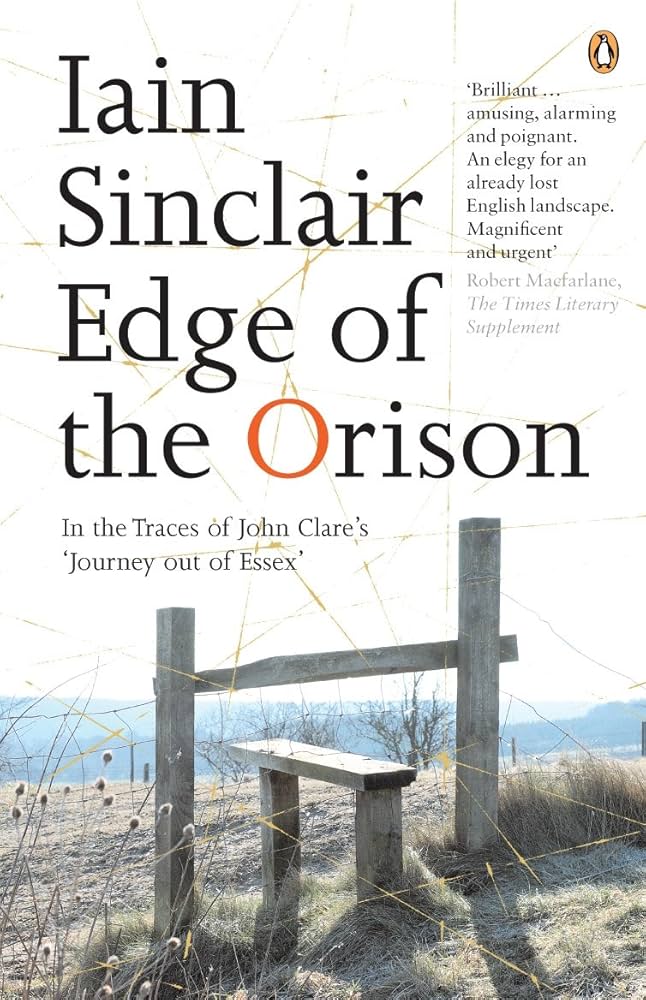
“In 1841 the poet John Clare fled an asylum in Epping Forest and walked eighty miles to his home in Northborough. He was searching for his lost love, Mary Joyce – a woman three years dead …In 2000 Iain Sinclair set out to recreate Clare’s walk away from madness. He wanted to understand his bond with the poet and escape the gravity of his London obsessions. Accompanied on this journey by his wife Anna (who shares a connection with Clare), the artist Brian Catling and magus Alan Moore – as well as a host of literary ghosts, both visionary and romantic – Sinclair’s quest for Clare becomes an investigation into madness, sanity and the nature of the poet’s muse.”

“Dining on Stones is Iain Sinclair’s sharp, edgy mystery of London and its environs Andrew Norton, poet, visionary and hack, is handed a mysterious package that sees him quit London and head out along the A13 on an as yet undefined quest. Holing up in a roadside hotel, unable to make sense of his search, he is haunted by ghosts: of the dead and the not-so dead; demanding wives and ex-wives; East End gangsters; even competing versions of himself. Shifting from Hackney to Hastings and all places in-between, while dissecting a man’s fractured psyche piece by piece, Dining on Stones is a puzzle and a quest – for both writer and reader.”
Text reproduced from Amazon and World of Books (accessed 14/11/24)
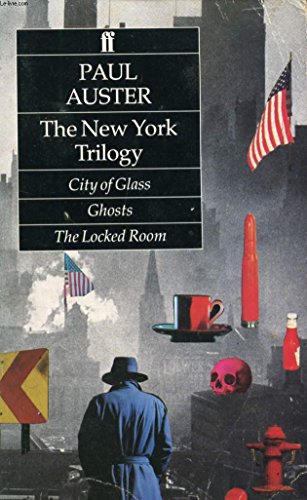
The New York Trilogy is perhaps the most astonishing work by one of America’s most consistently astonishing writers. The Trilogy is three cleverly interconnected novels that exploit the elements of standard detective fiction and achieve a new genre that is all the more gripping for its starkness. It is a riveting work of detective fiction worthy of Raymond Chandler, and at the same time a profound and unsettling existentialist enquiry in the tradition of Kafka or Borges. In each story the search for clues leads to remarkable coincidences in the universe as the simple act of trailing a man ultimately becomes a startling investigation of what it means to be human. The New York Trilogy is the modern novel at its finest: a truly bold and arresting work of fiction with something to transfix and astound every reader.
Text reproduced from https://www.londonreviewbookshop.co.uk/stock/the-new-york-trilogy-paul-auster (accessed 14/10/24)
I am in the process of preparing for my transfer exam next month which requires a report, a body of practice, a presentation and as a PGR candidate I undergo a viva. Here is the synopsis of my research as it stands presently:
The purpose of the PhD research is to explore and critically evaluate the contemporary relevance of chorography as a practice research method for the critical examination of place. The research aims to situate chorography as a significant and relatively under-acknowledged approach in visual art to map characteristics of the locale by examining the relations between the physical site, its numerous interpretations, and representations. It seeks to investigate the performative and embodied experience of chorographic practice as a potential original contribution to knowledge. Additionally, the research aims to develop new ways to examine artistic practices of place-making and its application in visual art by restoring, developing, and communicating a connection between chorography, past and present. Overall, the purpose of the PhD research is to contribute to the understanding and application of chorography in contemporary artistic practice and research, specifically focusing on its application to the site of Brontë country.
 denisestartin.co.uk