Research Context & Background

This PhD by practice explores chorography’s significance as a methodological tool in contemporary artistic practice, critically re-examining its historic yet neglected role in the documentation of place. Originating in Classical Geography (Ptolemy, c.149AD), chorography, or “place writing”, is historically understood as the detailed description and mapping of regions. This field-based approach qualitatively maps characteristics of the locale by examining its constituent parts. Historically, it has functioned as both a field-based method of qualitatively mapping and as an artistic or literary mode, linking events to landscape through pictorial and textual representation. Chorography was rediscovered in Renaissance Geography and British Antiquarianism in the 16th-17th centuries. Historically William Camden’s Brittania (1586) is an encyclopaedic approach to a geographic, “topographical-historical” (Mendyk, 1986, p.459) survey of the British Isles, which has been identified as a classic exemplar of the renaissance of a chorographic work “connecting past and present through the medium of space, land, region or country” (Rohl,2011, p.6). Britannia was part of an epic attempt to map the nation and give people a sense of cultural identity and belonging. British Antiquarianism retrieved chorography and recreated it in an expanded field of writing, reinterpreting its legacy, ensuring its survival, restoration, and continued communication.

While chorography has traditionally been seen as a representational tool, recent scholarship in cultural studies, archaeology, and performance has renewed interest in its methodological richness and interdisciplinary potential (Pearson, 2006; Shanks & Witmore, 2010; Rohl 2011, 2012, 2014). Yet there remains an absence of synthesis between these fields, and a lack of attention to gendered, embodied, and performative approaches, which this research addresses. Although chorography is pre-disciplinary, Shanks & Witmore (2010) claim that a genetic link underlies contemporary disciplinary approaches across heritage management, tourism, archaeology, historical geography, and contemporary art practice. They argue for a genealogical understanding of interdisciplinary practices concerned with relations of land, place, memory, and identity to understand present practical and academic positions. It is this link I am trying to follow and establish in contemporary artistic practice and research.

Central to this project is a critical re-examination of chorography in contemporary artistic practice, moving from documentation and representation to performance and embodiment. Drawing on Judith Butler’s theory of performativity (Butler, 1999), the research investigates how the body, particularly the gendered and mobile body, serves as a site of historical crossing, memory, and meaning-making. This shift has profound implications for who and what is remembered or forgotten, and for how places are re-collected and re-presented. Brontë Country, straddling West Yorkshire and the East Lancashire Pennines, has been chosen as the primary site for this investigation. Valued for its literary, historic, and symbolic significance, this landscape is both an active shaping presence (as in Emily Brontë’s Wuthering Heights, 1847) and a locus for contemporary artistic engagement. The region’s legacy of travel, narrative, fiction, gendered relations (a feature of their writing which is also lacking in chorographic history) and the literary imagination, compounded by the Brontës’ own use of pseudonyms, a strategy adopted in the practice research, renders it an exemplary terrain for rethinking chorography through a feminist, performative, and practice-led lens. This project approaches chorography not as a static or descriptive tradition, but as a speculative, embodied, and interdisciplinary methodology. Artistic practice, including moving image, performance writing, installation, and critical-creative text, serves both to enact and to interrogate chorographic methods: mapping not just physical terrain but also the complex intersections of place, history, narrative, cultural memory, gender, and the performative construction of identity. By combining historical method with contemporary form, the research aims to renew chorography’s relevance, to understand place not only artistically, but physically, contextually, and historically, and to open new possibilities for artistic research in and through place.

Episode 2: To Have and to Hold

I found a lock of hair in a glass case. The label said ‘Believed to be Emily’s’. Not Emily Brontë’s hair. Not a lock of hair. But hair, possibly Emily’s. The uncertainty is the most honest part. I think about the word believed, as if belief could bind the strands of hair to her scalp, as if glass could hold the heat of her breath. I hold it in my mind like a relic, a relic of a relic. Does the history of myself become parallel with the history of the object kept? What is this hinge or bridge that one builds to become the self that is now? I read Charlotte’s letters. I read Gaskell’s biography. I read the footnotes. I wonder how many women have been footnoted out of their own stories?

[Emily writes] She writes: “I have dreamed in my life, dreams that have stayed with me ever after, and changed my ideas; they have gone through and through me, like wine through water, and altered the colour of my mind.” I wonder if the same is true of objects. If they pass through us, staining the mind, altering the hue of memory. I wonder what Emily would have thought of her life behind glass. I wonder if Wuthering Heights was her own collection — of storms, of silences, of things too wild to hold. She never wanted to be seen, she wanted to vanish into the moor. And yet here she is, pinned like a butterfly. This is the trap: an anterior document, a document created to sustain an image, an image contained in a scene, a scene without a referent. What is occurring in this falling in together, apart, away?

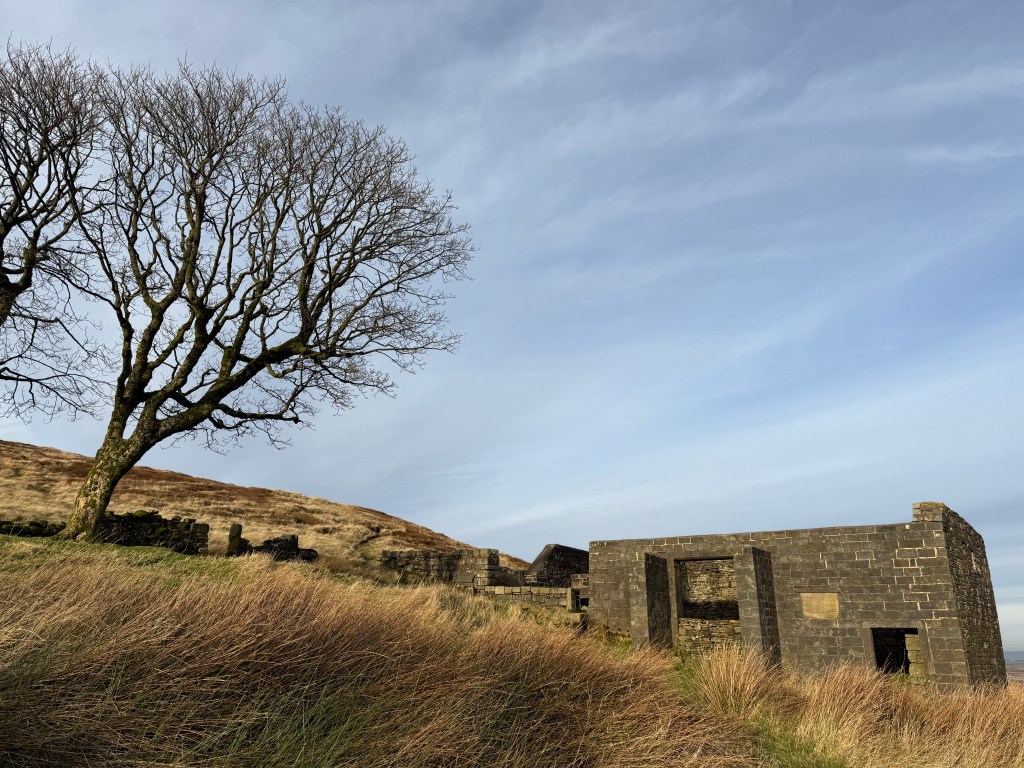
There is a desire to recuperate the forgotten, the abandoned, the fragmentary, the lost but it is a fool’s errand. I am both wild goose and chase. I wonder if collecting is a form of violence or is it a form of love? The human heart has hidden treasures, in silence sealed, in secret kept. Surely to collect is to love without reciprocity, to name without being known, to hold without being held. But the collection is not a sanctuary, it is a séance, a summoning of what refuses to stay buried. The photograph is torn, the letter is foxed, the lock of hair curls like a question mark. Even the archive has a body and it is failing. I hold a stone from the path to Top Withens, it feels like a breath caught in the throat. It fits in my palm like a secret. Or a wound. Or a promise I can’t keep. I don’t know if it’s hers. I don’t know if it’s mine. But I keep it. To have. To hold. To lose. And still, it slips through.