[A] “When I thought about what I could show you, what I could write you, I thought of this letter.”
[D] “We will take detours along the way tracing spaces in traces, spaces in places, traces in spaces, places in traces. We will have to trust we will find our way home because from there we go out to all other places. Let us linger here together at the threshold…”
[A] “In a letter, in a sentence there are 3 things I determine. The definite things, the names, the things yet to be resolved: the questions and the things that just don’t mean anything at all. I find myself paying attention to these pauses, silences and endpoints. I wonder if I can show you what I mean, I wonder about what we’re all doing and if our thoughts overwrite each other, whether you would hear what I am saying.
How often do we say: “I see what you mean”… well do you? I cannot see what you mean I can only imagine.”
[D] “In truth there is nothing I want to make you see, there is nothing I really mean and this nothing can never be exhausted. You made a distinction between hearing and listening just as I do between seeing and looking. Perception is an act of consumption in which we hazard nothing.”
You said: “When something is conclusive it means it never started; labour does not make a work and perhaps, you wrote, the first and last form is an empty bowl…”This made me entertain a fantasy of pointlessly making bowls which means labour could make a work but only as a device to understand the failure of creating an audience.
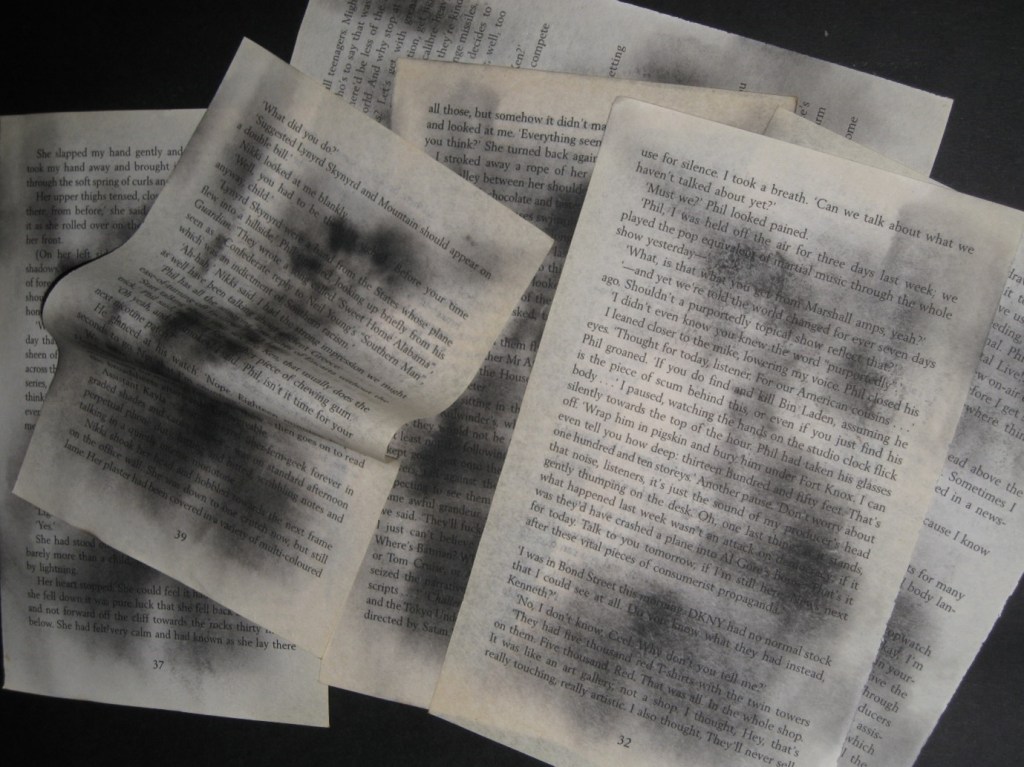
Ad Reinhardt
You wrote: Perhaps the only painting is black but there are endless possibilities in black. Old black, fresh black, lustrous black, dull black, emerald black, oil black, sunlight black, shadow black and the black of the lime tree in winter.
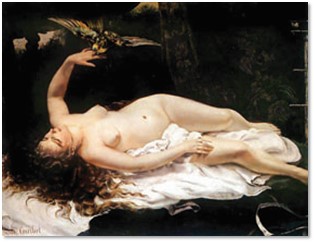
Courbet, Woman with a Parrot, 1866
You wrote: Maybe the only score is silent. What does it mean to experience silence as the essence of language?. Being silent is not the same as being mute. Silence is the only form of articulation. This is the gift of language.
I read a story about a child and a house built out of small red bricks. When construction was complete the child squatted next to it, placed a pig inside it and carefully replaced the top. Occasionally she walked away from the enclosure but always returned, opening it carefully, looking inside, emptying or filling it. This was her universe. Then you wrote me a story about a red house, a model that came to be built for real in red brick, found like a little time machine although you couldn’t determine if it goes to the past or the future. There is something tragic about the kind of architectural model created on the kitchen table. A house of meetings but also departures, its walls urge you to remember your compulsion to forget.
What does it mean to inhabit something, to capture its music? You thought about a nautilus shell for a long time and I wondered how you could blend with the darkness of the sea…
Dear Black Spot…
Gazing into your liquid emerald darkness suffused with silver halide crystals of light, sinking into your inky depths, enveloped in your perfect form, in a slumber dead to the world, an eternal caress wrapt in your tender abyss.
As I write to you I can sincerely say I have lived in this house although I cannot determine whether it is the past or the future. The ghostly sublime of a chair hovers in the background then I realised it never went away because it was never there in the first place. In the distance doors exploded from their origin, nothing is being asked or explained. A serene velocity at the mirrors edge hovers in the silver of the ground.
Symptoms manifested in the smashing of windows, the rehearsal of a ventriloquist act in empty rooms constructing an emotional temperature. I have stood under the darkening sky at the strike of madness where dead fingers dance, the dark matter of corporeal poetry: a shadow soundtrack of whispering grass kicking the air.
[A] “When we believe in a concept so deeply we might make a container for it over and over again…until the object might measure half the thought or the form smothers its nucleus. Just like a faucet that leaks [D: and there is comfort in this sound] concepts survive between half full and drowning.”
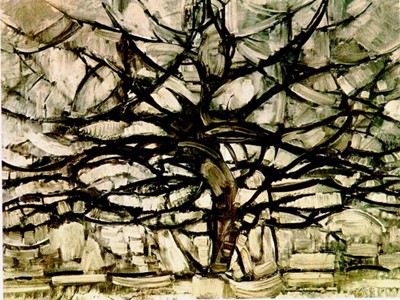
Piet Mondrian
[D] “Let us go, you and I beyond the perimeter where the Lime Tree is the tallest tree in sight, taller than the pines, the birches and willows, let us forget the names we give to the things we see.
There on the mossy bank of the lake I shall add my half empty to your half full and we shall wade out into its depths. We will forget that in spring and summer the Lime Tree was green all over and now in winter its branches are black, we will forget we are sad about that. We will forget because here in the lake we will be testing the concepts of surviving and drowning.”
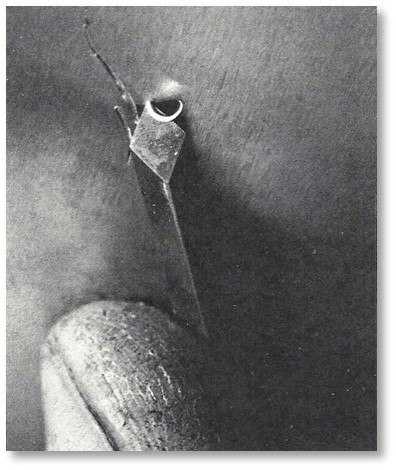
You wrote: Perhaps an artist cannot live, but only die in what he or she creates. In reality this appears to be a trifle like a paper cut and ‘when this cut is made nothing is destroyed’, but beneath the work are the cuts, sharp, clean, deep. How do you obtain relief? Breathe and keep cutting.
[A] “I wonder are you bored because time is being consumed. Boredom is when what you want is elsewhere and you are obliged to wait for it, or wait without it.” [D] This absent content is a fragment that shines like gold. There is no sound we can run to in this prototype theatre; we can only act out to the sides.
Roland Barthes writes: ‘There is a scenography of waiting: I organize it, manipulate it, cut out a portion in time in which I shall mime the loss of the loved object”… the object yet to come, the object that should have come and didn’t, the object that might never come, “provoking the effects of a minor mourning.” A Lover’s Discourse, Waiting, P.37
I am waiting for an arrival, a return, a promised sign. I have no sense of proportions. The being I am waiting for is not real. I create and re-create it over and over, starting from my capacity to love.
[A] “In a letter, in a sentence there are 3 things I determine. The definite things, the names, the things yet to be resolved: the questions and the things that just don’t mean anything at all. I find myself paying attention to these pauses, silences and endpoints.”
Fernando Pessoa writes “I think with my feelings and feel with my thoughts”.
[D] Do you see what I mean?… I imagine in this instance that you do.
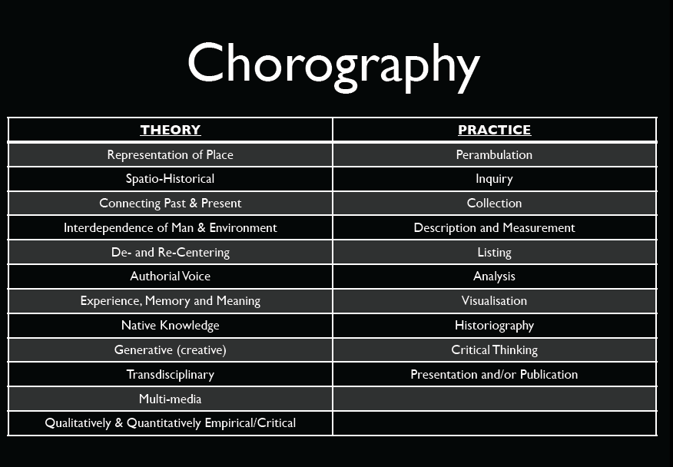
Introduction: Analysis of the following articles have revealed problems in defining the field of chorography as well as methods, theories and insights which warrant further examination. These summaries identify, illuminate and reflect on these issues and their implications in theory and practice.
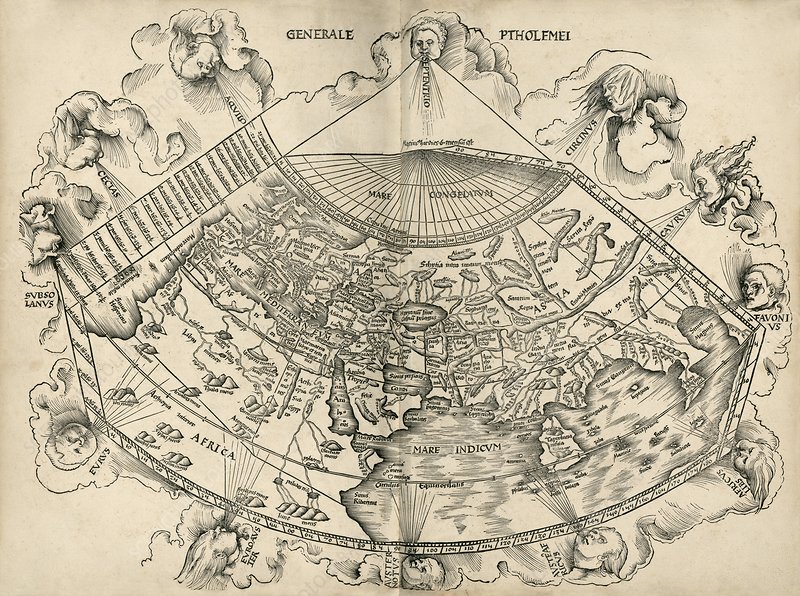
Ptolemy’s world map. This map of the world is from an edition of Ptolemy’s ‘Geographia’, published in 1513 by German cartographer Martin Waldseemuller (c.1470-1520)
Curry’s paper is concerned with the conflation of place and space in contemporary discourse which commonly obfuscate and erase their differences. His primary aim is to elaborate upon the terms chorography, topography and geography and delineate their differences by examining their ‘technologies and practices’. He suggests chorography is limited to the geographer’s knowledge, clearly in the context of this research this is not the case and in his own words ‘it is alive and well.’ Curry argues these geographic ways of knowing each have their own objects of study; region, place and the earth’s surface. He is critical of both their neglect in discussions of place or analyses which focus on scale in relation to these concepts as opposed to form and function. Curry employs a complex analogy of the invention of the US ZIP code to illuminate his argument.
Curry compares and contrasts these terms by tracing and re-interpreting their origins to distinguish them from contemporary understandings. He locates chorography and topography within foundational concepts of place and memory. Chorography was a qualitative way of interpreting the world, both celestial and terrestrial, and this knowledge was located in ‘signs or symbols’ which aimed to perceive relations ‘between events, places and the times of their occurrence’. He relocates topography’s association with mapping by placing it in the oral tradition and the ‘art of memory’. In this context places are created, narrated, performed and re-formed through symbolic associations. Place and experience are coextensive with each other and this element of the mnemonic has already been established independently in prior research.
For Curry the importance of this argument is not simply a matter of different scales of apprehension, but more significantly is intrinsically linked to repositories of knowledge, dissemination and retrieval. He argues space was ‘invented’ against the backdrop of place, due to emergent technologies necessitated by an increase in information, leading to an erasure of the chorographic and topographic by the geographic. Chorography and topography represent human patterns of knowing and belonging in contrast to the panoptic vision of geography. The implications of this observation equate to an erasure of memory practices and a movement from an embodied and emplaced performance of knowledge to its commodification. Places are increasingly mediated by technology and this also applies to the digital records of archaeological fieldwork. For instance when I was introduced to archaeological fieldwork at Erddig, Wales the corresponding planar database managed by the Historic Buildings, Sites and Monuments Record comprises 24 topographic views of each location in the field; a complex palimpsest inconceivable in a single view. This centralization of information which allows for the preservation of heritage data becomes an abstracted space of typology and categorization devoid of the people that inhabited them or the places that created them.
Curry’s analogy of the standardisation of the ZIP code can, in the context of this paper, be equated with geography reaching its empirical, scientific, mathematical and spatial exactitude in the art of cartography. This organisation of geographical knowledge, in the case of the ZIP code, privileges spatial points and co-ordinates whereby the particularities of place, regions, difference, the local and thus topography and chorography are subsumed and erased by spatial systematisation, the realm of demographics and the global organisation of information.
“Despite the great antiquity of the tradition, these all remain familiar and well-practiced methodologies employed by those engaged in archaeological fieldwork or interpretation.”
Res gestae,”things done,” all circumstances surrounding and connected with a happening.
…The antiquarians delved into what Sir Francis Bacon termed “history defaced, or remnants of history which have casually escaped the shipwreck of time.” He depicted it as a kind of salvage operation “though the memory of things be decayed and almost lost, yet acute and industrious persons, by a certain persevering and scrupulous diligence, contrive out of genealogies, annals, titles, monuments, coins, proper name & styles, etymologies of words, proverbs, traditions, archives and instruments as well public & private fragments of histories scattered about in books not historical, — contrive, I say, from all these thongs or some of them, to recover somewhat from the deluge of time.”
What follows is an abridged and long unfulfilled PhD proposal that was successfully submitted to the Critical Writing department at the Royal College of Art as well as Coventry University and remains unrealised due to personal and financial circumstances. I am now in a position to conduct this research independently and plan to embark on it over the coming weeks.
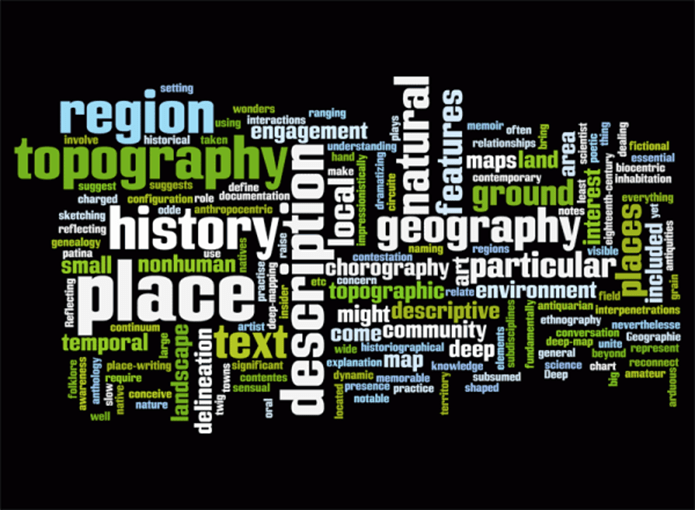
Darrell J.Rohl Chorography tag cloud
1.0 Abstract
To my knowledge this is the first PhD by practice in the UK to explore Chorography’s relevance as a methodological tool in contemporary artistic practice and critically address the historic yet neglected role of Chorography in the documentation of place. Pertinent to research across diverse academic disciplines this proposal is timely, relevant, and contemporaneous. Historically chorography, or place writing, is the artistic representation of a regional map which originated in Classical Geography (Ptolemy c.149AD). This field-based approach and detailed descriptor of place qualitatively maps characteristics of the locale by examining the constituent parts of that place.Currently there is a renewed methodological interest in chorography within Cultural Studies, Archaeology and Performance. These forms of chorography whilst practically and theoretically rooted in various strands of its developmental history, reflect its methodological richness and interdisciplinary nature although they do not have a locus as yet aligned. Therefore there is a need to analyse and synthesise these discrete bodies of knowledge that reflect current cultural pre-occupations with chorography to provide a clearer understanding of the relevance, meaning and impact of chorography today.
This research aims to provide a rigorous examination of chorography as a methodological tool which takes region as its lens and address it as a mode of mediating specific forms of cultural memory, narrative and belonging. This also includes asking how chorography can figuratively, metaphorically or symbolically excavate the hidden, the forgotten or the overlooked to reveal and re-present micro-histories, landscape narratives, texts, images, archives and collections either discarded or forgotten. Although a historic understanding is necessary this research recognises the chorographer’s body is also a site of historical crossing that both transcends and incorporates these boundaries made possible by the very nature of its mobility, which has implications for who, what and how people and places are remembered and re-presented.
As history, theory, artistic research and practice are increasingly complex and intertwined with bodies of knowledge from diverse spheres of scholarship and disciplinary boundaries become increasingly diffuse this ultimately raises the question of location. Combining tradition with innovation to position artistic research skills within the historically grounded yet expanded field of chorography I aim to actively engage this question in order to devise a new form and application of critical enquiry. Utilising chorography as a methodological framework in artistic practice will create new criteria with which to examine and re-interpret contemporary practices of place making by retrieving, restoring, developing and recreating a connection between chorography past and present. Combining historic method with contemporaneous form will enable a renewed understanding of the chorography of place not just artistically but contextually, historically and physically.
2.0 Research Context: Chorography
Chorography designates “a regional map in Renaissance geographic texts and the artistic description of regions” viewed and experienced from within linking “regional events at the time of occurrence in pictorial representations.” (Olwig 2001 and Curry 2005 cited in Päivi Kymäläinen and Ari A. Lehtinen 2010: 252). Chorography, defined by the polymath Ptolemy in the Geographike Hyphegesis (c.149AD) takes region as its lens. This field-based approach and detailed descriptor of place qualititively maps characteristics of the locale by examining the constituent parts of that place “to describe the smallest details of places.” Morra J, Smith M (2006: 17-18).
Chorography was re-discovered in Renaissance Geography and British Antiquarianism 16th -17th centuries. Historically William Camden’s Brittania (1586) or a Chorographicall Description of the most flourishing Kingdomes, England, Scotland, and Ireland is an encyclopaedic approach to a geographic, historical topographical survey of the British Isles which has been identified as a classic exemplar of the renaissance of a chorographic work “connecting past and present through the medium of space, land, region or country.” (Rohl 2012 2011). Cormack states “Chorography was the most wide ranging of the geographical sub disciplines since it included an interest in genealogy, chronology and antiquities, as well as local history and topography…uniting an anecdotal interest in local families and […] genealogical and chronological research.” (Cormack 1991 cited in Rohl 2012:22). British Antiquarianism therefore retrieved chorography and recreated it in an expanded field, re-interpreting its legacy, ensuring its survival, restoration and continuing communication. Susan Stewart discusses the antiquarian as being “moved by a nostalgia of origin and presence” whose “function is to validate the culture of ground.” (1984:153)
Currently there is a renewed methodological interest in chorography and broadly conceived place relations within Cultural Studies, Archaeology and Performance. There is therefore a need to assess, address and synthesise these discrete bodies of knowledge from diverse spheres of scholarship, theory and practice. Currently conducted independently of each other they nevertheless reflect current cultural pre-occupations with the concept, its application and theorisation. Selected practitioners and researchers of relevance to this study include Michael Shanks, Archaeologist, Stanford and Mike Pearson, Performance Studies, Aberystwyth. Their work Theatre/Archaeology (2001) creates a porous space whereby archaeological and performance theory combine to provide an architecture for the event “whose underlying questions was the representation of place and event” and the role of landscape within it (Shanks). Their concept of Deep Mapping is derived from chorography. They borrow the term from William Least Heat-Moon’s PrairyErth, an intensive look at a particular place that included discussion of geography, history, and ecology, that place being Chase County, Kansas. Pearson and Shanks were using the genre as a means to create techniques and re-think approaches to communities, locales and events. Their work incorporates chorography into performance and archaeology to activate, re-activate, question, examine and perform the histories of place utilising a range of methodological, archaeological, performance and narrative techniques including biography, memoir, folklore, topography to “juxtapose and interpenetrate the historical and the contemporary.” Pearson’s exercise in deep mapping (2007) is a complex intertextual topography and biographical derivé incorporating region, locale, chorography, landscape, memory, archaeology and performance “where historical, social, cultural and environmental temporalities are foregrounded.”
The scholarly work of Darrell J. Rohl, Archaeologist, Durham University, whose research is organised around past, present, people and place, identifies chorographic methods inarchaeological fieldwork andinterpretation (2012). Nicoletta Isar, Cultural Studies, Copenhagen University (2009) explores chorography and the performative relation between space and movement. This has largely been conceived under Dr A. Lidov’s neologism Hierotopy 2002, the organisation and mediation of sacred spaces, a transdisciplinary approach combining art history, archaeology and cultural anthropology.
3.0 Original Contribution to knowledge
Recent studies framed within visual arts do not adequately recuperate the concept, and its pertinence to the theorisation, contextualisation and politicisation of performative embodied tactics and spatial practices ‘space is a practised place.’(De Certeau 1984), O’Sullivan, Jill (2011) The chorographic vision: an investigation into the historical and contemporary visual literacy of chorography, PhD thesis, James Cook University (AU). This study traces the history and symbolism of chorography as a visual literacy of place through cartography and the graphic medium of print, privileging the map as the primary visual signifier of chorography. Although the study does acknowledge other forms of chorographic practice its principle aim is to map the development of historical chorography and the philosophical discourse on place whereby the practice based iterations reproduce historic practice without providing new applications or forms. It is these other forms of chorographic practice that depart from its historical nature that provide what I perceive to be chorography’s as yet unexplored methodological richness in artistic research and the layering of these historical crossings that connect the cultural and socio-political to the personal.
I argue as original contribution to knowledge if the relations posited within chorography are firstly empirical, experiential and emplaced it cannot be fully articulated by focussing on the cartographic. Put simply the medium is not the method. This authoritarian disembodied cartographic vision and static pictorial symbol or ‘image’ of place elides the textures of place and its complex network of relations i.e. the embodied, symbolic, socio-political, cultural, familial, contextual, discursive & historical which contribute to and profoundly affect how autobiographical identity is constructed, mediated, narrated, re-membered and situated. This research recognises that chorographic method is the trace of an embodied agent already implicated into the textures of place and that the physical act of mapped place is not synonymous with the map as object. Although a historic understanding is necessary this research recognises the body is itself a site of historical crossing that both transcends and incorporates these boundaries made possible by the very nature of its mobility. Historically chorography does not account for the body in the field yet a sensory physical mapping of place occurs prior to the act of representation.
There is a need to distinguish this act from its documentation and re-presentation to provide new theories, forms and applications by addressing the political implications of the embodied in the act of representation. To provide a contemporaneous account the performative relations between the body, mapping and place; the mobile, embodied and situated are therefore central to a contemporary interpretation of chorography. Historically there are no female chorographers and therefore no theoretical address on chorography that recognises the philosophical discourse on sexual difference and place from a feminine perspective in visual art. This research aims to address this lack.
The following research outcomes will provide a clearer understanding of the relevance, meaning and impact of chorography today.
Critically evaluate and determine chorography’s relevance and its application as a methodological tool that constructs and mediates specific forms of cultural memory, narrative and belonging and locate this in contemporary artistic research, theory and practice.
Create new criteria to examine practices of place making by retrieving, restoring, developing and communicating a connection between chorography past and present.
Assess and synthesise discrete bodies of knowledge from diverse spheres of scholarship, theory and practice. Conducted independently of each other they nevertheless reflect current cultural pre-occupations and a renewed interest in chorography.
Theorise chorography beyond its original conception, draw conclusions and propose future orientations, applications and developments.
4.0 Personal Statement & Objectives
The desire to recuperate the historic yet neglected method of chorography in artistic research is philosophically rooted in my practice. Engaging with different conceptions of sites as markers of place via a curatorial approach is to actively ‘take care’ in the restoration, conservation and curation of micro-histories, narratives, texts, images, archives and collections either discarded or forgotten. During this process a historical figure, site, place, event or voice or voices are adopted to activate the work and produce a narrative arc. There is a desire to retrieve and recreate those figures in a present context and reopen a dialogue that is directed back toward its own context, boundaries and form. This displays a sensitivity to the re-presentation of material employed and a continually recurring hinge is the problematic interface between the public and the private. This problematic in some respects undermines the desire to protect as this act re-stages, re-articulates, re-presents and re-mediates what I term the performance of the private, the entry of the private domain into the public arena where it is both commodified and incorporated into the rhetoric of display. The concepts operative in the work and research and are critically examined through diverse yet interconnected bodies of knowledge. I understand this to represent a chorographic approach and pre-disposition to the concept of chorography.
Art, whilst innovative, can use archaeological method or historiographic accounts to excavate and recontextualise our relations to the past. Legacy, whilst not always visible is present. Therefore a critical reflection must recognise these relations do not occur in isolation but ‘in situ’ and within a context that affects how they are critically, ideologically, philosophically and historically situated. Applying existing artistic skills in a new field will enable the development of a more comprehensive understanding of place, not just artistically, but historically, physically and contextually.



 denisestartin.co.uk