Mapping Cultures is a collection of essays exploring the diverse practices and cultures of mapping on the one hand, and the mapping of different forms of cultural practice on the other. The book draws on a wide range of disciplinary perspectives, including critical cartography, social anthropology, film and cultural studies, literary studies, art and visual culture, marketing, architecture, and popular music studies. Underpinning the theoretical and methodological approaches of all the contributions is a close engagement with mapping both as a mode of cultural and spatial analysis, and as a point of critical intersection in which ideas and practices of cartography are challenged, re-envisioned and brought into play with a broad range of theoretical perspectives. The collection is loosely organized around three main thematic sections: the cartographic textualities of space, landscape and place; mappings of performance and urban memoryscapes; and the practical, aesthetic and performative cartographies of critical spatial enquiry.
Across the world, walking is a vital way to assert one’s presence in public space and discourse. Walking maps the terrain of contemporary walking practices, foregrounding work by Black artists, Indigenous artists and artists of colour, working-class artists, LGBTQI+ artists, disabled artists and neurodiverse artists, as well as many more who are frequently denied the right to take their places in public space, not only in the street or the countryside, but also in art discourse. This anthology contends that, as a relational practice, walking inevitably touches upon questions of access, public space, land ownership, and use. Walking is, therefore, always a political act.
Artists surveyed include: Stanley Brouwn, Laura Grace Ford, Regina Jose Galindo, Emily Hesse, Tehching Hsieh, Kongo Astronauts, Myriam Lefkowitz, Sharon Kivland, Andre Komatsu, Steve McQueen, Jade Montserrat, Sara Morawetz, Paulo Nazareth, Carmen Papalia, Ingrid Pollard, Issa Samb, Sop, Iman Tajik, Tentative Collective, Anna Zvyagintseva. Writers include: Jason Allen-Paisant, Tanya Barson, André Brasil, Amanda Cachia, Sarah Jane Cervenak, Annie Dillard, Jacques Derrida, Dwayne Donald, Darby English, Édouard Glissant, Steve Graby, Antje von Graevenitz, Stefano Harney and Fred Moten, Elise Misao Hunchuck, Kathleen Jamie, Carl Lavery, JeeYeun Lee, Michael Marder, Gabriella Nugent, Isobel Parker Philip, Rebecca Solnit.
[A] “When I thought about what I could show you, what I could write you, I thought of this letter.”
[D] “We will take detours along the way tracing spaces in traces, spaces in places, traces in spaces, places in traces. We will have to trust we will find our way home because from there we go out to all other places. Let us linger here together at the threshold…”
[A] “In a letter, in a sentence there are 3 things I determine. The definite things, the names, the things yet to be resolved: the questions and the things that just don’t mean anything at all. I find myself paying attention to these pauses, silences and endpoints. I wonder if I can show you what I mean, I wonder about what we’re all doing and if our thoughts overwrite each other, whether you would hear what I am saying.
How often do we say: “I see what you mean”… well do you? I cannot see what you mean I can only imagine.”
[D] “In truth there is nothing I want to make you see, there is nothing I really mean and this nothing can never be exhausted. You made a distinction between hearing and listening just as I do between seeing and looking. Perception is an act of consumption in which we hazard nothing.”
You said: “When something is conclusive it means it never started; labour does not make a work and perhaps, you wrote, the first and last form is an empty bowl…”This made me entertain a fantasy of pointlessly making bowls which means labour could make a work but only as a device to understand the failure of creating an audience.
Ad Reinhardt
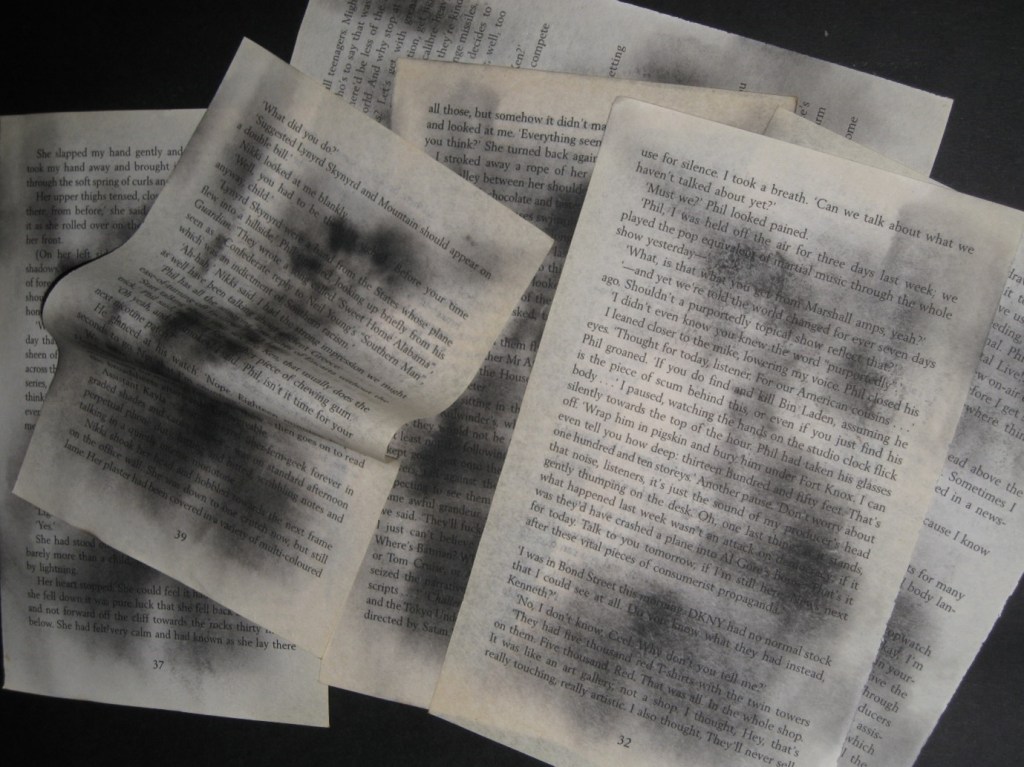
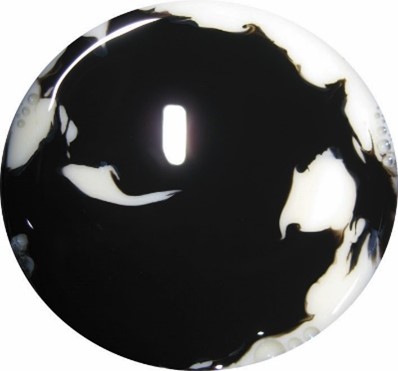
You wrote: Perhaps the only painting is black but there are endless possibilities in black. Old black, fresh black, lustrous black, dull black, emerald black, oil black, sunlight black, shadow black and the black of the lime tree in winter.
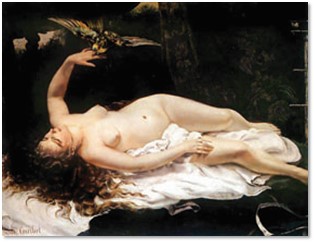
Courbet, Woman with a Parrot, 1866
You wrote: Maybe the only score is silent. What does it mean to experience silence as the essence of language?. Being silent is not the same as being mute. Silence is the only form of articulation. This is the gift of language.
I read a story about a child and a house built out of small red bricks. When construction was complete the child squatted next to it, placed a pig inside it and carefully replaced the top. Occasionally she walked away from the enclosure but always returned, opening it carefully, looking inside, emptying or filling it. This was her universe. Then you wrote me a story about a red house, a model that came to be built for real in red brick, found like a little time machine although you couldn’t determine if it goes to the past or the future. There is something tragic about the kind of architectural model created on the kitchen table. A house of meetings but also departures, its walls urge you to remember your compulsion to forget.
What does it mean to inhabit something, to capture its music? You thought about a nautilus shell for a long time and I wondered how you could blend with the darkness of the sea…
Dear Black Spot…
Gazing into your liquid emerald darkness suffused with silver halide crystals of light, sinking into your inky depths, enveloped in your perfect form, in a slumber dead to the world, an eternal caress wrapt in your tender abyss.
As I write to you I can sincerely say I have lived in this house although I cannot determine whether it is the past or the future. The ghostly sublime of a chair hovers in the background then I realised it never went away because it was never there in the first place. In the distance doors exploded from their origin, nothing is being asked or explained. A serene velocity at the mirrors edge hovers in the silver of the ground.
Symptoms manifested in the smashing of windows, the rehearsal of a ventriloquist act in empty rooms constructing an emotional temperature. I have stood under the darkening sky at the strike of madness where dead fingers dance, the dark matter of corporeal poetry: a shadow soundtrack of whispering grass kicking the air.
[A] “When we believe in a concept so deeply we might make a container for it over and over again…until the object might measure half the thought or the form smothers its nucleus. Just like a faucet that leaks [D: and there is comfort in this sound] concepts survive between half full and drowning.”
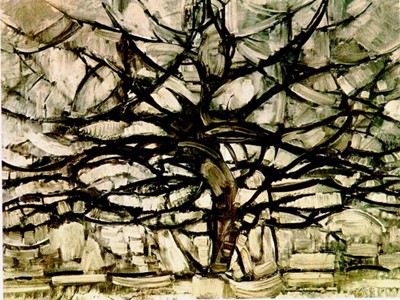
Piet Mondrian
[D] “Let us go, you and I beyond the perimeter where the Lime Tree is the tallest tree in sight, taller than the pines, the birches and willows, let us forget the names we give to the things we see.
There on the mossy bank of the lake I shall add my half empty to your half full and we shall wade out into its depths. We will forget that in spring and summer the Lime Tree was green all over and now in winter its branches are black, we will forget we are sad about that. We will forget because here in the lake we will be testing the concepts of surviving and drowning.”
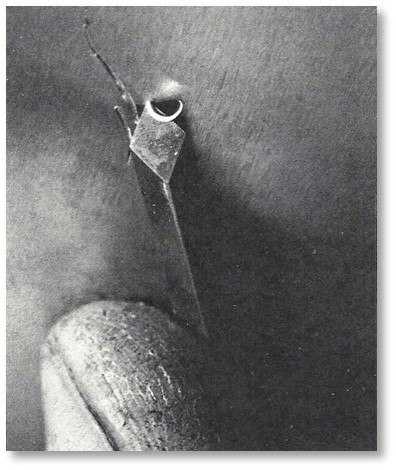
You wrote: Perhaps an artist cannot live, but only die in what he or she creates. In reality this appears to be a trifle like a paper cut and ‘when this cut is made nothing is destroyed’, but beneath the work are the cuts, sharp, clean, deep. How do you obtain relief? Breathe and keep cutting.
[A] “I wonder are you bored because time is being consumed. Boredom is when what you want is elsewhere and you are obliged to wait for it, or wait without it.” [D] This absent content is a fragment that shines like gold. There is no sound we can run to in this prototype theatre; we can only act out to the sides.
Roland Barthes writes: ‘There is a scenography of waiting: I organize it, manipulate it, cut out a portion in time in which I shall mime the loss of the loved object”… the object yet to come, the object that should have come and didn’t, the object that might never come, “provoking the effects of a minor mourning.” A Lover’s Discourse, Waiting, P.37
I am waiting for an arrival, a return, a promised sign. I have no sense of proportions. The being I am waiting for is not real. I create and re-create it over and over, starting from my capacity to love.
[A] “In a letter, in a sentence there are 3 things I determine. The definite things, the names, the things yet to be resolved: the questions and the things that just don’t mean anything at all. I find myself paying attention to these pauses, silences and endpoints.”
Fernando Pessoa writes “I think with my feelings and feel with my thoughts”.
[D] Do you see what I mean?… I imagine in this instance that you do.
Loïe Fuller & The Serpentine Dance, physical poet, 1862-1928
things shifting, slowly, imperceptibly, m-o-o-o-ving, don’t…know…where to…a movement toward […] away…shifting…things appearing…vanishing…[sub] emerging…it might be too soon to say “A Denise”…might be a “A…might be “A…D…might just be ” but at least that is a start…an opening
[flashing cursor on the screen as I pause then press return…and move…toward…
…uncertain steps, uncertain of his convictions, unsure of herself and…]
her future, an uncertain smile seeking a point at which rays of light converge as they simultaneously diverge, searching for the distinctness or clarity of an image rendered by an optical system in the act of moving,
a change in place
or
position, the focus of a lens, whir-click, click-clack
touching the ornaments – knick-knack – with uncertain fingers – touch, brush, tap, tap, tap…tick…tock, hearing the driving and regulatory mechanism of a watch or a clock, a movement toward, finding in the rhythmic structure of movement a self contained symphony…
a series of actions and progressive events, a centre of interest and a movement toward,
move as smoothly as wind across water, move listlessly, move quick and light, move like a flightless bird, like a shoal of silver fish, dart, descend, drift, float, glide, move as if on a treadmill to the centre of interest and a movement
toward the distinctness or clarity of an image,
pace, rush, scamper, shuffle, c-r-e-e-e-e-e-p, glide like a shadow|shadow, twist, travel, totter, hover […]
like a woman uncertain of his convictions, unsure of herself, an uncertain smile groping in the dark for the sub-conscious memory of a rhythmic structure of movement – toward – a self contained symphony.
uncertain seeking, unsure future, uncertain convictions, taking uncertain steps to a point…to a point…to a point…to a point…to a point…to to to the point at which rays of light simultaneously converge and diverge –
“Performativity” Butler says “is construed of that power of discourse to produced effects through re-iteration, to produce what it declares.” Performativity however, is only possible within the constraints of “iterability.” We are spoken more than we speak, done more than we do; therefore we are “constrained by what remains radically unthinkable” and, in the area of sexuality “by the radical unthinkability of desiring otherwise”. Inhabiting a sexed position then always engages citational practices, “citing the law under and through the force of prohibition and taboo, with the threat of ostracism and even death compelling and controlling the shape of production but without fully pre-determining it.” “Agency” then, according to Butler’s reconfiguration, is always “on drugs”. It is always under the influence of language and can only take place within our reiteration of the reiterable. Continue reading →




 denisestartin.co.uk