Currently Reading

This is a book about English art like no other.
Forget the tired rogues’ gallery of lords and ladies, forget the tall ships and haywains. These images cut to the heart of England’s psychic landscapes to portray an Albion unhinged, where magic and rebellion and destruction are the horses to which the country is hitched. On these fabled shores we are all castaways, whether our family has lived here for four thousand years or for four. Stephen Ellcock unleashes the magic and rebellion of England’s psychic landscapes through the power of images.  

Here you will find depictions of ancient trackways, chalk carvings and standing stones, of animal-masked community rituals, of streets set ablaze in protest, of occult dreams and psychedelic prophecies. There are over 200 images by artists ranging from William Blake, J.M.W. Turner and Samuel Palmer to Paul Nash, Louis Wain, Bill Brandt, Derek Jarman and Ithell Colquhoun to present-day visionaries such as Paula Rego, Cathy de Monchaux, George Shaw, Jamie Reid, Matt Collishaw, Tacita Dean, Lina Iris Viktor, Yinka Shonibare, Nick Waplington, Dan Hillier, Nicola Tyson, Sutapa Biswas and Chila Kumari Burman. The mind-blowing selection of images is accompanied by short texts by Mat Osman, exploring magic and mazes, ghosts and gardens, shipwrecks and cities. These poetic renderings of a spectral isle, together with Stephen Ellcock’s hallucinatory visual journey, reclaim Albion as an eternally inspiring and anarchic domain – an England on fire. 

Text reproduced from https://shop.tate.org.uk/england-on-fire-a-visual-journey-through-albions-psychic-landscape/35083.html (accessed 24/02/24)  

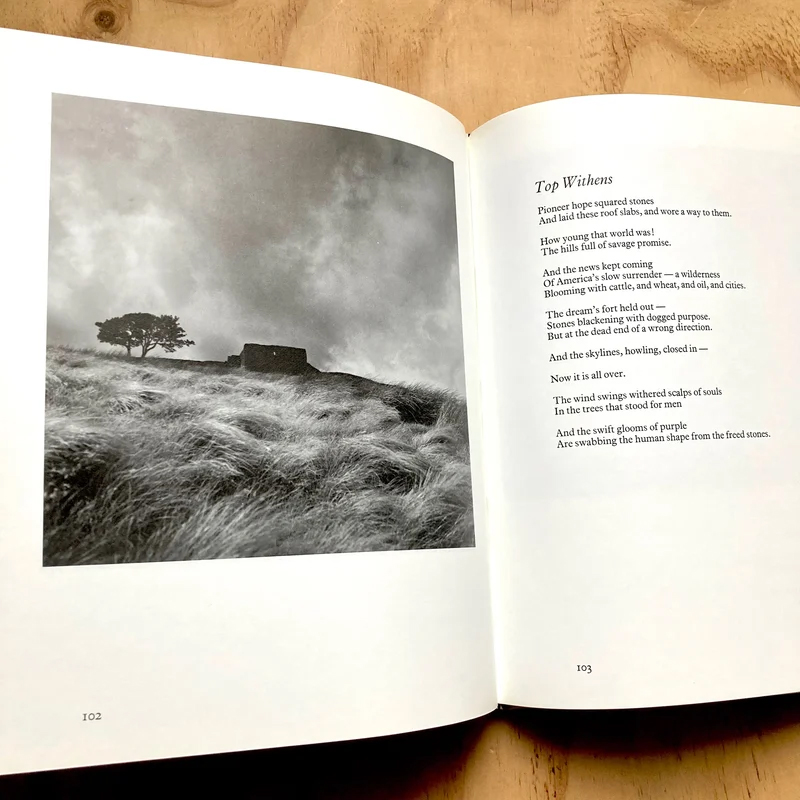
Remains of Elmet: A Pennine Sequence (1979)

Fay Godwin
Top Withens by Ted Hughes

“Ted Hughes (1930-1998) was born at 1 Aspinall Street, Mytholmroyd, in the West Riding of Yorkshire on the 17th August 1930. Ted was a pupil at the Burnley Road School until he was seven, when his family moved to Mexborough, in South Yorkshire. As a child he spent many hours exploring the countryside around Mytholmroyd, often in the company of his older brother, Gerald, and these experiences and the influences of the landscape were to inform much of his later poetry.

In ‘The Rock’, an autobiographical piece about his early childhood, Hughes writes about Scout Rock, whose cliff face provided ‘both the curtain and back-drop to existence‘. The area continued to be a powerful source of inspiration in his poetry long after he had left Yorkshire. Hughes described the experience of looking out of the skylight window of his bedroom on 1 Aspinall Street onto the Zion Chapel. The Chapel is long gone, but Zion Terrace remains, its name a reminder of more God-fearing times.

In his classic and richly personal collection Remains of Elmet: A Pennine Sequence (1979), with photographs by Fay Godwin, Hughes suggests that the Calder Valley was originally the kingdom of Elmet, the last Celtic land to fall to the Anglo-Saxons. A second, revised edition was published as Elmet in 1994. 

Many of Hughes’s other poems also relate to the Calder Valley. ‘Six Young Men’, for example, was written at Hughes’s parents’ house at Heptonstall Slack in 1956. The poem describes a photograph belonging to Hughes’s father of six of his friends on an outing to Lumb Falls, taken just before the First World War.”

Text reproduced from https://www.theelmettrust.org/elmet-trust-ted-hughes/ (accessed 25/01/23). Images reproduced from Pinterest.

Letters of Motivation – Move[ME]nt

Loïe Fuller & The Serpentine Dance, physical poet, 1862-1928

Loïe Fuller & The Serpentine Dance, physical poet, 1862-1928

things shifting, slowly, imperceptibly, m-o-o-o-ving, don’t…know…where to…a movement toward […] away…shifting…things appearing…vanishing…[sub] emerging…it might be too soon to say “A Denise”…might be a “A…might be “A…D…might just be ” but at least that is a start…an opening

[flashing cursor on the screen as I pause then press return…and move…toward…

…uncertain steps, uncertain of his convictions, unsure of herself and…]

her future, an uncertain smile seeking a point at which rays of light converge as they simultaneously diverge, searching for the distinctness or clarity of an image rendered by an optical system in the act of moving,

a change in place
or
position, the focus of a lens, whir-click, click-clack

touching the ornaments – knick-knack – with uncertain fingers – touch, brush, tap, tap, tap…tick…tock, hearing the driving and regulatory mechanism of a watch or a clock, a movement toward, finding in the rhythmic structure of movement a self contained symphony…

a series of actions and progressive events, a centre of interest and a movement toward,

move as smoothly as wind across water, move listlessly, move quick and light, move like a flightless bird, like a shoal of silver fish, dart, descend, drift, float, glide, move as if on a treadmill to the centre of interest and a movement

toward the distinctness or clarity of an image,

pace, rush, scamper, shuffle, c-r-e-e-e-e-e-p, glide like a shadow|shadow, twist, travel, totter, hover […]

like a woman uncertain of his convictions, unsure of herself, an uncertain smile groping in the dark for the sub-conscious memory of a rhythmic structure of movement – toward – a self contained symphony.

uncertain seeking, unsure future, uncertain convictions, taking uncertain steps to a point…to a point…to a point…to a point…to a point…to to to the point at which rays of light simultaneously converge and diverge –

move[ME]nt.

Foot Notes

Artists Foot Notes © My Sole

Loïe Fuller image reproduced from https://bibliolore.org/2013/05/20/loie-fullers-serpentine-success/