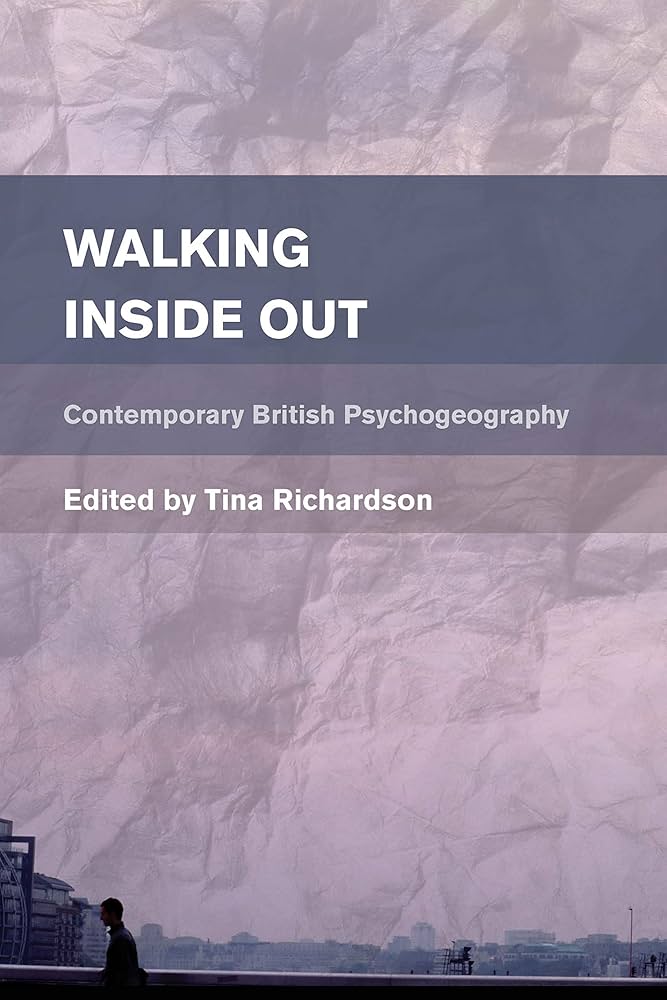
Walking Inside Out is the first text that attempts to merge the work of literary and artist practitioners with academics to critically explore the state of psychogeography today. The collection explores contemporary psychogeographical practices, shows how a critical form of walking can highlight easily overlooked urban phenomenon, and examines the impact that everyday life in the city has on the individual. Through a variety of case studies, it offers a British perspective of international spaces, from the British metropolis to the post-communist European city. By situating the current strand of psychogeography within its historical, political and creative context along with careful consideration of the challenges it faces Walking Inside Out offers a vision for the future of the discipline.
“Iain Sinclair’s classic early text, Lud Heat, explores mysterious cartographic connections between the six Hawksmoor churches in London. In a unique fusion of prose and poetry, Sinclair invokes the mythic realm of King Lud, who according to legend was one of the founders of London, as well as the notion of psychic ‘heat’ as an enigmatic energy contained in many of its places. The book’s many different voices, including the incantatory whispers of Blake and Pound, combine in an amalgamated shamanic sense that somehow works to transcend time. The transmogrifying intonations and rhythms slowly incorporate new signs, symbols and sigils into the poem that further work on the senses. This was the work that set the ‘psychogeographical’ tone for much of Sinclair’s mature work, as well as inspiring novels like Hawksmoor and Gloriana from his peers Peter Ackroyd and Michael Moorcock, and Alan Moore’s From Hell.”
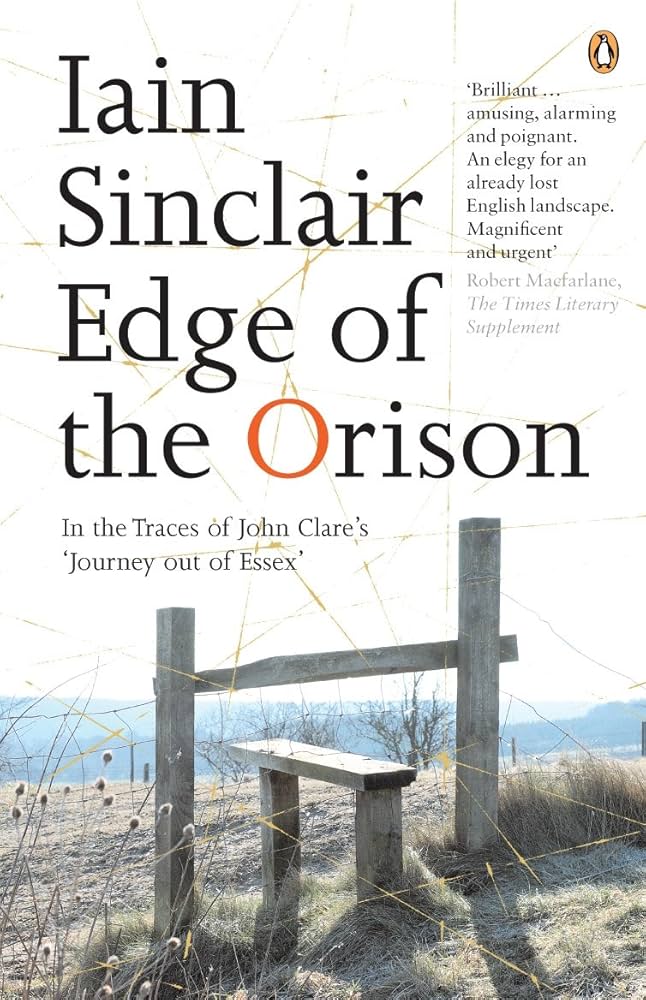
“In 1841 the poet John Clare fled an asylum in Epping Forest and walked eighty miles to his home in Northborough. He was searching for his lost love, Mary Joyce – a woman three years dead …In 2000 Iain Sinclair set out to recreate Clare’s walk away from madness. He wanted to understand his bond with the poet and escape the gravity of his London obsessions. Accompanied on this journey by his wife Anna (who shares a connection with Clare), the artist Brian Catling and magus Alan Moore – as well as a host of literary ghosts, both visionary and romantic – Sinclair’s quest for Clare becomes an investigation into madness, sanity and the nature of the poet’s muse.”
“Dining on Stones is Iain Sinclair’s sharp, edgy mystery of London and its environs Andrew Norton, poet, visionary and hack, is handed a mysterious package that sees him quit London and head out along the A13 on an as yet undefined quest. Holing up in a roadside hotel, unable to make sense of his search, he is haunted by ghosts: of the dead and the not-so dead; demanding wives and ex-wives; East End gangsters; even competing versions of himself. Shifting from Hackney to Hastings and all places in-between, while dissecting a man’s fractured psyche piece by piece, Dining on Stones is a puzzle and a quest – for both writer and reader.”
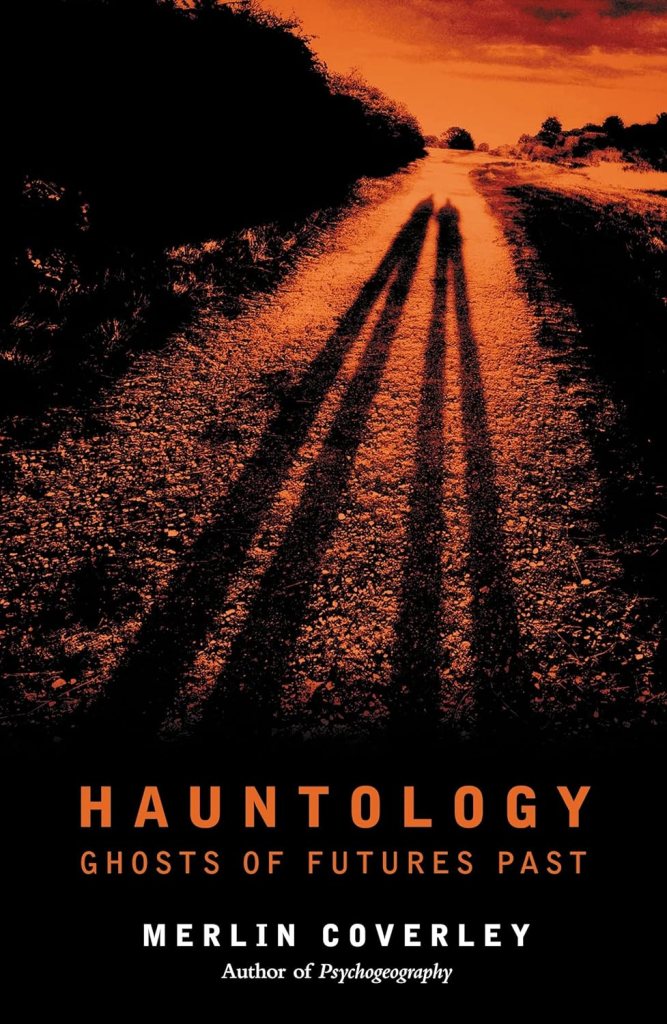
“Ghosts and spectres, the eerie and the occult. Why is contemporary culture so preoccupied by the supernatural, so captivated by the revenants of an earlier age, so haunted? The concept of Hauntology has evolved since first emerging in the 1990s, and has now entered the cultural mainstream as a shorthand for our new-found obsession with the recent past. But where does this term come from and what exactly does it mean? This book seeks to answer these questions by examining the history of our fascination with the uncanny from the golden age of the Victorian ghost story to the present day. From Dickens to Derrida, MR James to Mark Fisher; from the rise of Spiritualism to the folk horror revival, Hauntology traces our continuing engagement with these esoteric ideas. Moving between the literary and the theoretical, the visual and the political, Hauntology explores our nostalgia for the cultural artefacts of a past from which we seem unable to break free.”
A whalebone box found washed up on the shore. Is it an enigmatic object containing a secret? A survivor from a shipwreck? It was given to Iain Sinclair, Kötting’s walking companion on his latest jaunt themed film. They set out on an expedition to take this box to its place of origin, a beach on the Isle of Harris in Scotland’s Outer Hebrides. Artist Eden Kötting helps shape the film, and in many ways it’s an ode to her indomitable spirit. Shot using mainly super 8 and super 8 apps and incorporating elements of archive and pinhole photography, The Whalebone Box celebrates the notion of the home-made but is also an idiosyncratic road map.
Review from the Guardian
“His latest offering is more like a dream – or rather a conjunction of dreams, occupying that liminal space between waking and sleep (“half one thing, half the other”) where the land meets the sea, past meets present, and lo-fi home-made cinema brushes against something sublime. As with so many of Kötting’s films, the central conceit involves a journey – a quest apparently undertaken to restore the titular artefact to the place of its making in the Outer Hebrides, and thereby cure an amorphous “unwellness”. I have no idea how much of what is documented here is “true”; suffice to say that it all feels profoundly truthful.
We’re told that the whalebone box was made over 30 years ago (“it belonged to another time, another place”) by sculptor Steve Dilworth, who fashioned it from the skeleton of a whale that washed up on the Isle of Harris. Tied with the twine from a herring net, lined with the lead of melted weights, and filled with “calm water”, the box came into the possession of Iain Sinclair, the author and “psychogeographer” (“a walker and talker”), who has become a regular Kötting collaborator. Sinclair called the box his “animal battery”, and for years it sat by his desk while he wrote. But at some point he decided that it should be returned to its home and buried in the sand where the whale was beached. And so, aided by pinhole photographer Anonymous Bosch, Sinclair and Kötting embarked upon a “reversed pilgrimage” to do just that.
Part of The Whalebone Box is a typically fragmented account of that journey, venturing in a chronological fashion from the psychic aerial of Sway Tower in the New Forest to the standing stones of Lewis (via diversions through the Pyrenees), all recorded in a variety of DIY formats, both physical and digital, and interspersed with archive footage, still photography and animation. The other part is a journey into the dreams of Eden Kötting, the remarkable artist who has long been the muse and inspiration of her father, Andrew. In these sections we find Eden seated like a regal seer in a forest, a gun across her lap, holding a pair of binoculars to search for whales. In her dreams, Eden has fashioned an imitation of the whalebone box, a papery contraption that lacks the physical heft of its namesake. Yet somehow, this dream-box has found its way into the “real” world. Or maybe it’s the other way round?
Borrowing intertitles from Leviathan by Philip Hoare (the author who also informs and structures this odyssey), The Whalebone Box muses on familiar themes of folklore, history, mysticism and “happenstance”, as it meanders across disparate landscapes, several journeys becoming one. En route we encounter the graves of Basil Bunting (“Poet of Northern England”) and Sorley MacLean (“Poet of Northern Scotland”), and hear the poet-artist MacGillivray perform her spine-tingling murdered mermaid song in a church, sounding for all the world like a whale out of water, crying plaintively into the abyss. At each stage, the box (in both its incarnations) seems to become heavier, charged with “insane energy”, carrying the accumulated psychic weight of its journey.
Thrown into the mix are discussions of other boxes: Pandora’s box; the flight recorders from doomed aeroplanes; the mysterious container from Kiss Me Deadly (“what’s in the box?”); the conceptual box in which Schrödinger’s cat is simultaneously alive and dead – a subject that also haunted Carol Morley’s tangentially comparable Out of Blue. Beneath it all, an ambient soundtrack ebbs and flows, from low pulsing throbs to rhythmic beats and floating melodies, interspersed with whispered words (“I love you inside out”) and fragments of other movies – the voiceover from Sunset Boulevard; the trailer for John Carpenter’s The Thing. You can feel the ghost of Derek Jarman in Kötting’s work: the use of collage; the investigation of memory; the allusions to Shakespeare’s The Tempest; the deconstruction of cinema itself. Yet, The Whalebone Box has something even more personal in its subtle exploration of the bond between father and daughter, an expression of love that had me laughing one moment and crying the next. With such a tender, beating heart, this is in some ways Kötting’s most unexpectedly accessible work. And, as Eden says more than once in her subtitled voiceover: “It’s true!”
“Andrew Kötting recreates scenes of the fascinating and melancholy 90-mile walk undertaken in 1841 by the nature poet John Clare, in a bizarre documentary. Film-maker Andrew Kötting again takes inspiration from that great psycho-geographer Iain Sinclair – with whom he recorded an unclassifiably strange journey by pedalo in the 2012 film Swandown. Now he has been inspired by Sinclair’s book Edge of the Orison, about the fascinating and melancholy 90-mile walk undertaken in 1841 by the nature poet John Clare, from a mental asylum in Epping to Northampton, on a pilgrimage to find Mary Joyce, the woman with whom he believed himself to be in love.
Kötting has Toby Jones recreate the scenes of Clare’s great journey or ordeal, often amid bizarrely alienating and alienated scenes of modern life. Jones recites some of Clare’s work in voiceover, and Kötting also asks Jones’s father Freddie Jones to recreate his performance as Clare from a 1970 Omnibus documentary, from which he samples the patronising narration assuring us that Clare “was a minor nature poet who went mad”. Engagingly, oddly, and rather disturbingly, Kötting himself dresses as a “straw bear” who ambles about the place like some occult folk sacrifice and Sinclair undertakes an interview on the subject of Clare with Alan Moore, who describes Northampton as so drenched with literary and poetic association that it is “a kind of vision-sump”. Kötting’s critical reading of Clare emphasises his transgressive quality but the film allows us to suspect that Clare was quite as sophisticated and self-aware as anyone making this film.”




 denisestartin.co.uk