PhD Synopsis

Brontë Country Map

The Chorography of Place: Mapping new ecologies of landscape, memory, history and visual culture.

This PhD by practice aims to explore chorography’s relevance as an organising principle in contemporary artistic practice and critically address the historic yet neglected role of chorography in the documentation of place. Chorography, or place writing, is the artistic representation of a regional map which originated in Classical Geography (c.149AD). This field-based approach and detailed descriptor of place takes region as it’s lens and qualitatively maps characteristics of the locale by examining the constituent parts of that place. If a sensory physical mapping of place occurs prior to representation where is the body in the process of chorography?

There is a need to distinguish this act from its documentation and re-presentation to provide new theories, forms and applications by addressing the political implications of the embodied in the act of representation. To provide a contemporaneous account the performative relations between the body, mapping and place; the mobile, embodied and situated are therefore central to a contemporary interpretation of chorography.

To enact these relations sites chosen for their historic, symbolic or mythological significance include Brontë Country which straddles West Yorkshire and the East Lancashire Pennines, the Devil’s Bridge in Wales and St. Michael’s Mount, Cornwall. Applying chorographic methods in artistic practice I aim to realise a historically grounded exploration of place by performing and documenting embodied, visual, textual and symbolic mappings. These mappings will form the basis of artworks, critical and performance writing, book works, performance and installation which will translate chorographic methods and the physical act of mapping into artistic practice. Combining historic method with contemporaneous form will enable a renewed understanding of the chorography of place not just artistically but physically, contextually and historically.
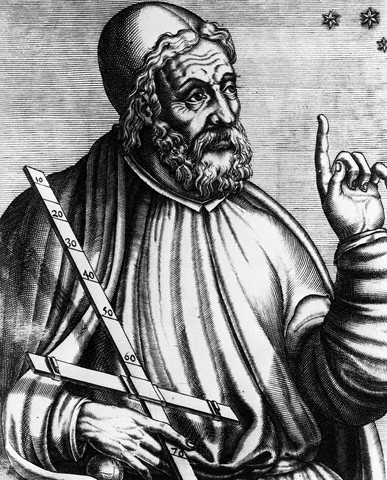
Extract from In What Geography Differs From Chorography, Claudius Ptolemy

1584 — An illustration of Ptolemy holding a cross-staff, published in Les vrais portraits et vies des hommes illustres (1584). — Image by © Bettmann/CORBIS

“Geography is a representation in picture of the whole known world together with the phenomena contained therein, it differs from Chorography in that Chorography, selecting certain places from the whole, treats more fully the particulars of each by themselves – even dealing with the smallest conceivable localities, such as harbors, farms, villages, river courses, and such like. It is the prerogative of Geography to show the known habitable earth as a unit in itself, how it is situated and what is its nature, and it deals with those features likely to be mentioned in a general description of the earth, such as the larger towns and great cities, mountain ranges and principle rivers […]

The end of Chorography is to deal separately with a part of the whole, as if one were to paint the eye or ear by itself. The task of Geography is to survey the whole in its just proportions, as one would the entire head, and afterwards those detailed features which portraits and pictures may require, giving them proportion in relation to one another so that their correct measurement apart can be seen by examining them, to note whether they form the whole or a part of the picture. Accordingly therefore it is not unworthy of Chorography, our out of its province, to describe the smallest details of places, while Geography only deals with regions and their general features. […] Chorography is most concerned with what kind of places those are which it describes, not how large they are in extent. Its concern is to paint a true likeness, and not merely to give exact position and size. Geography looks at the position rather than the quality […] Chorography needs an artist, and no one presents it rightly unless he is an artist…”

Claudius Ptolemy quoted in Volume II, Visual Culture: Histories, Archaeologies and Genealogies of Visual Culture. Eds. Morra, J, Smith. M, (Oxon, Routledge: 2006), p.17‐18.