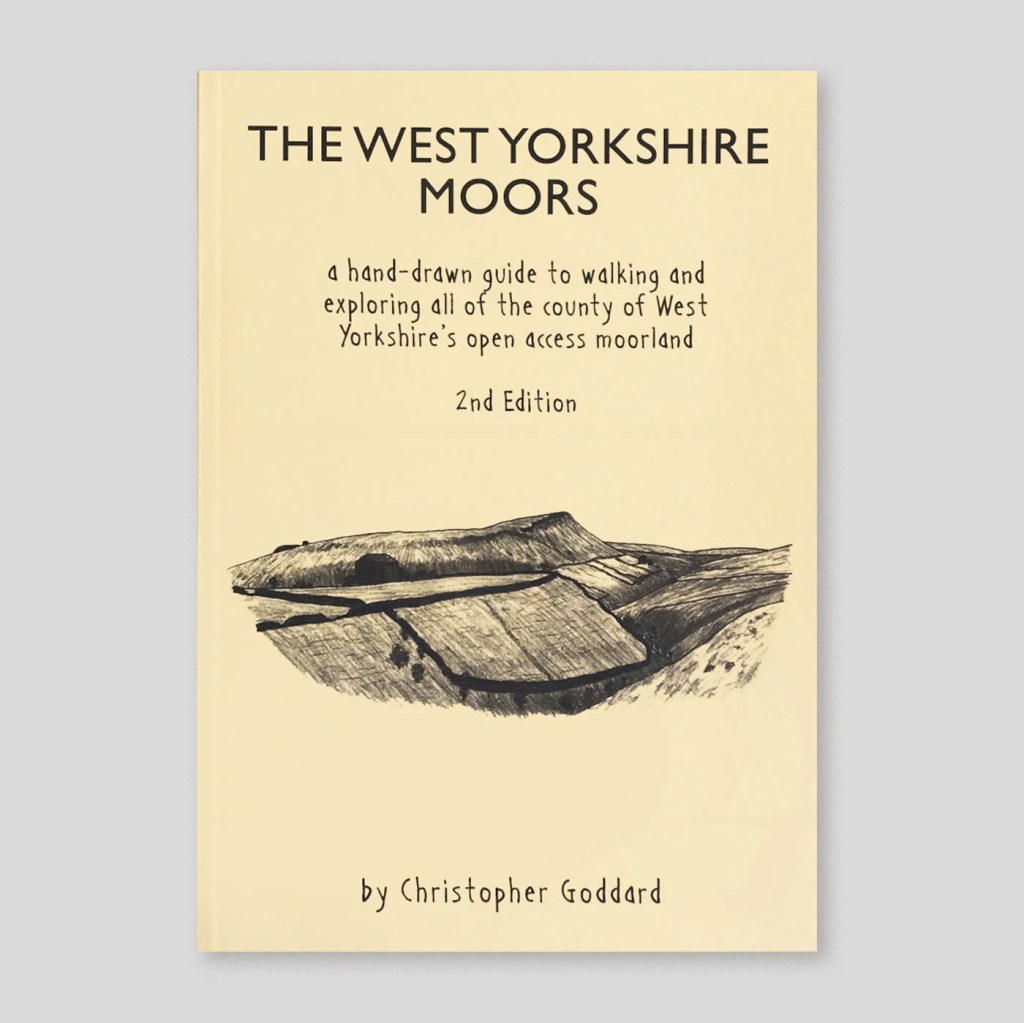
Walking the West Yorkshire Moors

The West Yorkshire Moors is an original cartographic guide to the moorlands of West Yorkshire. The book traces old and new paths, unearths lost names and discovers hidden features on even the most apparently empty corner of these moors. There are extensive notes and sketches of the area’s history, wildlife, folklore and etymology. Twenty-nine suggested routes are included, most of which are accessible by public transport. These moors stretch from Ilkley, Keighley and Bingley in the north to Holmfirth, Marsden and Meltham in the south. This new edition of the book features amended and digitally remastered maps, and several new sketches. All the routes have been updated, with two brand new ones added.

Image & text reproduced from https://christophergoddard.net/product/the-west-yorkshire-moors/ (accessed 11/12/24) Book available from website
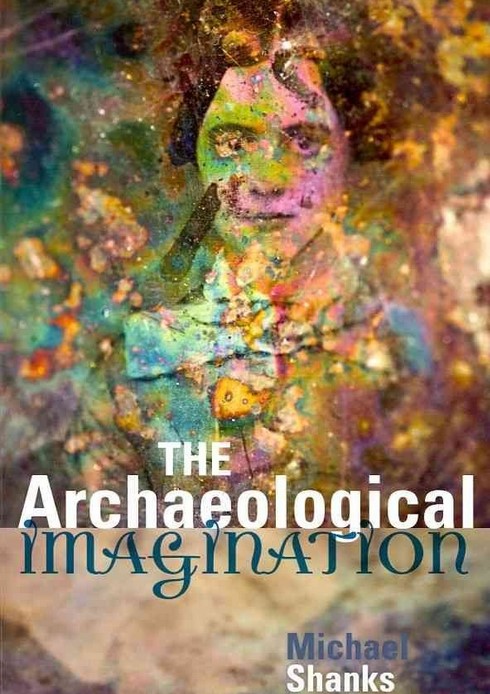
Currently Reading

“Archaeology is a way of acting and thinking—about what is left of the past, about the temporality of what remains, about material and temporal processes to which people and their goods are subject, about the processes of order and entropy, of making, consuming and discarding at the heart of human experience. These elements, and the practices that archaeologists follow to uncover them, is the essence of the archaeological imagination.”

In his book Shanks offers the following definition: “To recreate the world behind the ruins on the land, to reanimate the people behind the shard of antique pottery, a fragment of the past: this is the work of the archaeological imagination, a creative impulse and faculty at the heart of archaeology, but also embedded in many cultural dispositions, discourses and institutions commonly associated with modernity. The archaeological imagination is rooted in a sensibility, a pervasive set of attitudes toward traces and remains, towards memory, time and temporality, the fabric of history.” pp.25

Text reproduced from https://www.google.co.uk/books/edition/The_Archaeological_Imagination/a6tJDAAAQBAJ?hl=en&gbpv=0 (accessed 13/08/23)

Poly-Olbion

William Hole’s frontispiece (from the Folger Shakespeare Library [http://luna.folger.edu/luna/servlet/s/7ihql3])

“Poly-Olbion is an expansive poetic journey through the landscape, history, traditions and customs of early modern England and Wales. Originally published in two parts (1612, 1622), it is also a richly collaborative work: Michael Drayton’s 15,000-line poem, which navigates the nation county by county, is embellished by William Hole’s thirty exquisite engraved county maps, and accompanied for its first eighteen ‘songs’ by the young John Selden’s remarkable prose ‘Illustrations’. Drayton was a close associate of Shakespeare and Ben Jonson, and his Poly-Olbion crystallizes early modern ideas of nationalism, history and memory.”

Image and text reproduced from https://poly-olbion.exeter.ac.uk/ (accessed 09/07/23)
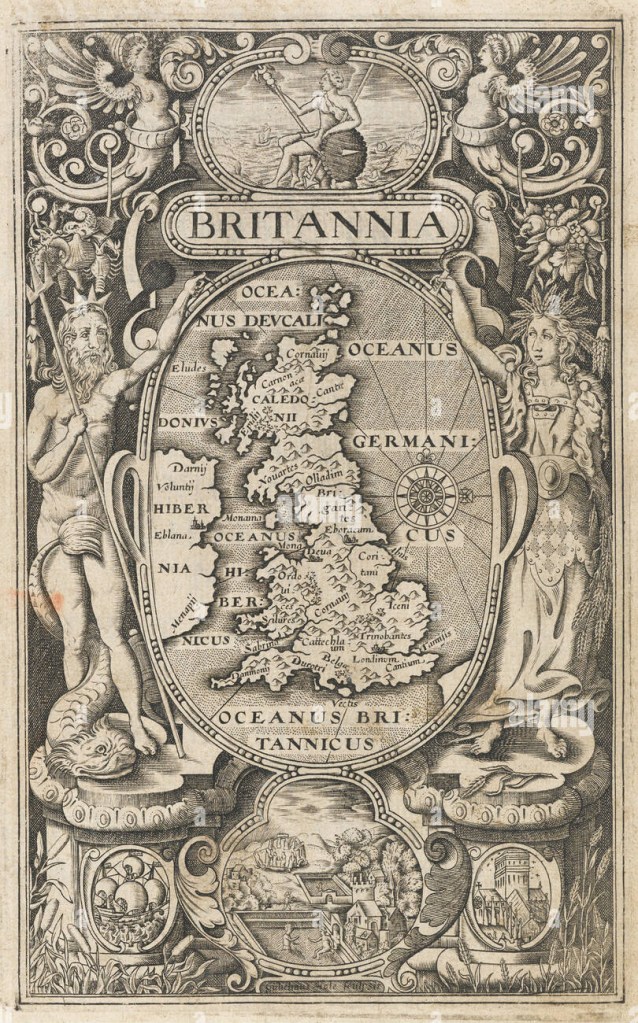
William Camden’s Brittania

“A map of England, Wales, Scotland eastern Ireland, in an oval supported by Neptune and Ceres, with vignettes of Britannia sitting on a rock, a ship, St Paul’s Cathedral, and Stonehenge and the Roman Baths. On the map London and York are marked, but most of the other names are tribes. This frontispiece was one of three maps engraved by William Rogers (c.1545-c.1604) for the 1600 edition of William Camden’s ‘Britannia’, the fifth edition of the work, yet the first to contain maps. It was not until 1607 that a full suite of county maps was included, alongside a larger version of this map, engraved by William Hole.”

Chorography designates “a regional map in Renaissance geographic texts and the artistic description of regions” viewed and experienced from within linking “regional events at the time of occurrence in pictorial representations.” (Olwig 2001 and Curry 2005 cited in Päivi Kymäläinen and Ari A. Lehtinen 2010: 252). Chorography or place‐writing forms an aspect of the tri‐partite structure belonging to a classical Geographic distinction between Topography, Chorography and Geography, Päivi kymäläinen and Ari A. Lehtinen (2010). Chorography, defined by the polymath Ptolemy in the Geographike Hyphegesis (c.149AD) takes region as its lens. This field-based approach and detailed descriptor of place qualitatively maps characteristics of the locale by examining the constituent parts of that place “to describe the smallest details of places.” Morra J, Smith M (2006: 17-18). Cormack states “Chorography was the most wide ranging of the geographical subdisciplines, since it included an interest in genealogy, chronology, and antiquities, as well as local history and topography…unit[ing] an anecdotal interest in local families and […] genealogical and chronological research.” (Cormack 1991 cited in Rohl 2011: 22).

Chorography was re-discovered in Renaissance Geography and British Antiquarianism 16th -17th centuries. Historically William Camden’s Brittania (1586) or a Chorographicall Description of the most flourishing Kingdomes, England, Scotland, and Ireland is an encyclopaedic approach to a geographic, historical topographical survey of the British Isles which has been identified as a classic exemplar of the renaissance of a chorographic work “connecting past and present through the medium of space, land, region or country.” (Rohl 2011: 22). Camden’s place in this changing historiographical framework of the English Renaissance is critical to elevating the field of historical studies in tandem with scientific documentation as a new and original contribution to knowledge and the discovery of ‘England’ and a sense of ‘Englishness’ (Richardson 2204: 112).

With its overriding pre-occupation with place Camden’s Brittania (1586), arranged chronologically, is a county-by-county survey of England & Wales which travels from the South to the North and represents a new ‘topographical-historical method’ (Mendyk 1986 cited in Rohl 2011: 22). The science of map making was still in it’s infancy but Camden was linked to its development and utilised it when it became available (Richardson 2004:117). Cartographic representations however “aim at synchronic representation”, chorographic descriptions of the countryside, by contrast, opt instead for the diachronic.” Reconstructing a topographically organised historical account in a specific area. Hence in Marchitello’s formulation “Chorography is the typically narrative and only occasionally graphic practice of delineating topography not exclusively as it exists in the present moment, but as it has existed historically. This means not only describing surface features of the land (rivers, forests, etc.), but also the “place” a given locale has held in history, including the languages spoken there, the customs of it’s people, material artefacts the land may hold, and so forth.” Marchitello in (Swann 2001, p.101). British Antiquarianism therefore retrieved chorography and recreated it in an expanded field, re-interpreting its legacy, ensuring its survival, restoration and continuing communication. Susan Stewart discusses the antiquarian as being “moved by a nostalgia of origin and presence” whose “function is to validate the culture of ground.” (1984:153)

Text reproduced from https://www.abebooks.co.uk/servlet/BookDetailsPL?bi=31158455803&cm_mmc=ggl--UK_Shopp_RareStandard--product_id=bi%3A%2031158455803-_-keyword=&gclid=CjwKCAiApvebBhAvEiwAe7mHSKrgSaHbIJ-gLMONnS4zfobOGGL_kNcSs86HQENjxVf97aIYKEEEchoCF4YQAvD_BwE (accessed23/11/22)

Image reproduced from https://www.alamy.com/frontispiece-map-of-britannia-from-the-early-printed-book-entitled-britain-or-a-chorographical-description-of-the-most-flourishing-kingdoms-england-scotland-and-ireland-and-the-lands-adjoining-out-of-the-depth-of-antiquity-beautified-with-maps-of-the-several-shires-of-england-written-by-william-camden-william-camden-may-2-1551-november-9-1623-was-an-english-antiquarian-historian-and-topographer-image246621803.html (accessed 23/11/22)