Currently Reading

“Since 1857, hardly a year has gone by without some sort of Brontë ‘biography’ appearing. These range from pious accounts in Victorian conduct books to Freudian pyschobiographies, from plays, films and ballets to tourist brochures and images on tea-towels, from sensation-seeking penny-a-liners to meticulous works of sober scholarship. Each generation has rewritten the Brontës to reflect changing attitudes – towards the role of the woman writer, towards sexuality, towards the very concept of personality. The BrontëMyth gives vigorous new life to our understanding of the novelists and their culture and Lucasta Miller reveals as much about the impossible art of biography as she does about the Brontës themselves.”

Text reproduced from https://www.amazon.co.uk/Bronte-Myth-Lucasta-Miller/dp/0099287145/ref=sr_1_1?crid=JRQVJMGQ82N&keywords=the+bronte+myth&qid=1682966752&sprefix=the+bronte+myth%2Caps%2C684&sr=8-1 (accessed 01/05/23)
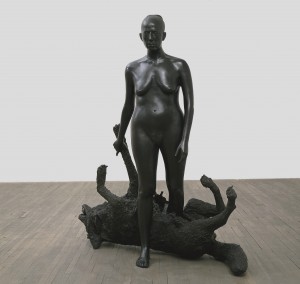
Metamorphosis of the Feminine – The Bloody Chamber, Angela Carter and Kiki Smith

Kiki Smith, Rapture, 2001, Bronze, 67 1/4 x 62 x 26 1/2 inches Edition of 3

Kiki Smith, Rapture, 2001, Bronze, 67 1/4 x 62 x 26 1/2 inches
Edition of 3

“It’s a resurrection/birth story; ‘Little Red Riding Hood’ is a kind of resurrection/birth myth.”

The Bloody Chamber by Angela Carter is a collection of short stories in which Carter re-appropriates the fairy tale in the service of the feminine to re-work patriarchal constructions of gender from within the genre. Female protagonists constantly transgress the boundaries of the patriarchal and the received definition of the fairy tale moral in relation to the feminine (i.e the innocent female child and the sacrificial female). The primary story after which the collection is named is a re-working of Bluebeard by Charles Perrault and was influenced by Carter’s readings of the Marquis De Sade. Carter asserts that Sade “put pornography in the service of women, or, perhaps, allowed it to be invaded by an ideology not inimical to women …” [1]. This extremely brief presentation aims to highlights connections between the representation of female experience in Visual Art and The Bloody Chamber. Continue reading