Micro Critique Paper No.4

Introduction: Analysis of the following articles have revealed problems in defining the field of chorography as well as methods, theories and insights which warrant further examination. These summaries identify, illuminate and reflect on these issues and their implications in theory and practice.

Paper 4: Curry, M. (2005) “Toward A Geography of a World Without Maps: Lessons From Ptolemy And Postal Codes”. Annals of the Association of American Geographers [online] 95 (3), 680-691. Available from http://onlinelibrary.wiley.com/doi/10.1111/j.1467-8306.2005.00481.x/abstract [5th October 2015]
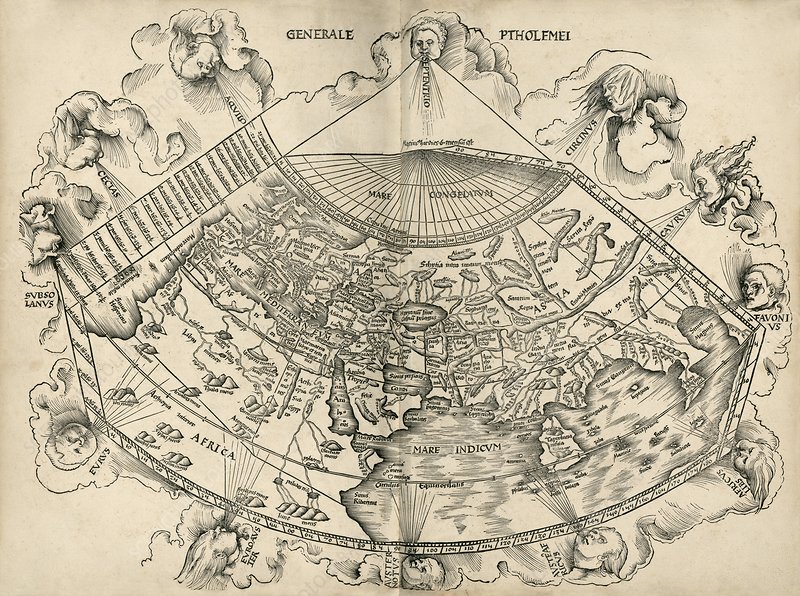
Ptolemy’s world map. This map of the world is from an edition of Ptolemy’s ‘Geographia’, published in 1513 by German cartographer Martin Waldseemuller (c.1470-1520)

Curry’s paper is concerned with the conflation of place and space in contemporary discourse which commonly obfuscate and erase their differences. His primary aim is to elaborate upon the terms chorography, topography and geography and delineate their differences by examining their ‘technologies and practices’. He suggests chorography is limited to the geographer’s knowledge, clearly in the context of this research this is not the case and in his own words ‘it is alive and well.’ Curry argues these geographic ways of knowing each have their own objects of study; region, place and the earth’s surface.  He is critical of both their neglect in discussions of place or analyses which focus on scale in relation to these concepts as opposed to form and function. Curry employs a complex analogy of the invention of the US ZIP code to illuminate his argument.

Curry compares and contrasts these terms by tracing and re-interpreting their origins to distinguish them from contemporary understandings. He locates chorography and topography within foundational concepts of place and memory. Chorography was a qualitative way of interpreting the world, both celestial and terrestrial, and this knowledge was located in ‘signs or symbols’ which aimed to perceive relations ‘between events, places and the times of their occurrence’.  He relocates topography’s association with mapping by placing it in the oral tradition and the ‘art of memory’. In this context places are created, narrated, performed and re-formed through symbolic associations. Place and experience are coextensive with each other and this element of the mnemonic has already been established independently in prior research.

For Curry the importance of this argument is not simply a matter of different scales of apprehension, but more significantly is intrinsically linked to repositories of knowledge, dissemination and retrieval. He argues space was ‘invented’ against the backdrop of place, due to emergent technologies necessitated by an increase in information, leading to an erasure of the chorographic and topographic by the geographic. Chorography and topography represent human patterns of knowing and belonging in contrast to the panoptic vision of geography. The implications of this observation equate to an erasure of memory practices and a movement from an embodied and emplaced performance of knowledge to its commodification. Places are increasingly mediated by technology and this also applies to the digital records of archaeological fieldwork. For instance when I was introduced to archaeological fieldwork at Erddig, Wales the corresponding planar database managed by the Historic Buildings, Sites and Monuments Record comprises 24 topographic views of each location in the field; a complex palimpsest inconceivable in a single view. This centralization of information which allows for the preservation of heritage data becomes an abstracted space of typology and categorization devoid of the people that inhabited them or the places that created them.

Curry’s analogy of the standardisation of the ZIP code can, in the context of this paper, be equated with geography reaching its empirical, scientific, mathematical and spatial exactitude in the art of cartography. This organisation of geographical knowledge, in the case of the ZIP code, privileges spatial points and co-ordinates whereby the particularities of place, regions, difference, the local and thus topography and chorography are subsumed and erased by spatial systematisation, the realm of demographics and the global organisation of information.

Image reproduced from https://www.sciencephoto.com/media/428654/view/ptolemy-s-world-map-16th-century (accessed 03/11/22)
Intercorporeal, Intersubjective, Imaginary and Rational Spatialities: Between Existence and Abstraction

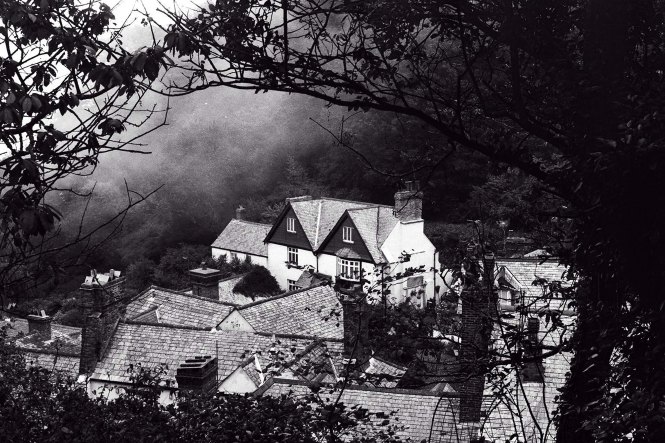
Untitled © Denise Startin

“If a person feels inside a place, he or she is here rather than there, safe rather than threatened, enclosed rather than exposed, at ease rather than stressed. Relph suggests that the more profoundly inside a place a person feels, the stronger will be his or her identity with that place.”

‘Space is multiple. Such multiplicity is both the precondition for and the result of spatial practices. Spatiality and practicality ground one another. There are different ways of attempting to grasp this co-dependent multiplicity. For example,

“…Relph defines four sorts of space, or knowledge about space, produced by different relationships to places. At the first step ‘pragmatic’ spaces are organised by our bodily situation (left or right, up or down). Second is perceptual space, organised through our intentions and centred on us – what we focus upon, what we look at, thus tending to be centred on the observer. Existential space is informed by cultural structures as much as our perceptions – it is space full of social meaning. This space is defined in relationship to some human experience or task. Finally, cognitive space is how we abstractly model spatial relationships.” (Crang, 1998:110). While this is a valuable starting point, recent re-thinkings of the phenomenological heritage, within which Relph lies, may point to a slightly different classification, coordinating person-hood with place-hood. This schema is based on the intercorporeal (as embodied-situated interaction), the intersubjective (as symbolic, performative, narrative interaction), the imaginary (as fantasmal, intracorporeal, medial-virtual interaction) and rational (as geometric, logical, coded interaction), each with their different degrees of freedom. Each of these four dimensions may or may not be well integrated and may well be skewed in various different directions, such that, for example, one’s fantasmal imaginings may begin to dominate and render unsustainable one’s intercorporeal and intersubjective relations. Through integration of these dimensions, spatial practices coordinate, integrate and separate spatialities centred on the self, and its motivated engagement with the world, with the spatialities that derive from geometric and logical calculation and fabrication, the structures of the designed and manufactured world. This is to acknowledge, while re-articulating Heidegger’s focus on care:

“Heidegger does not talk about intentions so much as care. Since we are always engaged with the world, we must focus our attention on particular aspects at any given time. We thus have different types and levels of care for different things at different times. The world might then be seen as comprising different levels of care.” (Crang, 1998: 110). The conclusion that Crang draws from this passage above, in which Relph interprets Heidegger, is that (human) knowledge of the world is always em-placed. It starts from and continues to be based around places as centres of care about the world. Thus, notes Crang, employing this approach suggests that we make sense of the world through the materials at hand, not from abstract schemes.

Continue reading

Subjects of dispersal

Hands:Holding by Rune T

‘Foucault uses the language of space to highlight the formative effects of discourse and the instability of the plane it constitutes. Foucault’s analytics and politics are inextricably linked to creating an alternative physics of space. His alternative spatial text-ure both represents itself as a more accurate depiction of the real work of power and shifts the paradigmatic grounds for conceiving power. Power has generally been conceived as a dichotomous structure pairing intent and result, cause and effect, oppressor and oppressed. But Foucault levels the dimensionality of the social edifice, making power, knowledge, and subjects alike the temporary internal effects of a dispersed, evanescent field. The subject loses its organic solidity to appear like a bubble within a perpetually plastic substance. Subjects appear ‘in-different’ neither casually prior to a power’s mechanism, not imaginative outside its perpetually [re]formative web: Continue reading