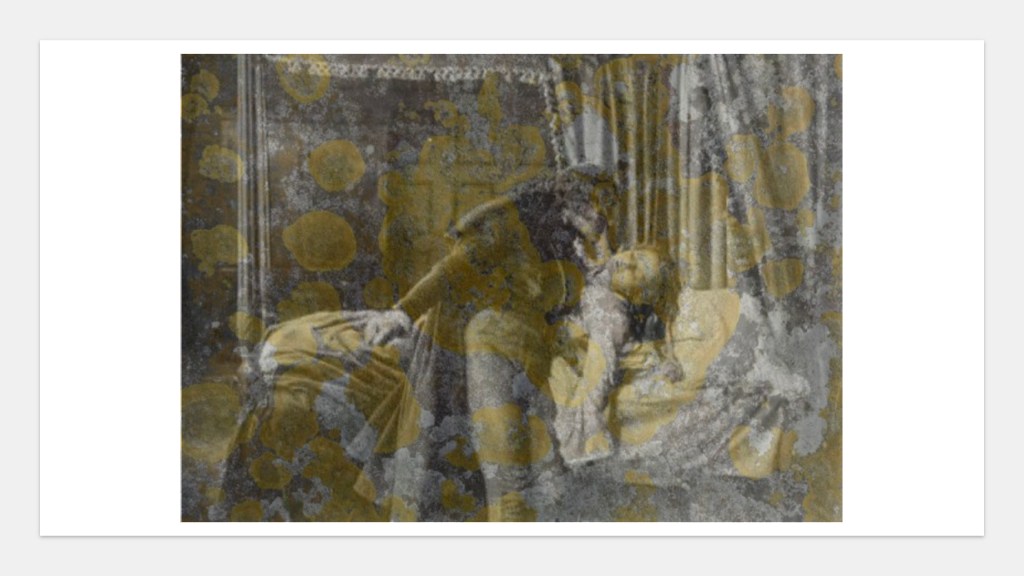
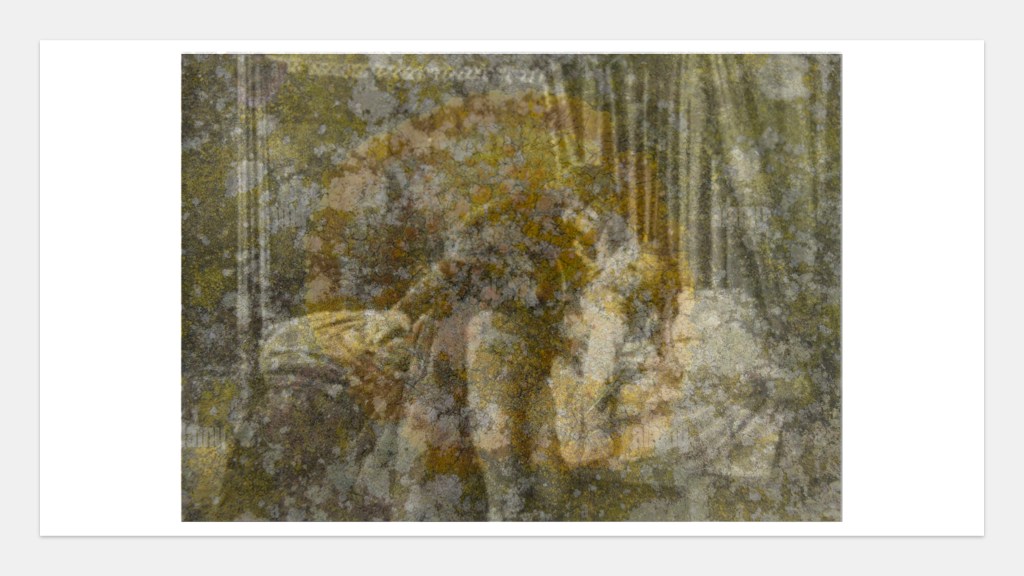
Still you beckoned me with your availability, your parlour games, your desire to cater to every whim, the promise to fulfil any fantasy. Your body gorged my vision. Replete with the extent of you, I could never see the end of you, never see beyond you, never get outside you, never get inside you…yet…always the feeling of you moving inside me. And it clings, and it rings and the falling begins.
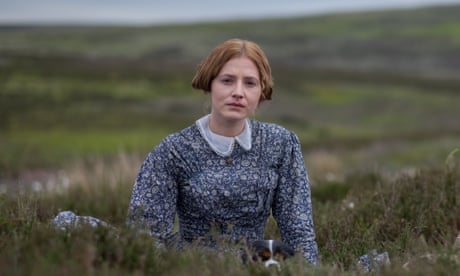
“In Wuthering Heights (Oscilloscope), the English director Andrea Arnold doesn’t so much adapt Emily Brontë’s much-loved 1847 novel as reconstruct it through the fog of a fever dream. This spare, often dialogue-free tone poem is the polar opposite of a Merchant Ivory-style literary costume drama: Rather than re-upholster the familiar story of Heathcliff and Catherine’s doomed love on the moors of Yorkshire, Arnold has chosen to strip it down to the bone. Gone are the multiple nested narrators, as well as nearly the entire second half of the book. What remains is an almost abstract flow of sounds and images that envelop the viewer like sense memories from some forgotten childhood: boots tromping through fields of black muck, twigs scraping at an icy window, dogs barking in the distance, candlelight reflecting off wet skin.
If you went in to this Wuthering Heights with no knowledge of the book or any of its many film adaptations, I’m not sure the contours of the story would ever fully emerge from the literal and metaphorical fog—and if you went in primed for bodice-ripping escapism, you might very well run out gasping with boredom somewhere around the beginning of hour two. But if you can slow down your movie metabolism enough to acclimate to its world, Arnold’s naturalistic retelling grasps an elemental truth about the novel. As much as it’s a story of romantic obsession, Wuthering Heights is a saga of familial hate, an unflinching look at the way cruelty and prejudice get handed down from one generation to the next.
In Arnold’s vision, the hatred heaped on Heathcliff, a foundling adopted by the Earnshaw household as a young teenager, is more explicitly racial than it was in the book. Described by Brontë as a dark-complexioned “gipsy” or “Lascar” of uncertain origin, Heathcliff is played here by two black men (Solomon Glave as a young man, James Howson as an adult), and the epithets hurled at him by his spiteful adopted brother Hindley (Lee Shaw) include the n-word. After Earnshaw père dies suddenly, Hindley and his sister Catherine (played by Shannon Beer as a teen and Kaya Scodelario as an adult) clash over Heathcliff’s fate. Hindley insists he be ejected from the house and kept on as a lowly farmhand, while Catherine begs for Heathcliff to remain a member of the family. When the obstinate, hard-drinking Hindley won’t listen, Catherine simply spirits Heathcliff away from his chores for long tromps on the sodden, windswept moors. (It’s unclear whether their teenage love is ever consummated, but there’s a good deal of wrestling in the mud.) Eventually, Catherine is courted by their wealthy neighbor Edgar Linton (Oliver Milburn), whose proposal forces her to make a choice between civilization (or is it enervation?) and savagery (or is it freedom?).
The decision Catherine makes, and the ever-widening circle of suffering it causes, becomes the focus of much of the rest of the novel, but if Arnold’s impressionistic retelling unfolds from any one character’s point of view, it’s Heathcliff’s. The film opens on him as an adult, back at the farm known as Wuthering Heights, where he’s beating his forehead bloody against a wall that has Catherine’s name carved in it. Soon we jump back in time to learn what it is that’s left him so distraught. From there, the back story comes at us in scattered fragments of memory that seem to combine the perspective of both young lovers (fittingly enough, since, as Cathy avers in the novel, “I am Heathcliff”): the muddy hem of a skirt seen from behind as Cathy runs down a hill. The two of them after a day on the moors, laughing as Cathy identifies feathers they’ve collected. Then, more ominously, an unflinching close-up on the seemingly real slaughter of a young goat (though the credits assure us no animals were harmed in the making of this film, there will also be trapped rabbits and woefully mistreated house dogs.) The primal bond that links the young pair (half-fraternal, half-romantic) is established with no exposition and barely any dialogue—in one scene, Heathcliff’s back is covered in cuts after a savage beating from Hindley, and Cathy licks them clean with the naturalness of an animal grooming its wounded mate.
The screenplay, by Arnold and Olivia Hetreed, must have made for a slim bundle of paper to carry around the set: We hear far less human speech than we do of creaking floorboards and the howling Yorkshire winds that gave the titular farm its name. The sound design by Nicholas Becker is ingeniously layered, allowing all the homely ambient noises of Yorkshire farm life—crying babies, clattering carriage wheels—to coexist at once in the viewer’s ear, all of it bringing us information about what’s happening just outside the frame. (The film’s sonic austerity falters only in the final moments, when a contemporary folk song by the British band Mumford and Sons appears on the soundtrack.) Robbie Ryan’s cinematography (the film is shot on HD video in the same square-shaped ratio he used for Arnold’s last film, Fish Tank) is bleakly stunning. He makes the moors look at once diaphanous and earthy, using a palette so bled of color that the movie appears, at moments, to be shot in black and white.”
“I walked recently through the North York Moors national park and along the Yorkshire coast, reaching Scarborough, and climbed towards its castle high on a clifftop, and to the grave of Anne Brontë, who died aged 29 and is buried in a churchyard beneath the castle. By the sea she so loved, it was easy to see and feel how the landscape of the north so powerfully shaped the literature and lives of the Brontës. This evocative book encourages people to engage with the places that proved so inspirational. As I walk, Anne’s haunting last words to her sister Charlotte echo through my mind: “Take courage.”
“I’ll walk where my own nature would be leading: it vexes me to choose another guide,” Emily Brontë declared. This trailblazing spirit led her to forge a unique path through literature. Here, she becomes a posthumous guide to Michael Stewart as he follows in her footsteps – along with the footsteps of her sisters, brother Branwell and father Patrick – in a series of vividly chronicled walks that explore the geographical and emotional terrain of their writing. Stewart travels through the north of England, across moors and meadows, up mountains and through cities and villages and along coastal paths. He also voyages into the inner lives of the Brontës, showing how external place shaped their internal landscapes, how the wild fuelled their imagination.
He begins his walks in the Brontë birthplace, Thornton, in west Yorkshire, where Patrick spent his “happiest days” before the untimely death of his wife Maria and two eldest daughters. He also follows part of the Pennine Way to the ruin of Top Withens, thought to have inspired Emily’s farmhouse location of Wuthering Heights. He captures how for Emily “the moors were a place of awe and fascination. It was a land that was alive with a terrible destructive beauty.” These engaging present-tense walks include an excellent account of recreating the walk that Mr Earnshaw took in 1771 when he travelled from Wuthering Heights to Liverpool – Stewart ventures via Littleborough and Manchester with his dog Wolfie, and has some hair-raising wild camping experiences.
“It is a walking book, but it is also a social and literary history of the North,” Stewart writes. Along the way, he perceptively excavates the past, exploring how it was in the north that the Industrial Revolution took off, “thanks to a combination of soft water, steep hills and cheap labour”. As well as fascinating historical context, he paints a vivid portrait of the present day, too, as he walks through landscapes both bleak and beautiful, equally adept at capturing the gloom of an industrial estate and “a brilliant blue and golden orange kingfisher”, which makes him think of a Gerard Manley Hopkins poem. He compellingly conjures the force of the winds, the earthy smell of peat bogs, the haunting call of the curlew, the sound of skylarks.
“The idea of being authors was as natural to us as walking,” Charlotte said. Woven through his Brontës journey, Stewart also explores how he developed a love of literature and became an author himself with the sisters at the heart of his books. He recalls how his fascination with the novel Wuthering Heights began when Kate Bush’s single reached No 1 in the pop charts in 1978. His mother was reading the novel while studying an English literature O-level at night school, having left school at 15. “She told me what the story was about. She told me about how, one summer night, after three days of travel on foot, Mr Earnshaw brought a dark-skinned orphan back from the streets of Liverpool to his farm in Yorkshire. She told me about how his daughter Cathy spat at the boy and his son Hindley booted him.”
Stewart borrowed the book from the local library and read it on the bus journey to work in a factory in Manchester. In adulthood he moved to live in Thornfield, the Brontë birthplace, and wrote a novel, Ill Will: The Untold Story of Heathcliff, during his research spending hours walking the moors. He also devised the Brontë Stones project for which Bush wrote a poem dedicated to Emily, left in the landscape.
“I close my eyes and see the landscape in my mind,”Stewart writes. The book is a terrific tribute to the Brontës – and to the landscapes that shaped their literature. It also beautifully shows how landscape grows in the imagination and lays bare the “invisible” world of the heart and mind, and how the places we inhabit shape the people we become. It will send the reader back to Bush’s glorious “Wuthering Heights” and to the Brontës’ brilliant books, and will inspire us to roam the wily, windy wildernesses captured so hauntingly in their work.”





 denisestartin.co.uk