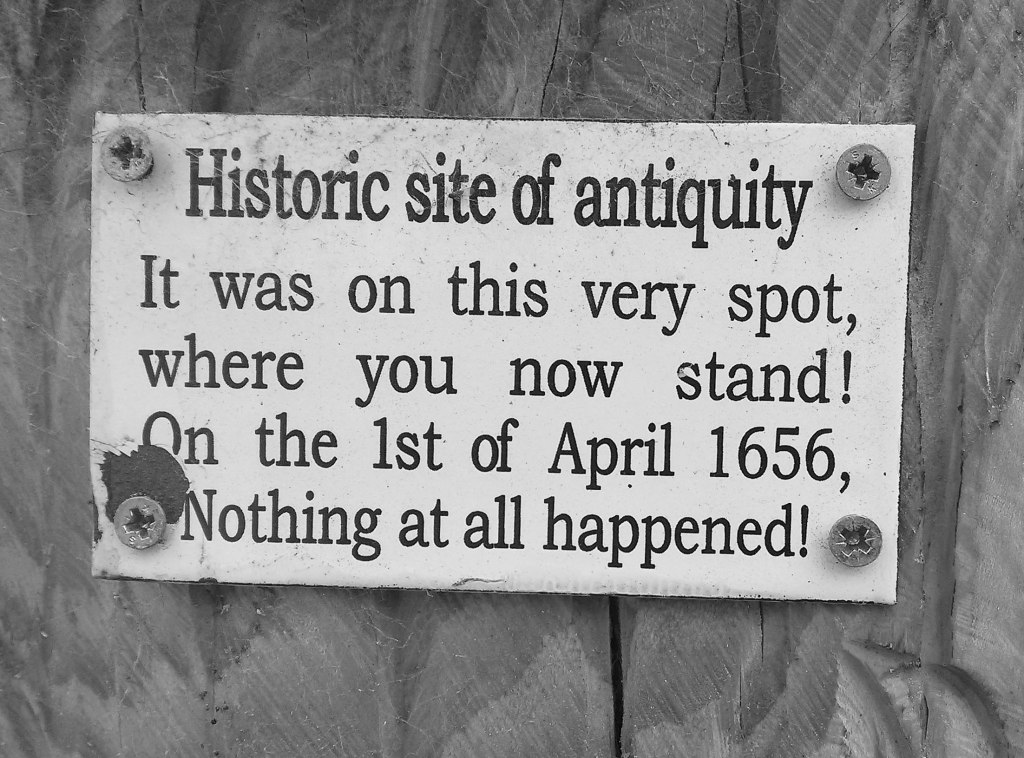
Searching Enquiries
#landscape #archaeology #keywords

Palimpsest “something reused or altered but still bearing visible traces of its earlier form”, antiquity, artefacts, archive, bricolage, boundary, collage, chronology, collection (vernacular & formal), conservation, context, corporeal, curation (from curator ‘care taker’), discovery, document, earthworks (boundary & linear), echo, embodied, environment, evidence, excavation, enduring, field, flora & fauna, forensics, foundation, fragment, habitat, habitus, heterogeneity, history, historiography, genealogy, genealogy of place, grid, identity, inscription, inheritance, interpretation, landscape archive, landscape narratives, layers, legacy, local, locale, maps, mapping, memory, memorial, methodical, mnemonic, montage, monument, museum, museology, narrative, origins, performative, place, politics of location, positionality, preservation, record, recovery, reconstruction, relic, remainder, residue, restoration, ruin, site, situation, situated, systematic, strata, stratigraphy, trace, temporal, textual, textural, thick description, topography, vestige.
…this immediately recalled another haunting encounter with a vanished object that had taken root in my consciousness, grabbing me with stony fingers, extending out of the gloom of history, as if to take possession…
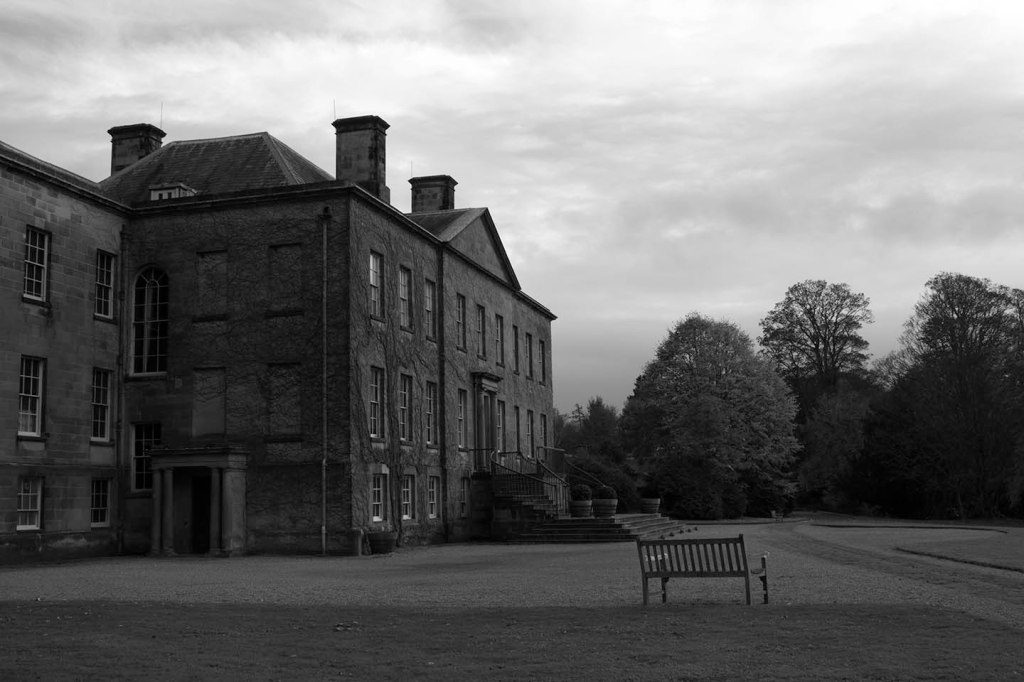
… an obsessive, yet thwarted hunt, for a Druidic Statue pictured in The Chronicles of Erthig on The Dyke simply entitled THE DRUID. For a static object he had been surprisingly peripatetic, missing, relocated and mutilated, not to mention the case of THE DRUID and it’s double. He had not however been a lonely wanderer for a whole cast of characters and host of voices past and present had captured his trials and travels and assisted me on mine.
These dramatis personae included the antiquary, the 2nd wife, the head gardener, the rector and chorographer, the photographer, the rare book conservator, the family historian and culminated in the unlikely event of a deathbed confession by The Labourer to the Rector & Chorographer, concerning a mishap relating to the arm of THE DRUID, which apparently haunted him all the way to his grave, until that point he held his tongue and spake nothing. The act of collecting in this instance was not just a gathering but an act of dispersal. In short THE DRUID sent this peripatetic subject on a wild goose chase tracing this enigmatic signifier through desire lines and ribbons in the dirt across a number of temporalities and spatial locations. These included the Family Museum, a strange cornucopia of domestic and exotic objects all staged in a coffin like structure fit for Snow White, the Flintshire Archives at The Old Rectory in Hawarden, the Attic and the North Flat (formerly the Yorke’s family quarters), it was now home to rare and antiquarian books (I failed to find the flat several times because it was hidden behind a secret door of mahogany panelling at the bottom of the stairs).

“Bell-horses, bell-horses, what time of day? It is six in the morn. We are off and away!”
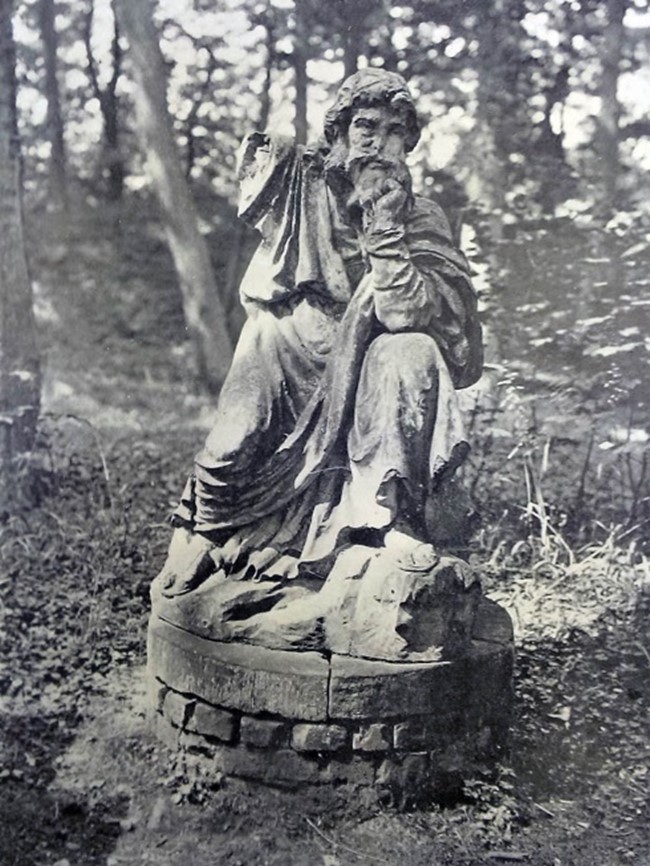
In contrast to the Antiquary’s somewhat melodramatic encounter with the patriarchal stone figure of the Druid in a dealer’s shop in London, mine was a humble affair. According to the family historian when his eyes alighted upon the object this encounter turned the event, a desire to possess the coveted object, into something of a spectacle. With the cracking of a great whip, the humble trade of an empty cheese wagon was temporarily promoted to the transport of a more fragile cargo; a relic of bygone days swathed in straw. All of which was performed to the rapture of a gaping throng of onlookers. My encounter with the Druid however, occurred with the event of the image within the private space of the book and the intimate act of reading. Like the antiquary of old I was equally struck by the image of the Druid, captivated like Narcissus caught in the auto-affective structure of his gaze, briefly I entered another’s space becoming a site of inscription like the blank page.
Like Poe’s purloined letter the image was both a revealing and a concealing, in the space of the book I had no place to run to in this prototype theatre, I could only act out to the sides. What was it about this image that pricked me so? Was it the idea that it was entitled THE DRUID, a paradigmatic example on which all other Druids are based? Or did I somehow respond to the sound of its evocation when its sightless eyes, wrapt in eons of stony reflection, appeared to meet my gaze? Perhaps it was its elegiac nature, its enigmatic status framed within the frame of the page rendered even more mysterious by its decontextualized display. This fragment of a larger scene was impossible to locate in time or place…a somewhere else, an elsewhere…
Closer inspection revealed the image was harbouring its own complex mise-en-abyme caught up in several layers of representation. In the first instance it is an image of an image, it is also the image of an image of an object. This object which appears to be made of stone is a statue representing THE DRUID which in itself is a representation, a copy without original or an original copy? From whence does this image derive? Whose spectral visage did it bear? The statue in fact is not made of stone but Coade Lambethware, a type of ceramic mimicking the characteristics of stone in turn mimicking the human form, a human countenance, a funereal fleshy foot, a flowing beard that did not flow, locks of hair locked in place and folds of textured cloth draped in ceramic stone. The whole scene is a fiction, a complex masquerade, an impossible image of an impossible object. Yet there it was, a chimera hiding in plain sight…
53°01′38″N3°00′24″W / 53.0272°N 3.0066°W
….some time later on site…
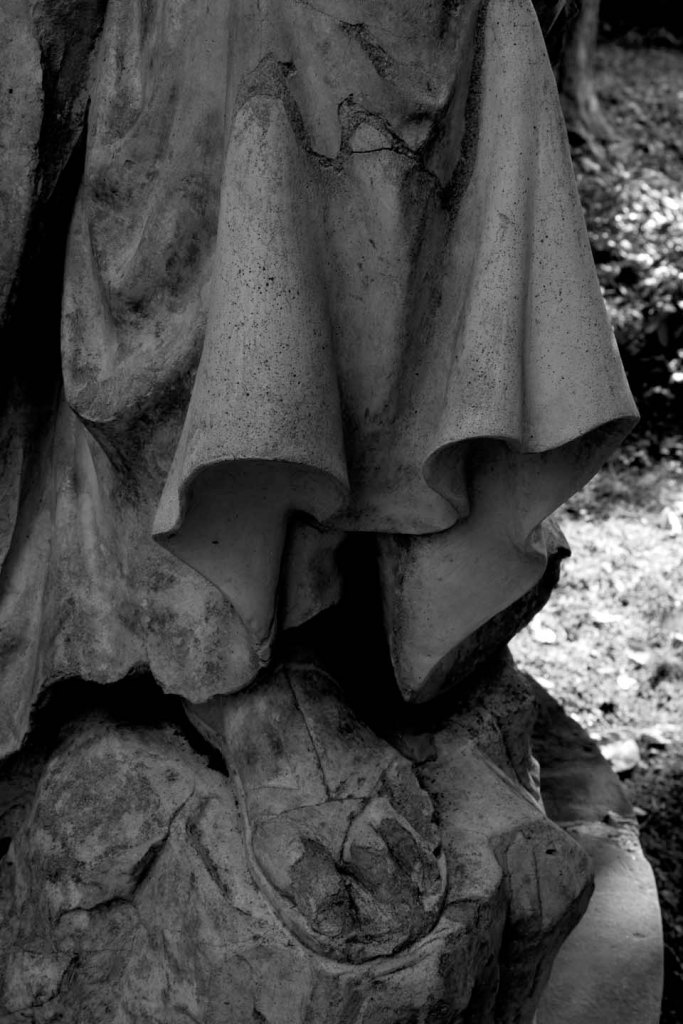
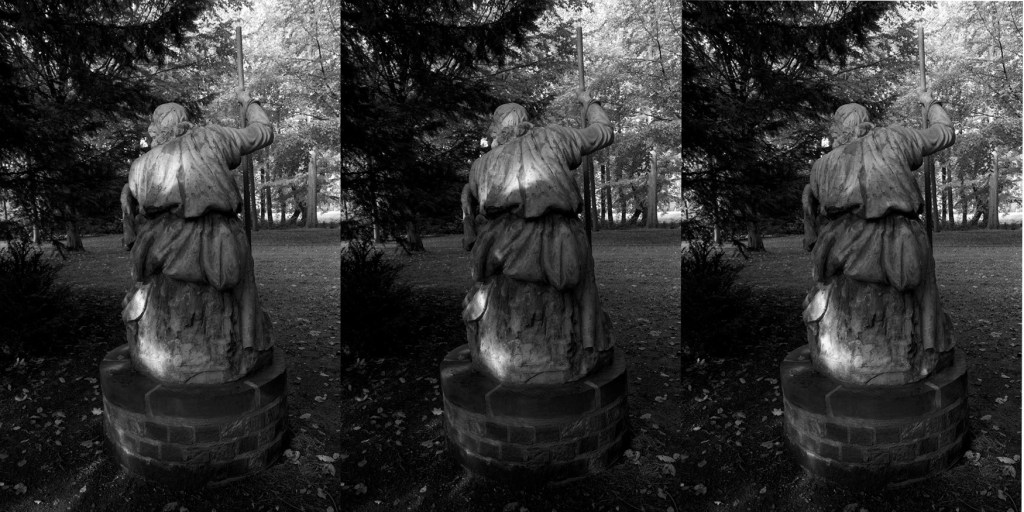
I confess to being crestfallen when denied the thrill of the chase regarding the poetic desire to locate the lost object, the missing, peripatetic, mutilated statue of THE DRUID. This desire was impeded since I had conversed earlier with the Archaeology Intern who subsequently that day consulted the Head Gardener, thereby locating the statue’s whereabouts in the garden along the Moss Walk. The Druid had been found, surprisingly made whole again, but it was a sad scratch, a collection of fragments badly restored, scored, marked, glued, pitted, stained and etched into by various vandals including a…
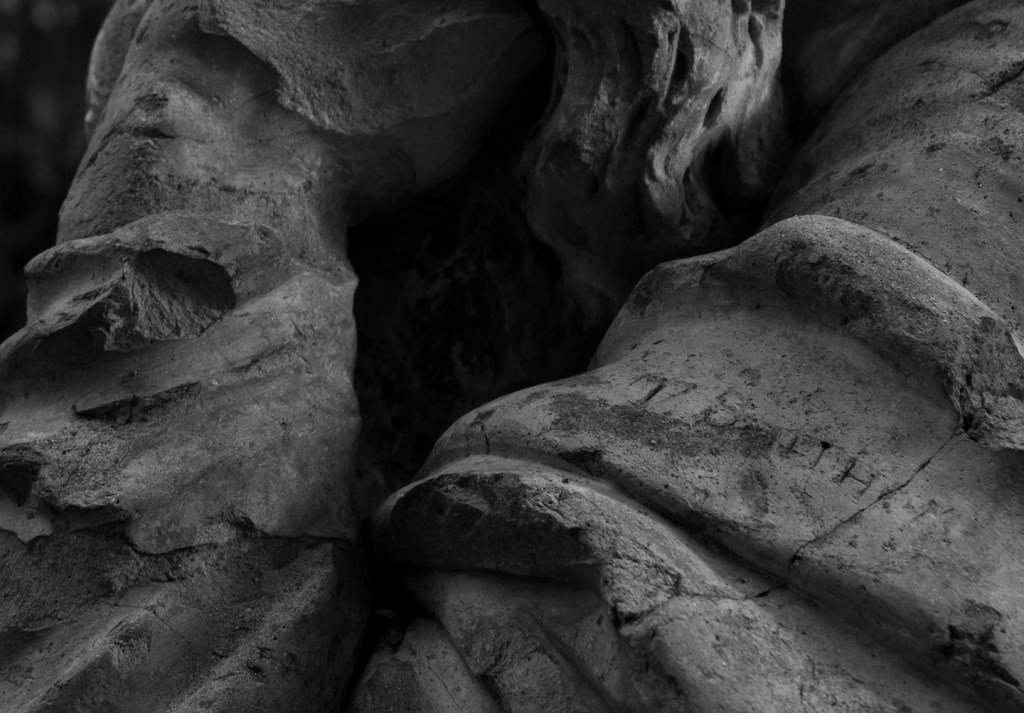
“The Druid’s Arm, which has at last been repaired (in 1922) and was what in this room having been hidden away in 1880 after being dug up in the wood. The arm was considered too dilapidated to be mended so it was hidden away, & when found in 1908, it was kept in the Museum for 14 years. The story of the Druid is to be found elsewhere and on the board in the wood.”
The manufactured fake right arm, sutured onto the main body of the original fake ceramic stone statue of a representation of a druid, was quite different in texture, colour and accentuated pallor. Strange to touch, this phantom limb caused a shudder as the object appeared to be a kind of Frankensteinian act of restoration. Upon close inspection, depressingly he was clutching a broom handle in his fake right arm as his staff of office. Not unlike Ruskin’s bookcases, the Head Gardener informed me that the statue had been found in pieces unceremoniously dumped in a bin around 1950. I revisited the statue regularly at different times of the day observing the light to determine the best time to capture an image but despite my best photographic efforts repeated over 50 times I could not recapture the enigma of the original, I failed to inflect the icon with the same blank magic.
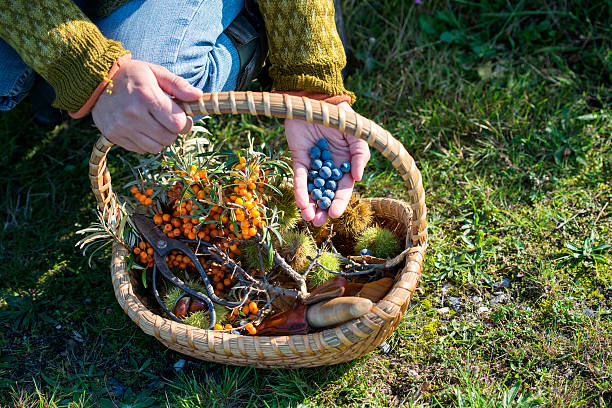
As part of Green Week in Coventry, Green Futures for Coventry City of Culture organised a Folklore and Foraging Walk & Talk which took place in the City Centre. Along the way we were regaled by tall tails performed by the professional Storyteller Pyn Stockman. Food foraging has become popular in recent years as chefs have turned to foraged food to produce local and seasonal menu’s.
It was here we found and learned to recognise the edible and medicinal plants that are growing abundantly and freely. These include Dandelions which can make a salve or a pesto and the flowers, leaves and roots can all be consumed. Next there was Chickweed for sprinkling on salads or making a pesto. Stinging Nettles are a superfood packed with vitamins and nutrients and have a long history in folklore and myth. Nettle was used up until the 18th Century for making cloth and the sting of the nettle is said to protect against fairies, sorcery and black magic. It was here in part of the City Wall ruin that Pyn regaled us with our first tale, The Six Swans by the Brother’s Grimm whereby six brothers were enchanted and turned into Swans, and a princess who suffers a terrible injustice although she could not speak of it to anyone, worked for six years making clothes of nettle (in the link it is Star Flowers) to regain their human form and undo the spell. Other plants good for foraging include Miner’s Lettuce, Wild Violet whose leaves are edible and medicinal and Red & White Clover & Fiddlehead Ferns.
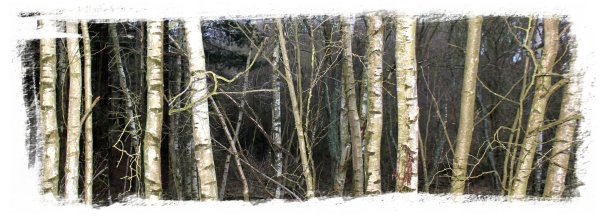
When we stopped in a kind of small, natural Birch Grove, Pyn told us another story about Betushka, the Goddess of the Birch tree. Birch wood is believed to drive out evil spirits and banish fears. The Birch is known as the Mother Tree or the lady of the forest. Although the tale that was told was Czechoslovakian folklore of the Birch abounds for instance in Norse and Celtic Mythology. As a pioneer species it represents rebirth, new beginnings and growth. Finally we finished at a Hawthorn tree and the hobgoblin known as Robin Goodfellow, otherwise known as Puck from A Midsummer Night’s Dream. He is famous for shape shifting and misleading weary travellers. And there in the blustering wind, which almost carried Pyn’s voice away, our journey ended.
Image reproduced from https://www.istockphoto.com/photos/foraging (accessed 11/03/22). For more information about foraging visit https://www.growforagecookferment.com/what-to-forage-in-spring/ Image reproduced from http://www.ecoenchantments.co.uk/myogham_birchpage.html (accessed 11/03/22)
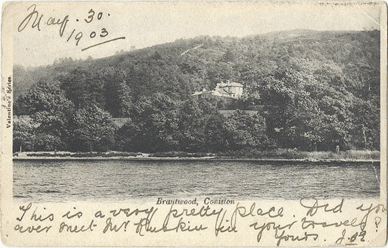
“All one’s life is a music if one touches the notes rightly and in time” John Ruskin, The Ethics of Dust.
On a restorative trip to Windermere, Lake District, Cumbria we paid a visit to the humble yet handsome Brantwood, home of John Ruskin for the last 28 years of his life. I stood in Ruskin’s turret, an addition to the South West Corner of the house. The turret is simultaneously built into his bedroom and out into the landscape, overlooking Coniston Water. Autumn was ablaze, the pinnacles of the snow powdered peaks, beautifully treacherous, were reflected in the calm steel grey of Coniston Water. This strange quixotic space, a kind of architectural ecstasis, symbolises Ruskin’s ideal of the individual stepping forth encompassing one’s responsibility to oneself and to society. It is a liminal space, a threshold space, a space of transition between the enclosure and perceived comfort of the home and exposure to what lies beyond. The architecture and containment of the turret only served to heighten this sensation of struggle, physically and symbolically taking root in my imagination. I experienced something akin to “an intimate immensity”, Bachelard’s term for our imaginative capacity to inhabit a landscape internally.
“to stay what is fleeting, and to enlighten what is incomprehensible, to incorporate the things that have no measure, and immortalise the things that have no duration.” Bachelard.G The Poetics of Space
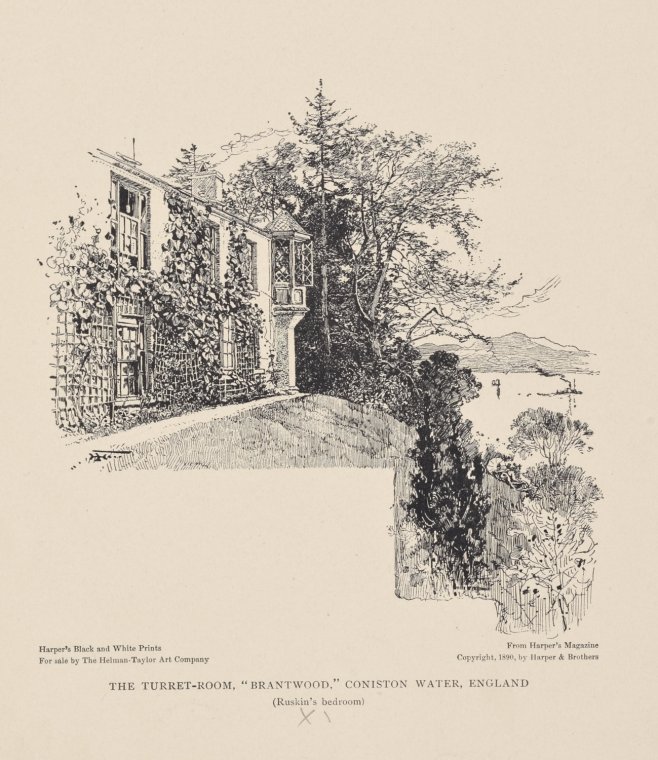
Ruskin had not lain in his bedroom for many years, a Fuselli like nightmare caused him to flee and never return. He said “One of the most provoking and disagreeable of the spectres was developed out of the firelight on my mahogany bedpost: and my fate, for all futurity, seemed continually to turn on the humour of dark personages who were materially nothing but the stains of damp on the ceiling.”(From a letter to Thomas Carlyle 23rd July 1878, Brantwood Quotations.)
Inhabiting this dichotomous space, the now public life of the once private interior, I performed a private ceremony in public, a simple gesture without fanfare – I laid my hand gently on Ruskin’s pillow seeking a resonance, a communion, whilst contemplating [….] how his prolific and nimble mind had been reduced to dust and silence after a lifetime of mental toil. His work had become his tomb. His ruined mind turned to the labour of the hand, the hand to the labour of the land, to heart and home.
It was there in the photo album on display in the adjoining room it was discovered that Ruskin’s much loved boat, painted in an electric blue, was named after the epic poem Marmion by Sir Walter Scott. Indeed since discovering Scott he has arrived unbidden at every turn, like an unwelcome visitor, that flibbertigibbet of a man! I imagined Ruskin holding court in one of his Salon’s whilst reciting Scott’s poetry which I understand he did frequently. Although it is noted by Ruskin that Scott’s house rebuilt in the Scottish baronial style is an ‘incongruous pile.”
When I spoke to Howard Hull, Director of Brantwood, and recounted my experience of the place and the connection between Ruskin, intimacy, and the performance of the private it struck a chord with him. We discussed various things including the idea of a project entitled Letters to the Landscape, which also struck a chord and we digressed into a discussion about the talismanic memory of objects, magical properties mythologised over time. Some of Ruskin’s belongings were distributed locally to the descendant’s of Ruskin’s circle but are now eventually finding their way home as the benefactors memory becomes severed through time from those who inherited them. Howard recounted an anecdote about the apparent discovery of Ruskin’s bookcases found “buried under 50 years of sawdust.” I laughed as it seemed to contain an unsettling portent as Howard said “The village undertaker tapped me on the shoulder from behind.” This immediately recalled another haunting encounter with a vanished object that had taken root in my consciousness, grabbing me with stony fingers, extending out of the gloom of history, as if to take possession…
Images reproduced from https://digitalcollections.nypl.org/items/9e279c0e-5485-d9e0-e040-e00a18067520 (accessed 07/03/22)
 denisestartin.co.uk