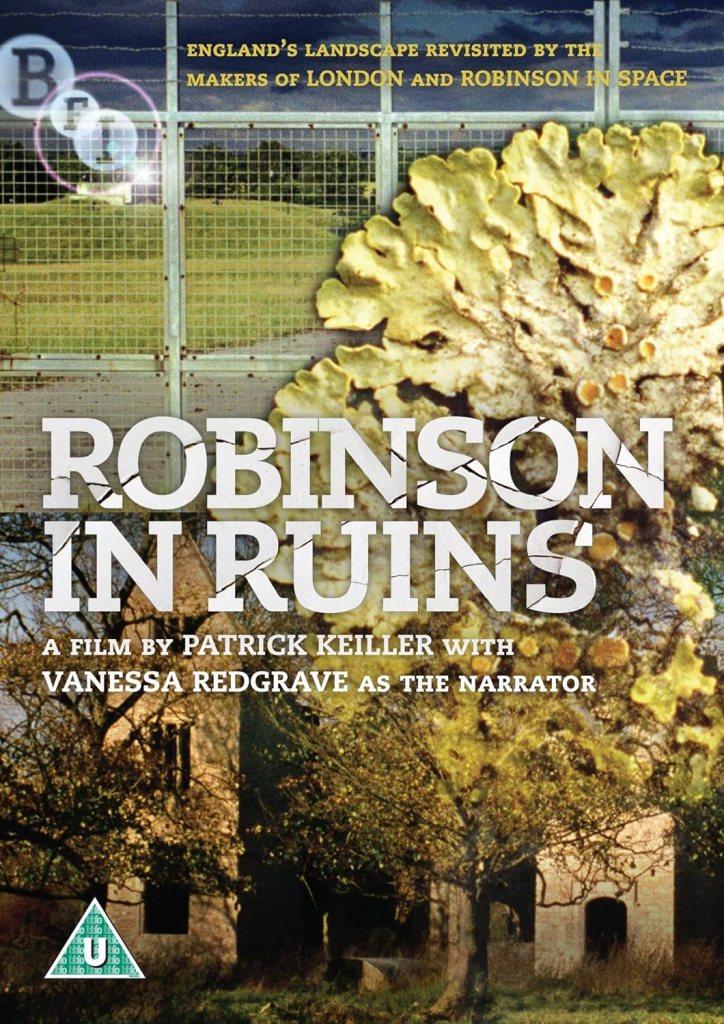
“The opening sentence of Patrick Keiller’s new film, voiced with laconic precision and italic irony by Vanessa Redgrave, is calculated to quicken the hearts of admirers of Keiller’s enigmatic oeuvre: “When a man named Robinson was released from Edgecote open prison, he made his way to the nearest city and looked for somewhere to haunt.” Robinson in Ruins is the third of Keiller’s feature-length essay-fictions to deposit his eccentric protagonist among the relics of millennial England, where he functions once more as the comically half-deluded conduit for the director’s own brand of visionary scholarship. As a fictional invention, the autodidact aesthete Robinson, whom we only ever encounter via the films’ narrators’ vexed relations with him, is an absurd sort of wraith, tricked up from reminders of Defoe and Céline, but surely also a descendant of the Regency showman Robertson, inventor of the proto-cinematic phantasmagoria. In Robinson in Ruins, his spectral patch is the landscape around Keiller’s own home in Oxford: its industrial heritage, its residual romanticism, the weird energies of Englishness at a time of global economic collapse.
In successive close-ups, a patch of lichen on an Oxford road sign comes to resemble the profile of Goethe. Robinson, at large among the relics of military-industrial technology, eventually settles on a disused cement works, crumbling into romantic ruin, as the potential site of a new utopian community. The history of clearances and land riots ghosts the new landscape of PFI follies, unpeopled agribusiness and the amnesiac transformation of every fraught patch of land (Greenham Common included) into a Site of Special Scientific Interest. All of this is rendered, meanwhile, with Keiller’s customarily austere but rapt visual style – though in this case, as suits a film partly about the persistence of pastoral in the face of rapacious land grabs, the shots are longer. The camera tarries with fields of oil seed rape, nodding foxgloves and shivering primroses until they start to look monstrous, every bit as alien as the relics of 19th-century architecture and décor that so exercised the surrealists. Before Keiller’s (or Robinson’s) prophetic gaze, the English countryside is a monument to itself, and ripe for revolutionary appropriation.”
Text reproduced from https://www.theguardian.com/film/2010/nov/20/robinson-ruins-patrick-keiller-dillon (accessed 18/09/23)
 denisestartin.co.uk