
“Iain Sinclair’s classic early text, Lud Heat, explores mysterious cartographic connections between the six Hawksmoor churches in London. In a unique fusion of prose and poetry, Sinclair invokes the mythic realm of King Lud, who according to legend was one of the founders of London, as well as the notion of psychic ‘heat’ as an enigmatic energy contained in many of its places. The book’s many different voices, including the incantatory whispers of Blake and Pound, combine in an amalgamated shamanic sense that somehow works to transcend time. The transmogrifying intonations and rhythms slowly incorporate new signs, symbols and sigils into the poem that further work on the senses. This was the work that set the ‘psychogeographical’ tone for much of Sinclair’s mature work, as well as inspiring novels like Hawksmoor and Gloriana from his peers Peter Ackroyd and Michael Moorcock, and Alan Moore’s From Hell.”
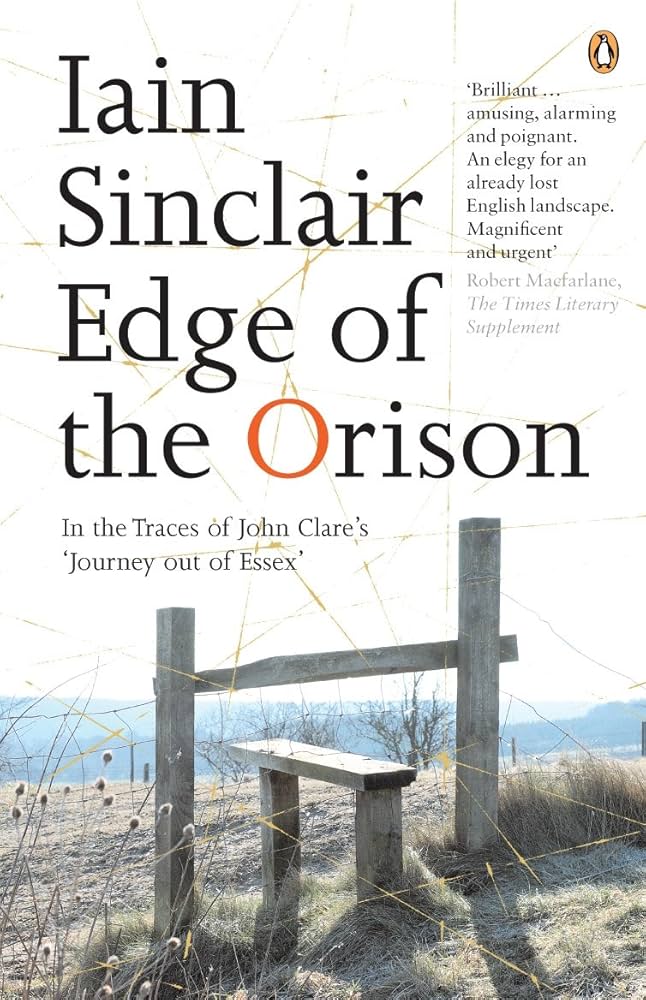
“In 1841 the poet John Clare fled an asylum in Epping Forest and walked eighty miles to his home in Northborough. He was searching for his lost love, Mary Joyce – a woman three years dead …In 2000 Iain Sinclair set out to recreate Clare’s walk away from madness. He wanted to understand his bond with the poet and escape the gravity of his London obsessions. Accompanied on this journey by his wife Anna (who shares a connection with Clare), the artist Brian Catling and magus Alan Moore – as well as a host of literary ghosts, both visionary and romantic – Sinclair’s quest for Clare becomes an investigation into madness, sanity and the nature of the poet’s muse.”

“Dining on Stones is Iain Sinclair’s sharp, edgy mystery of London and its environs Andrew Norton, poet, visionary and hack, is handed a mysterious package that sees him quit London and head out along the A13 on an as yet undefined quest. Holing up in a roadside hotel, unable to make sense of his search, he is haunted by ghosts: of the dead and the not-so dead; demanding wives and ex-wives; East End gangsters; even competing versions of himself. Shifting from Hackney to Hastings and all places in-between, while dissecting a man’s fractured psyche piece by piece, Dining on Stones is a puzzle and a quest – for both writer and reader.”
Text reproduced from Amazon and World of Books (accessed 14/11/24)
 denisestartin.co.uk