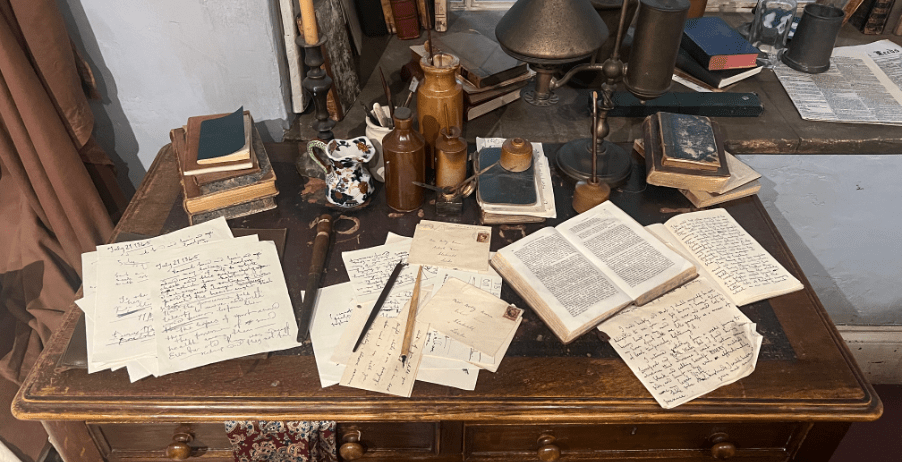
Fig.1 depicts Branwell Brontë’s desk at the Parsonage, part of Simon Armitage’s installation.
The desk is presented not merely as an archival object, but as a curated scene.
While Emily Brontë’s writing desk inspired this project, its modest size and protective casing rendered it visually elusive. In contrast, Branwell’s desk is prominent, cluttered, tactile, and performative. It transforms the archive into an encounter, where memory is actively constructed rather than simply preserved.
However, this is not strictly Branwell’s desk. It serves as a symbolic object, representing both a failed legacy and a speculative presence. The surrounding items are deliberately arranged, their authenticity uncertain. What matters is not whether they are real, but what they perform: a residue of ambition, a trace of authorship unmade.
The desk functions as a surrogate archive, a site where silence is staged, absence made visible. It embodies not Branwell himself, but the concept of Branwell, a mnemonic placeholder in literary history.
My entire PhD could be characterised as an attempt to crack open this image—to deconstruct its rhetoric of display, interrogate the politics of preservation, the aesthetics of collecting, and the archive’s desire to hold what cannot be kept, to capture what cannot be retained.
This is where the work begins…
Let us go you and I, let us begin by walking, together, into the landscape.
The wind on the moor carries more than weather, it carries memory, sediment, and the ghostly residue of letters never sent…
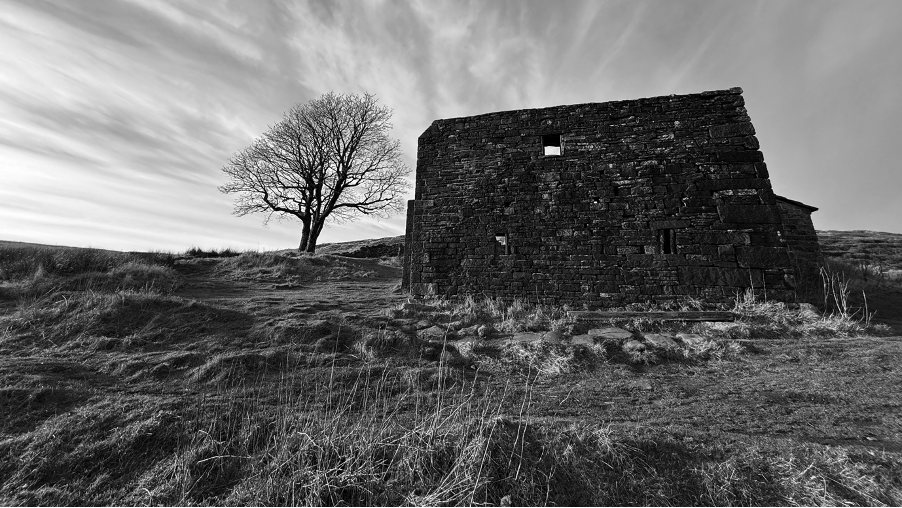
Dispatches 03/02/2024: Today, there is a 65% chance of precipitation. The temperature is 5 degrees, but it feels like 2. The wind direction is South, at a speed of 9 miles per hour. Humidity is at 73% and visibility is very good. The sun rose at 7.39 am and set at 4 pm.
This is how the day began, A weather report. A mood. A trace.
It’s not just data, it’s atmosphere. It sets the tone for a fieldwork that is not simply visual but experiential, even visceral. Not evidentiary, but affective.
In Letters to the Landscape (2025), I return to Brontë Country not to recover a lost past, but to trace the gesture of its dispersal.
This thesis begins with a walk: a slow, deliberate movement through terrain marked by literary inheritance and vernacular forgetting. The film, composed of fragments, postcards, voiceovers, and archival stills, does not seek to reconstruct history, but to perform its dislocation. Through a speculative feminist lens, I engage with the archive not as a repository, but as a site of haunting and (re)collection. Drawing on Derrida’s notion of spectrality (1994) and Schneider’s theory of the explicit body (1997), I ask: What remains when the archive is touched, not read? What kinds of knowledge emerge when history is felt rather than narrated? What happens when the archive is performed rather than preserved?
These provocations set the stage for a research journey that is as much about unearthing as about unsettling, as much about absence as about presence.
These fragments, objects, weather, walk, and archive embody the approach this thesis will take, moving between the material and the imagined, the evidentiary and the affective, the archive and the field, they set the mood and method for what follows. In what remains of this introduction, I move from the poetics of encounter to the conceptual and methodological frameworks that underpin this research.
From here, I turn to map the conceptual terrain, outlining the research questions, and situating my practice within the intersecting traditions of chorography, speculative feminist historiography, and creative fieldwork. The following section introduces the research context and background, main aims, themes, and structure of the thesis, and describes how the performative and speculative methods evoked here will be developed throughout its sections and into Brontë Country and beyond.
This is also where the work begins…
 denisestartin.co.uk