Book

Jasper Johns, Book 1957, Encaustic on book and wood

Jasper Johns, Book 1957, Encaustic on book and wood

“The book’s obviousness, its palpable presence, is thus such that we have to say that it exists and is present since without it nothing could ever be present, and yet that it never quite conforms to the conditions of real existence.” Maurice Blanchot

Text reproduced from A Survey of materiality in Literature by James Stuart, for the rest of the article click here

Image reproduced from The disappearance of objects: New York art and the rise of the postmodern city

Incommunicado

November2012 006

© Denise Startin

Dear Reader

Many apologies for the lack of continuous activity on the blog of late. Having recently produced a thesis for the MA I am undertaking (the effect of which has been to somewhat ironically kill my voracious writing and reading habits) the process has left me textually satiated, linguistically engorged and physically sick.

The thesis was part performative, part theoretical, part confession, part autobiography (which of course is a fallacy since one can only live one’s life not write it).The philosopher Phillipe Lacoue-Labarthe develops this rhythmic train of thought particularly in relation to autobiography and music; ‘the need to tell, to confess, write oneself.’ [1] Perhaps having partly written myself into textual oblivion through examining my haecceity one has been left comparatively mute. To draw upon an analogy  between writing and excrement ‘I’ have been evacuated. ‘I’ write myself, ‘I’ kill myself (after Derrida).

In Footnote 115 of the thesis I discussed the relation of the textual fetish and desire, here I quote myself “Elizabeth Grosz explains there are ‘two conceptions of desire – negative and positive.’ The one that concerns us here in relation to Freud and Lacan is desire as lack, that is ‘a yearning for what is lost, absent, impossible. Desire is posited as an economy of scarcity, where reality itself is missing something (the object whose attainment would yield completion), a linked to the death drive (the struggle for mutual recognition) and annihilation (which the object of desire threatens). Continue reading

Thinking on Paper

“A radical experiment in design and typography Stéphane Mallarmé’s poem Un Coup De Des (A Throw of the Dice will Never Abolish Chance 1897) privileges form over content or rather form as content , such that blank space, varied typography and the material folds of the book augment and even transform the semantics of the text. As Mallarmé writes in his preface to the first issue of the poem:

“The paper intervenes every time an image on its own, ceases or retires within the page, accepting the succession of the others, and it is not a question unlike the usual state of affairs, of regular sound effects or verses – rather of prismatic subdivisions of the idea, the instant when they appear and during which their cooperation lasts , in some exact mental setting. The text imposes itself in various places, near or far from the latent guiding thread, according to what seems to be the probable sense.”

(For the French version and (albeit different) English translation click here.

Text reproduced from http://directory.eliterature.org/node/573 Image reproduced from http://www.wookmark.com/image/8624/crumpled-white-paper-texture-by-melemel-jpeg-2048-1536

Herstmonceux Castle

herstmonceaux

© Denise Startin

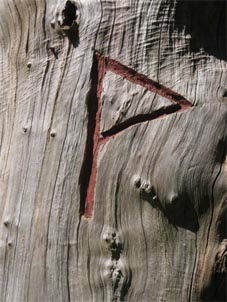
Herst Henge or Wood Henge exists in the Gardens of Herstmonceux Castle. The trees are carved with encoded rune messages. This is the symbol for WYN = Joy and Happiness, the transforming of life for the better. There were 7 symbols in total. The overall interpretation was given thus: “Herst Henge incorporates all the meanings of the runes and translates them into the context of the site. Herst Henge is a place of rest and relaxation, when someone enters into the ring, they will feel that they are experiencing a new beginning in their life, a sense of revitalization will prevail. Herst Henge is a circle of protection and anyone spending  time within the circle will feel empowered and able to depart on a new and challenging time in their life with increased physical and mental energy.”

It certainly was a beautiful place but I think after an exceptionally stressful year I would have needed to just stay in the circle ad infinitum. Hopefully if you meditate on this image a sense of revitalization will prevail for you, if it does let me know.! “Herstmonceux is renowned for its magnificent moated castle, set in beautiful parkland and superb Elizabethan gardens. Built originally as a country home in the mid- 15th – century, Herstmonceux Castle embodies the history of Medieval England and the romance of Renaissance Europe.” Herstmonceux Castle is in Hailsham, East Sussex. [This is not a one horse town, this is a one gnat town but very handy for Eastbourne and Hastings where they do the most excellent fish and chips!]

Rune text quoted from signage in Herstmonceaux castle gardens. Text quoted from http://www.herstmonceux-castle.com/index.php

Friedrich Nietzsche

“The assumption of a single subject is perhaps unneccesary: perhaps it is just as permissible to assume a multiplicity of subjects whose interaction and struggle is the basis of our thought and our consciousness in general? A kind of ‘aristocracy of cells’ in which dominion resides? To be sure, an aristocracy of equals, used to ruling jointly and understanding how to command? My hypothesis: The subject as multiplicity. ” (Nietzsche 1968: 270)

For a short but informative passage about Nietzsche and the musical rythms (Also pursued in different ways by Phillip Lacoue-Labarthe and Julia Kristeva) in his texts click here

Text reproduced from Elizabeth Grosz, Volatile Bodies, Toward a Corporeal Feminism, Indiana University Press, 1994: p.122

Image reproduced from http://philossophy.wordpress.com/2010/04/10/modernity/